
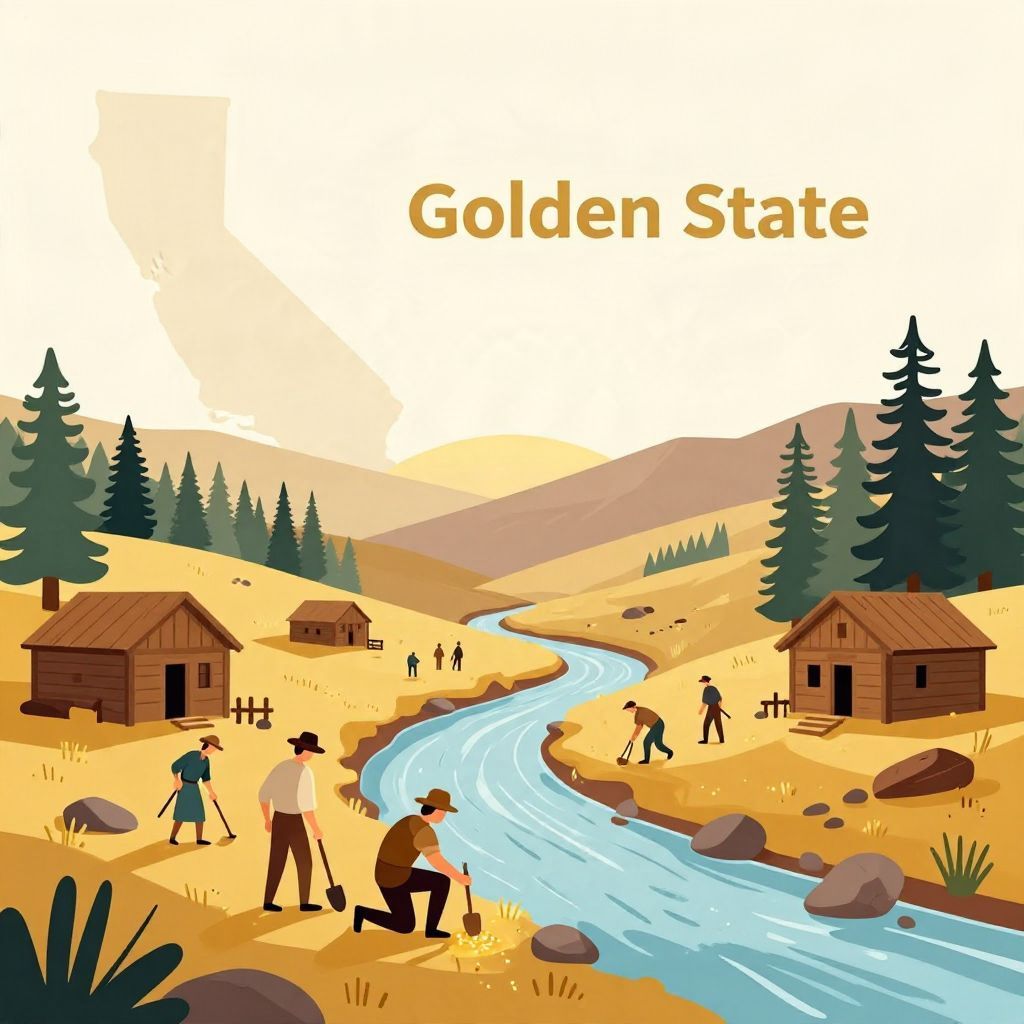
Why is California called the Golden State? The short answer is that the name grew out of the California Gold Rush of 1848–1855, when news of gold transformed the region’s population, economy, and reputation almost overnight. The nickname also fits California’s sunny landscape and golden hills, but its historical root is the rush for gold.
Over time, “Golden State” came to mean more than mining. It became a symbol of opportunity, migration, and the promise associated with California in the American imagination.
Why Is California Called the Golden State?
California is called the Golden State primarily because the Gold Rush made gold central to its modern identity. After gold was discovered in 1848, thousands of people rushed west, and the state’s rapid growth, wealth, and fame закрепed the golden nickname. The phrase also later matched California’s golden poppies, sunlit climate, and rolling hills.
The Gold Rush and the Origin of the Nickname
The strongest historical explanation begins with the discovery of gold at Sutter’s Mill in January 1848, in what was then Mexican California. The find was made by workers associated with John Sutter’s mill project near present-day Coloma. Once the discovery became public, it triggered one of the most dramatic migrations in North American history.
By 1849, tens of thousands of people had arrived from the eastern United States, Latin America, Europe, China, and elsewhere. These newcomers were soon known as “forty-niners.” The rush for gold made California famous far beyond the Pacific coast, and the association between the region and gold became deeply embedded in popular language.
How the Gold Rush changed California
- Population boom: California’s population surged in a very short time.
- Economic transformation: Mining, shipping, trade, and services expanded rapidly.
- Political change: California entered the Union as a state in 1850, partly because of the explosive growth caused by the Gold Rush.
- Cultural identity: The state became linked with wealth, ambition, and opportunity.
The Gold Rush did not just bring gold seekers. It also brought merchants, laborers, farmers, and investors who helped build towns, roads, ports, and institutions. In that sense, the nickname “Golden State” reflects both a literal mineral discovery and the broader boom that followed.
When Did “Golden State” Become a Common Name?
The exact moment the nickname became widespread is hard to pin down, but it developed in the decades after the Gold Rush. By the late 19th century, “Golden State” was already being used in newspapers, promotional literature, and public language to describe California. It was especially useful because it captured both the history of gold mining and the state’s image as a place of abundance.
Unlike an official legal title, the nickname emerged gradually through common usage. That matters historically: state nicknames often begin as popular descriptions before they become fixed cultural labels. California’s case is a good example of a name shaped by both event and image.
Was the Name Only About Gold?
No. Although the Gold Rush is the main reason, the nickname also fits California’s geography and symbolism. The state’s dry summer grasslands often turn a rich golden color, and the California poppy, the state flower, adds to that visual association. For many people, “golden” suggests sunlight, warmth, and beauty as much as mineral wealth.
This dual meaning helped the nickname endure. If California had only been associated with mining, the name might have faded as the Gold Rush ended. Instead, the word “golden” remained useful because it could describe the landscape, climate, and idealized image of the state.
Literal and symbolic meanings of “golden”
- Literal gold: the discovery and mining of gold in the mid-19th century.
- Visual landscape: golden hills, fields, and poppies.
- Symbolic prosperity: opportunity, growth, and success.
- State identity: a shorthand for California’s place in American history.
California Before the Gold Rush
To understand the nickname fully, it helps to remember that California’s history did not begin with the Gold Rush. Long before 1848, the region was home to many Indigenous peoples, including the Chumash, Ohlone, Miwok, Pomo, Tongva, and others, each with distinct languages, economies, and cultures. Their histories stretch back thousands of years.
In the Spanish colonial period, California became part of a wider imperial system through missions, presidios, and settlements. After Mexican independence in 1821, California was part of Mexico until the U.S.-Mexican War. The Gold Rush happened at a moment when the region was already undergoing political upheaval, making the discovery especially consequential.
Why the timing mattered
The gold discovery occurred just as the United States was expanding westward. That meant the news arrived in a region already caught between empires, migration, and contest over land. The Gold Rush accelerated American settlement and helped reshape California’s political future far faster than would otherwise have happened.
How the Gold Rush Shaped California’s Reputation
The Gold Rush gave California a reputation for sudden opportunity. People who came west imagined they could strike it rich, and even those who did not find gold often found work in related industries. The state became associated with reinvention, risk-taking, and mobility—traits that later became part of California’s broader mythos.
This reputation outlasted the mining era. In later generations, California was linked to agriculture, railroads, film, aerospace, technology, and tourism. The “Golden State” nickname remained useful because it could stretch to fit each new phase of growth while still pointing back to the original gold discovery.
From mining camp to modern symbol
- 1848–1855: gold discovery and rapid migration
- 1850s onward: statehood and institutional growth
- Late 19th century: nickname spreads in public use
- 20th century: “Golden State” becomes a durable cultural brand
Popular Legend Versus Historical Evidence
Some stories about state nicknames become exaggerated over time, but California’s case is well grounded in historical evidence. The Gold Rush is not a myth or a later invention; it is a documented event that changed the region profoundly. What is less certain is the precise first use of the phrase “Golden State.” That nickname appears to have developed gradually rather than being coined by one identifiable person.
So the historical answer is straightforward: California is called the Golden State because gold discovery and gold fever defined its early American era, and because the image of gold later suited the state’s landscape and identity. The nickname is both historical and symbolic, which is why it has lasted so long.
Why the Nickname Still Matters Today
California’s nickname continues to resonate because it captures a central theme in the state’s history: the idea that people came there seeking a better future. That promise has taken many forms over time, from mining wealth to farmland, entertainment, innovation, and migration. The word “golden” suggests not only riches but also aspiration.
At the same time, the nickname can simplify a complicated past. The Gold Rush brought opportunity to some, but it also brought displacement, violence, environmental damage, and deep inequality, especially for Indigenous communities and many laborers. A full historical understanding of the “Golden State” should include both the promise and the cost.
In the end, California is called the Golden State because the Gold Rush made gold the defining fact of its early modern history, and because the state’s landscape and symbolism reinforced that meaning. If you want to explore how state nicknames develop or how “golden” became a cultural symbol, you may also enjoy reading about why New Jersey is called the Garden State and what a golden age means in history.