
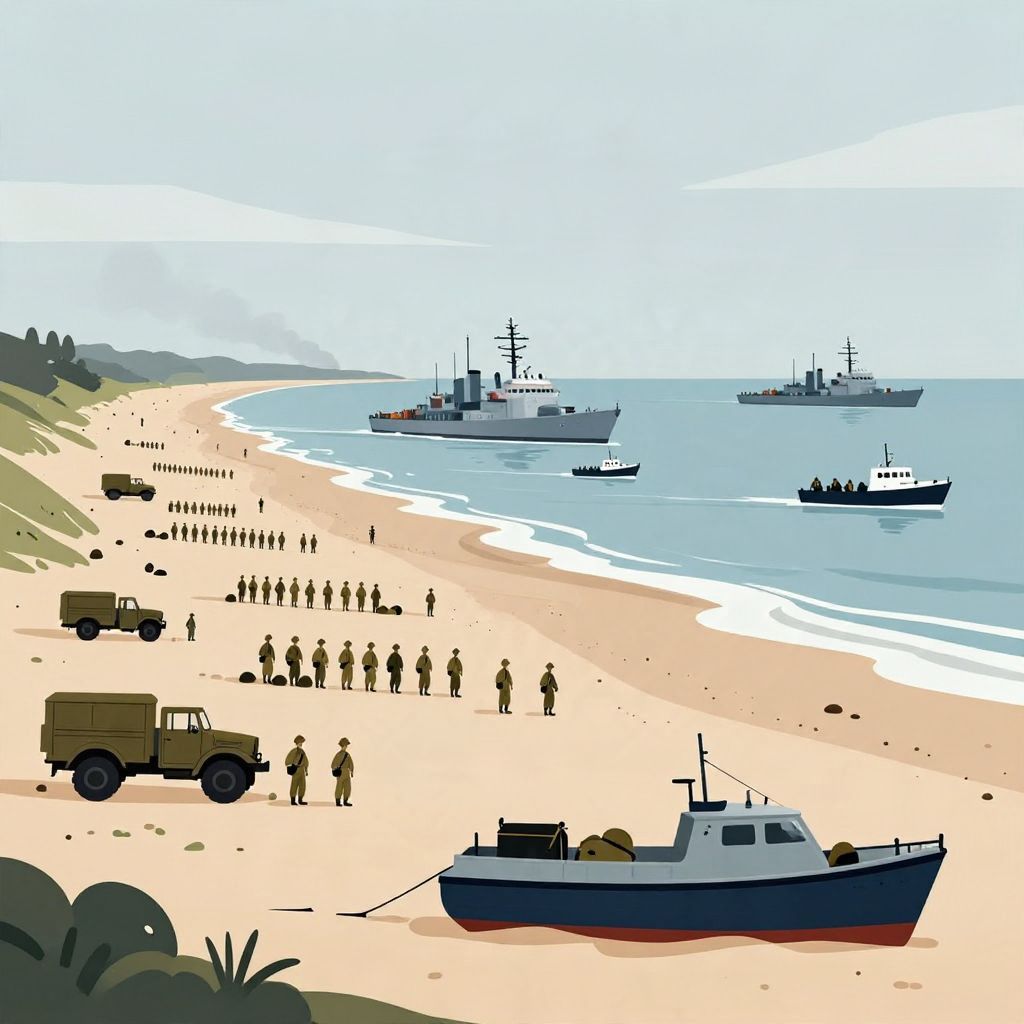
In 1940, many British and French soldiers were saved from the Germans by the evacuation from Dunkirk, the dramatic rescue of Allied troops trapped on the French coast after the rapid German advance through Belgium and northern France. The operation did not win the war, but it preserved the core of the British Expeditionary Force and tens of thousands of French troops for future fighting.
The rescue became one of the defining moments of World War II because it turned a military disaster into a strategic survival. Its success depended on a narrow strip of beach, a shrinking perimeter, and a remarkable evacuation effort by naval vessels, destroyers, and hundreds of civilian boats.
What Saved Many British And French Forces From The Germans In 1940?
The evacuation from Dunkirk, carried out from 26 May to 4 June 1940, saved many British and French forces from capture. Known as Operation Dynamo, it evacuated about 338,000 Allied troops from the beaches, harbor, and breakwaters of Dunkirk after German armor cut off their retreat. The rescue was possible because the Allied perimeter held long enough for ships and small boats to carry men across the Channel.
Why Allied Troops Ended Up Trapped at Dunkirk
The evacuation was not planned as a triumph, but as an emergency response to a fast-moving collapse in northern France. In May 1940, Germany launched its western offensive through the Ardennes, bypassing the main Allied defensive assumptions and splitting the British and French armies from the south.
Once German forces reached the Channel coast near Abbeville, the British Expeditionary Force, much of the Belgian army, and several French units found themselves pinned against the sea. Their supply lines were cut, and the route south was blocked. Dunkirk became the last major escape point.
The speed of the German advance
German success in 1940 came from a combination of armored thrusts, air power, and operational surprise. The Allied command had expected the main attack to come through central Belgium, as in 1914. Instead, German panzer divisions drove through the Ardennes, crossed the Meuse, and raced westward. That maneuver did not destroy the Allied armies immediately, but it shattered their position and forced a desperate withdrawal.
How Operation Dynamo Worked
Operation Dynamo was directed from Dover by Vice-Admiral Bertram Ramsay. The evacuation began on 26 May 1940 and continued until 4 June. It used a mixture of military destroyers, transports, ferries, and many smaller civilian craft that could approach the shallow beaches and ferry men to larger ships offshore.
The operation succeeded because the British and French defenders kept a shrinking defensive ring around Dunkirk long enough to buy time. Without that perimeter, the evacuation would have collapsed before most troops could board ships.
What made the evacuation possible
- The defensive perimeter held by British and French troops around the evacuation zone.
- Naval coordination from Dover, which organized shipping, routes, and embarkation points.
- Shallow beaches and the mole, which allowed troops to board from the shoreline and from the long eastern breakwater.
- Weather and visibility, which sometimes limited German air attacks and helped shipping movements.
- German operational choices, including pauses and shifting priorities that gave the Allies precious time.
The Role of the “Little Ships” and the Royal Navy
One of the most famous aspects of Dunkirk was the use of civilian vessels, later remembered as the “little ships.” Fishing boats, pleasure craft, ferries, lifeboats, and other small craft helped shuttle soldiers from the beaches to larger ships or carried them directly across the Channel. These civilian boats were important, but they did not act alone. The Royal Navy carried the main burden, especially with destroyers and larger transports.
The little ships became a powerful symbol because they represented improvisation, national unity, and rescue under fire. Historically, however, the evacuation was a combined military and civilian effort, not a purely civilian miracle. The operation depended on organization, discipline, and the willingness of trained sailors and soldiers to keep working in dangerous conditions.
British and French cooperation
Although Dunkirk is often remembered as a British rescue, French troops also played a crucial role. They defended the perimeter, helped maintain order, and later covered the final stages of the evacuation. Many French soldiers were evacuated as well, though not all could be removed before the Germans entered the city. Some French units remained behind to continue the fight or were later captured.
Why the Germans Did Not Destroy the Evacuation
The survival of so many Allied troops was not inevitable. German forces were close enough to make the evacuation extremely dangerous, but several factors limited their ability to finish the job quickly.
One important issue was the temporary halt of German armored units near Dunkirk in late May 1940. Historians have debated the reasons for this pause for decades. It may have reflected concern about terrain, supply, the need to reorganize after rapid advances, or a preference to let the Luftwaffe finish the task. Whatever the exact mix of motives, the pause gave the Allies time to strengthen the perimeter and expand the evacuation.
German air attacks were serious, but they did not stop the evacuation. The Royal Air Force fought to protect the shipping lanes and the beachhead, though the air battle over Dunkirk was costly. German aircraft sank or damaged ships, but they could not fully disrupt the continuous flow of men across the Channel.
Limits of German air power
Popular memory sometimes suggests that the Luftwaffe could have annihilated the evacuation if only it had tried harder. That is too simple. Air power was dangerous, but it was not enough on its own to stop a large-scale withdrawal across a defended coastline. Smoke, weather, anti-aircraft fire, and the sheer number of moving targets complicated German attacks.
How Many Troops Were Saved?
By the end of the evacuation, about 338,000 Allied soldiers had been rescued, including roughly 198,000 British and 140,000 French and Belgian troops, though exact figures vary by source and counting method. The number most often cited for Dunkirk is around 338,000 total evacuees. What matters historically is that a large portion of the British Expeditionary Force escaped, along with many French soldiers who could later rejoin the war effort.
The rescue was incomplete and costly. Heavy equipment, vehicles, artillery, and supplies were largely abandoned on the beaches. The British army lost much of its material, and the French suffered severe losses in men and equipment. Yet the preservation of trained manpower was crucial. Britain did not lose its army in France, and that changed the course of the war.
Why Dunkirk Mattered So Much
Dunkirk mattered because it prevented a military catastrophe from becoming a total strategic collapse for Britain. If the British Expeditionary Force had been destroyed or captured in full, Britain would have faced the war with far fewer trained troops and a much weaker position at home. The evacuation preserved the core of an army that could be rebuilt for later campaigns.
For France, Dunkirk was part of a broader national disaster. The evacuation did not save France from defeat in 1940, which came soon after. But it did allow some French troops to continue fighting, and it helped sustain the idea that the war was not over. In that sense, Dunkirk became linked to the later continuation of resistance, both in Britain and among Free French forces.
A military defeat turned into a political symbol
Winston Churchill famously warned that wars are not won by evacuations, and he was right. Dunkirk was not victory. It was survival. Still, the event quickly acquired immense symbolic power in Britain because it suggested endurance under pressure and the possibility of recovery after disaster. That “Dunkirk spirit” became part of wartime memory, even if the reality was more complex than later legend.
What Happened After the Evacuation?
The immediate aftermath was grim. France continued to collapse in June 1940, and Paris fell soon after. Britain now stood largely alone against Nazi Germany in Western Europe. The rescued troops had to be rearmed, retrained, and reorganized, while the country prepared for the possibility of invasion.
Yet the evacuation also gave Britain something invaluable: time. The army that escaped from Dunkirk helped defend the home islands and later returned to combat in North Africa, Italy, and Northwest Europe. The evacuation did not end the war, but it made continued resistance possible.
- 10 May 1940: Germany invades the Low Countries and France.
- Mid-May 1940: German armored forces break through in the Ardennes and race to the Channel.
- 26 May 1940: Operation Dynamo begins at Dunkirk.
- Late May 1940: British and French troops defend the perimeter while evacuation continues.
- 4 June 1940: The evacuation ends after hundreds of thousands have been rescued.
Historical Significance and Lasting Memory
Dunkirk remains one of the most studied episodes of the Second World War because it shows how war can turn on logistics, timing, and command decisions as much as on battlefield heroics. It also reveals the difference between tactical success and strategic survival. Germany won the battle for France, but it failed to eliminate Britain’s army.
In historical memory, Dunkirk has often been simplified into a story of miraculous rescue. The truth is more demanding and more interesting: Allied soldiers fought a delaying action, naval officers organized a massive evacuation, civilian boat owners answered the call, and German hesitation helped create the opening. Together, those factors saved many British and French forces from the Germans in 1940. For more context on the fall of France, see why France fell so quickly to the Nazis and the wider wartime turning point in what happened in 1941.