
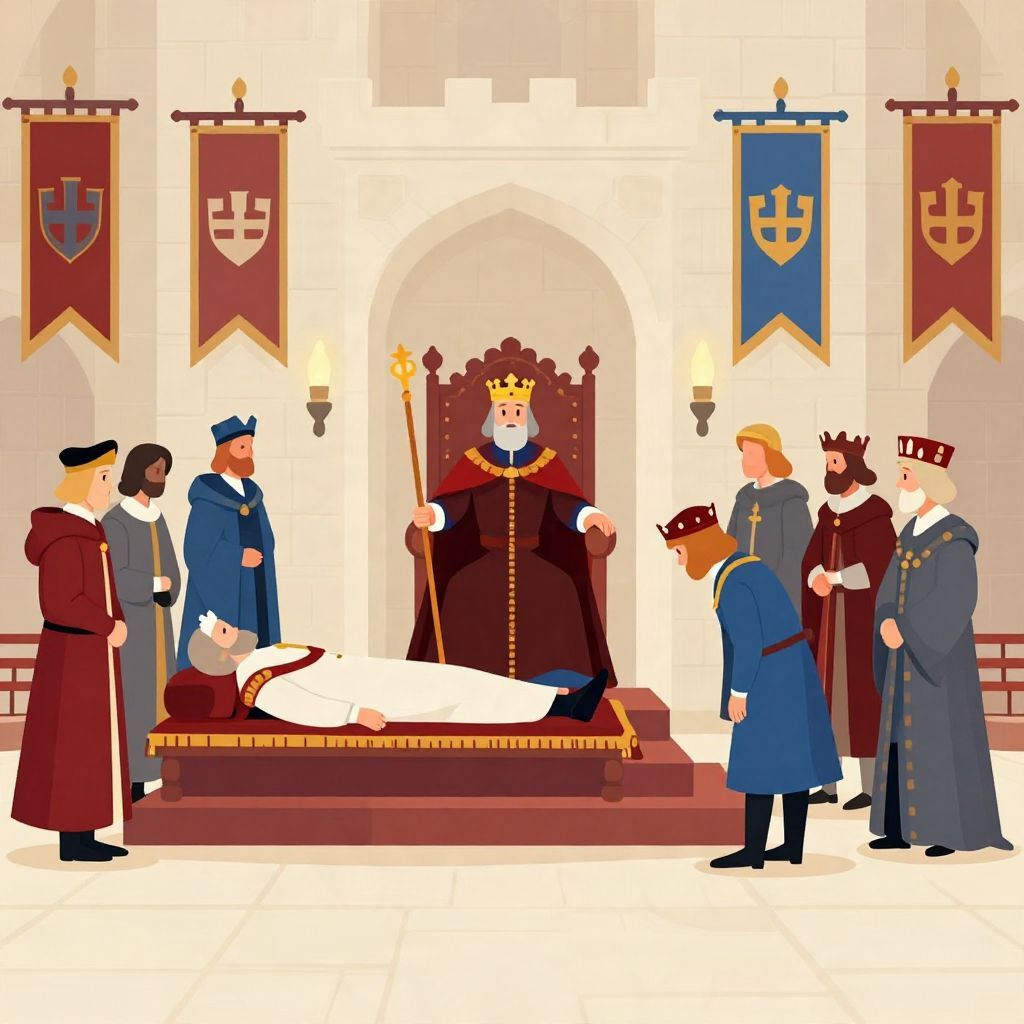
The phrase “The King is dead, long live the King” sounds paradoxical, but it is really a statement of continuity in monarchy. It announces the death of one ruler and the immediate accession of the next, so that the crown never appears vacant. The formula became famous in medieval France, but the idea behind it is older and wider than one language or dynasty.
Its history reveals how monarchies tried to prevent instability, civil war, and uncertainty at the moment of succession. The phrase has survived because it captures a central truth of hereditary rule: a king may die, but the institution of kingship must go on.
What does “The King is dead, long live the King” mean?
The phrase means that as soon as one monarch dies, the next lawful monarch immediately becomes king or queen. It is not a contradiction. “The king is dead” refers to the deceased ruler; “long live the king” is a wish for the new sovereign’s long reign and a declaration that the monarchy continues without interruption.
In practical terms, the formula helped reassure subjects, nobles, armies, and foreign powers that there was no power vacuum. In hereditary monarchies, especially in Europe, succession was often a moment of danger. A clear public declaration reduced confusion and reinforced legitimacy.
Where did the phrase come from?
The best-known origin is in France. The formula is traditionally associated with the death of Charles VI in 1422 and the accession of his son, Charles VII. French royal proclamations used the equivalent of “Le roi est mort, vive le roi!” to announce that the new king succeeded instantly. The wording emphasized that the crown passed at the very moment of death.
Although the exact phrasing is often linked to early fifteenth-century France, the underlying principle is older. Medieval and early modern monarchies developed legal and ceremonial ways to show that sovereignty did not disappear between rulers. The famous formula became a compact, memorable expression of that political idea.
Why France mattered
France had a strong tradition of sacral kingship and dynastic continuity. The French crown was not supposed to be “empty” in the way an elected office might be after a vacancy. The heir succeeded immediately by right of blood, even if coronation came later. The phrase fit this system perfectly because it separated succession from coronation.
That distinction mattered. A new king might not be crowned for months, but he was still king from the instant the previous monarch died. The ceremony confirmed the fact; it did not create it.
How did the succession formula develop over time?
The formula developed out of a broader medieval concern: how to preserve authority during a transfer of power. In many kingdoms, the death of a ruler could invite rival claims, noble rebellion, or foreign intervention. A public proclamation naming the successor made the transition appear orderly and lawful.
By the late Middle Ages, European monarchies increasingly treated succession as automatic in hereditary dynasties. The phrase gave verbal form to that principle. It also reflected the growing importance of state institutions, which needed to function even when the person at the top changed.
A short timeline of the idea
- Early and high medieval period: hereditary succession becomes more formalized in several European monarchies.
- 14th–15th centuries: French royal practice helps popularize the succession formula.
- Early modern period: the phrase and its equivalents spread in court ceremony and political language.
- Later centuries: the expression becomes a general idiom for smooth succession, even outside monarchy.
This timeline is approximate because the phrase did not appear everywhere at once, and surviving records are uneven. What is clear is that the political need came first, and the famous wording followed.
Why was this phrase politically important?
Monarchies depended on the belief that authority was continuous. If people thought the throne was empty, they might question laws, taxes, military command, or succession rights. The formula prevented that uncertainty by announcing both death and continuity in one breath.
It also protected against competing claims. In dynastic politics, a delay could encourage pretenders or rival branches of a royal family. By declaring the next monarch immediately, the state reduced the chance that anyone could argue the throne was open for contest.
Continuity over vacancy
The phrase reflects a key constitutional idea: the office outlives the officeholder. Modern states often use similar logic when they ensure that a president, prime minister, or judge is replaced according to law the moment a term ends or a vacancy occurs. Monarchies expressed this principle in especially dramatic language.
That is why the phrase has endured long after many countries abandoned monarchy. It names a universal political problem: how to transfer authority without chaos.
Was the phrase always used exactly this way?
Not always. The wording varies by language and period, and the famous English form is a translation of a French royal formula rather than a single fixed sentence used everywhere in the same way. In some contexts, it was a ceremonial announcement; in others, a political slogan or later literary reference.
There is also a difference between the historical phrase and popular usage today. Modern speakers sometimes use it casually to mean “one leader has died and another has taken over,” or even more broadly, “one era ends and another begins.” That broader meaning is real, but it is a later extension of the original royal context.
Common misunderstandings
- It does not mean the old king and new king rule at the same time.
- It does not mean there is no mourning or grief.
- It does mean the monarchy continues without a legal break.
How did coronations fit into the process?
In many monarchies, coronation was a sacred and political ceremony, but it was not the moment a ruler became king. The new monarch already held the title by inheritance or law. Coronation publicly confirmed that status, blessed it, and displayed it before the realm.
This separation between accession and coronation explains why the phrase mattered so much. A kingdom could not wait for a ceremony to know who ruled. The succession formula made the legal transition immediate, while the coronation could follow later as a ritual of legitimacy.
Example: accession before ceremony
When a king died far from the capital, or when travel and communication were slow, the realm needed a quick answer to a simple question: who is king now? The answer, in hereditary monarchy, was the heir. The proclamation made that answer public and official.
What is the historical significance of the phrase?
The phrase is significant because it captures a major shift in political thinking: the state as a continuing institution rather than a personal possession of one ruler. Even in strongly personal monarchies, succession had to be organized, predictable, and public.
It also shows how language can shape political reality. A short formula could calm uncertainty, affirm legitimacy, and communicate a legal principle to a wide audience. In that sense, the phrase was not just ceremonial; it was a tool of governance.
Lasting influence
Over time, “The King is dead, long live the King” became a cultural shorthand for transition. Writers, historians, and journalists use it to describe the end of one era and the beginning of another. It appears in discussions of politics, business, sports, and pop culture, usually to signal that succession is immediate and inevitable.
Its endurance comes from its elegance. The phrase compresses loss and continuity into a single line, reminding us that succession often involves both grief for the old and acceptance of the new.
Why does the phrase still matter today?
Even in countries without kings, the phrase remains useful because it expresses a timeless political truth: institutions survive only if transitions are orderly. Whether the subject is a monarch, a president, a party leader, or a company executive, the challenge is the same—how to replace one authority without creating a vacuum.
Historically, the phrase belongs to monarchy, but its meaning has outlived the system that produced it. It is a reminder that power is never only about individuals; it is also about rules, continuity, and public recognition.
In the end, “The King is dead, long live the King” is both a royal announcement and a political idea. It marks the death of one ruler, the instant rise of another, and the determination of a kingdom to remain whole through change. If you want to explore the biblical background of royal death and succession, see how King David died and how King Saul died.