
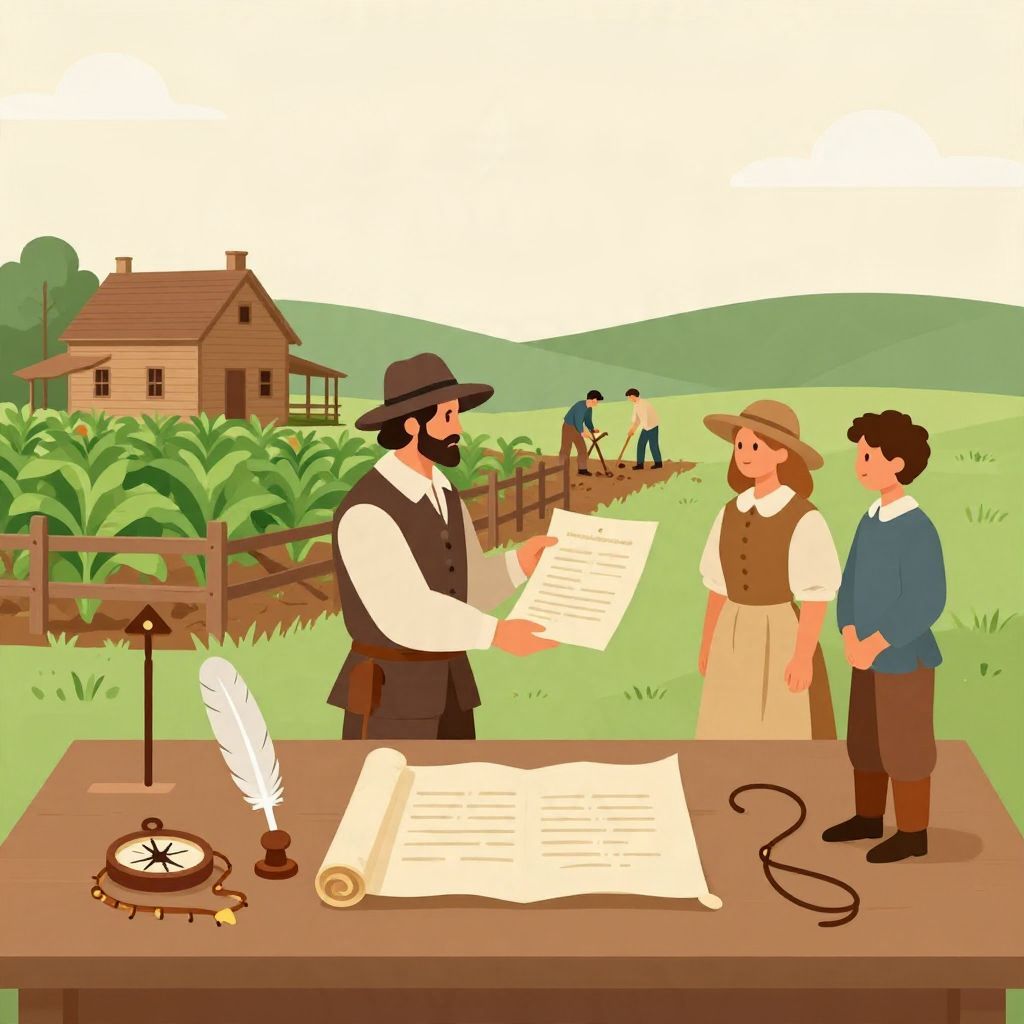
The headright system was a land-grant policy used in parts of colonial America, especially Virginia and later other southern colonies, to encourage settlement by giving land to people who paid for their own passage—or the passage of others—to North America. It helped populate English colonies, expand plantation agriculture, and concentrate land in the hands of wealthy planters.
In practice, the system shaped migration, labor, and inequality in early America. It rewarded those with money and connections, while also helping create a demand for indentured servants and, eventually, enslaved labor. Understanding the headright system helps explain how colonial societies grew and why land ownership became so uneven.
What Was the Headright System?
The headright system was a colonial land policy that granted a fixed amount of land, usually 50 acres per “headright,” to settlers or investors for each person whose transportation to America they financed. It began in Virginia in the early 17th century and became one of the most important tools used by English colonies to attract immigrants and expand settlement.
The basic idea
The word headright referred to a right tied to a person, or “head.” If a colonist paid to bring an individual across the Atlantic, that colonist could claim land for each person transported. This could include family members, indentured servants, and sometimes other laborers. The policy was designed to solve a colonial problem: how to get enough people to settle and work the land.
Why Was the Headright System Created?
The headright system emerged because English colonies, especially Virginia, needed settlers, labor, and profits. Early colonies were fragile. Disease, food shortages, conflict, and high mortality rates made survival difficult. Colonial leaders and the Virginia Company wanted more people to move to America, cultivate land, and make the colony economically viable.
Labor shortage in the Chesapeake
The Chesapeake region, including Virginia and Maryland, developed around tobacco farming. Tobacco was labor-intensive, and large plantations required many workers. Since free labor was scarce and expensive, colonial elites looked for ways to attract workers without paying wages. The headright system offered land as an incentive, turning migration into a business opportunity.
Encouraging private investment
The policy also encouraged wealthy colonists and investors to finance migration. Instead of the colony paying for settlement directly, private individuals could do it and receive land in return. This reduced the financial burden on colonial governments while helping elites acquire large tracts of territory.
How Did the Headright System Work?
Under the headright system, a person who paid for an immigrant’s passage received a land grant for that immigrant. In Virginia, the standard grant was often 50 acres per headright, though the exact amount and rules could vary over time and by colony. The land was usually claimed through colonial authorities after the sponsor documented the transport.
A simple example
If a planter financed the passage of 10 indentured servants, that planter could receive 500 acres of land. If the same person also paid for family members or additional workers, the land grant increased accordingly. This made it possible for ambitious colonists to accumulate very large estates.
Who benefited most?
Although the system was open in theory, it favored people with capital, political influence, and access to labor. Wealthy planters could transport many workers at once and claim vast holdings. Smaller farmers sometimes benefited too, but the system gradually encouraged land concentration rather than broad equality.
Origins and Early History of the Headright System
The headright system is most closely associated with Virginia, where it developed in the early 1600s. The colony’s leaders were desperate to strengthen settlement after years of instability. By the 1610s and 1620s, land-grant policies had become a central part of colonial expansion in the Chesapeake.
Virginia’s early settlement
Jamestown, founded in 1607, struggled for survival. The colony initially depended on uncertain support from the Virginia Company and on trade, agriculture, and labor arrangements that often failed. As tobacco became profitable in the 1610s, colonial leaders needed a reliable way to bring in workers and expand cultivation. The headright system fit that need.
Connection to the Virginia Company
The Virginia Company and colonial officials used land grants to attract settlers and reward investors. In this early period, land was a powerful incentive because it was abundant in colonial eyes, even though it was already inhabited by Native peoples. The policy reflected English assumptions that land could be distributed by colonial authority, regardless of Indigenous claims.
How the Headright System Changed Colonial Society
The headright system had major social and economic consequences. It encouraged migration, expanded plantation agriculture, and helped create a powerful class of landowners. It also deepened inequality by giving wealthy settlers the means to acquire more land than ordinary migrants could ever hope to obtain.
Growth of plantations
In the Chesapeake, large plantations became common because tobacco required extensive acreage and labor. Headrights made it easier for planters to build estates large enough to support cash-crop production. Over time, land ownership became increasingly concentrated in the hands of a planter elite.
Expansion of indentured servitude
The system worked closely with indentured servitude. Many migrants could not afford passage to America, so they agreed to work for a set number of years in exchange for transportation. Sponsors gained both labor and land, while servants received a chance, however uncertain, at freedom and sometimes land of their own after their contracts ended.
Transition toward enslaved labor
As the 17th century progressed, planters increasingly turned to enslaved Africans. The headright system did not create slavery, but it helped build the plantation economy in which slavery expanded. By making large landholdings easier to obtain, it supported the growth of labor-intensive agriculture that eventually relied heavily on racial slavery.
Was the Headright System Fair?
By modern standards, the headright system was deeply unequal. It rewarded those already able to pay for migration and ignored the rights of Native peoples whose lands were being claimed. While some poor settlers could gain land indirectly, the system mostly strengthened elites and widened social divisions.
Impact on Indigenous peoples
The land granted under headright policies was not empty land. It was part of Native homelands, and colonial expansion often led to displacement, warfare, and broken agreements. The system therefore belonged to a broader pattern of settler colonialism, in which European colonies claimed territory and transformed it for their own use.
Unequal access to land
In theory, the system could help ordinary migrants. In practice, the greatest rewards went to those who could sponsor many arrivals. Wealthy planters and merchants benefited far more than small farmers or laborers. This helped shape the social hierarchy of the southern colonies for generations.
Where Was the Headright System Used?
The headright system is best known in Virginia, but similar land-grant ideas appeared in other English colonies, especially in the southern Atlantic world. The details varied from place to place, and not every colony used the system in exactly the same way. Still, the basic principle—land in exchange for settlement or transport—was widely influential.
Virginia and Maryland
Virginia used the system most famously, and Maryland also adopted versions of land grants tied to immigration and settlement. In both colonies, tobacco agriculture created strong incentives to recruit labor and expand acreage.
Later influence in the South
Other southern colonies and frontier regions used related policies to encourage growth. Even when the term headright was not always used, the logic remained similar: land was offered as a reward for bringing people into colonial territory.
How Long Did the Headright System Last?
The headright system did not disappear overnight. It remained influential through much of the colonial period, but its importance changed as colonial economies and land policies evolved. By the 18th century, many colonies had developed more complex land systems, and the original headright model became less central.
Decline in importance
As population grew and available land became more contested, colonial governments increasingly regulated land grants in different ways. The rise of slavery also changed labor systems in the South, reducing reliance on indentured servitude. The headright system’s original purpose—to attract settlers and laborers—became less important than it had been in the early 1600s.
Long-term legacy
Even after the system faded, its effects remained. It helped establish patterns of large-scale landownership, plantation agriculture, and social inequality that shaped the colonial South and influenced the early United States.
Why Does the Headright System Matter in American History?
The headright system matters because it reveals how land, labor, and empire worked together in colonial America. It was not simply a method of rewarding settlers; it was a tool of expansion that encouraged migration, enriched elites, and accelerated the displacement of Native peoples. It also helped lay the groundwork for plantation society.
Key historical significance
- It promoted English settlement in North America.
- It encouraged the growth of tobacco plantations.
- It increased demand for indentured servants and, later, enslaved labor.
- It concentrated land in the hands of wealthy colonists.
- It contributed to the dispossession of Indigenous peoples.
Headright System in Simple Terms
If you want the shortest definition, the headright system was a colonial land policy that gave settlers land for each person they brought to America. It was meant to populate the colonies, but it also helped create a wealthy planter class and deepen inequality in the English Atlantic world.
In historical terms, the headright system was both an incentive and a mechanism of expansion: it rewarded migration, fueled plantation growth, and linked land ownership to labor exploitation. For related context on how American land policies evolved, see what the Homestead Act was and what the Northwest Ordinance was.