
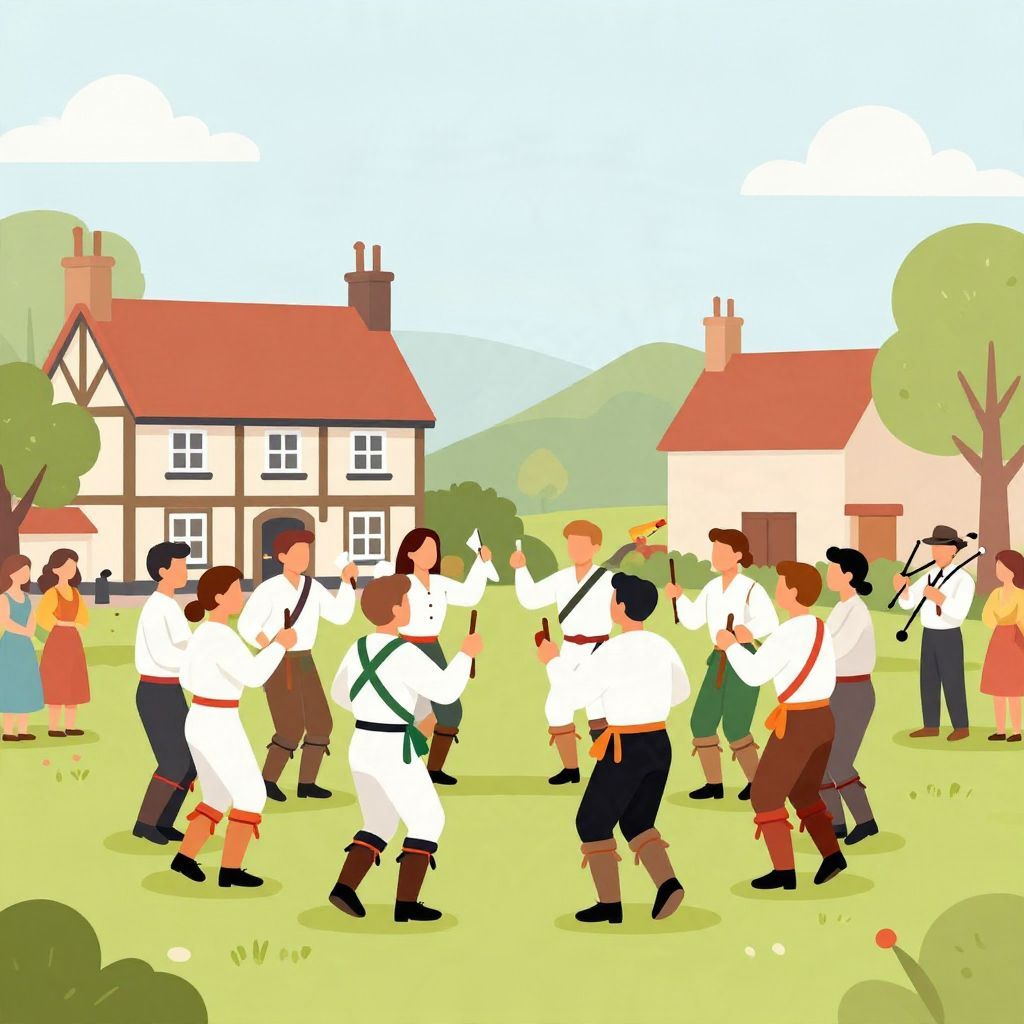
What is Morris dancing? It is a traditional English folk dance performed by groups of dancers, usually in costume, using sticks, handkerchiefs, bells, and rhythmic stepping. The dance is most strongly associated with rural England, but its history is more complex than a simple “ancient custom” story.
Morris dancing developed over centuries, changing with local communities, changing fashions, and periods of revival. Its origins are debated, but by the late medieval and early modern periods it had become a recognizable part of English festive life.
What Is Morris Dancing?
Morris dancing is a traditional form of English folk dance in which performers dance in coordinated figures, often in sets of six or eight, to live music. The style usually includes bells strapped to the legs, sticks or handkerchiefs as props, and lively stepping patterns. It is best understood as a living folk tradition rather than a single fixed dance.
Where Did Morris Dancing Come From?
The origins of Morris dancing are uncertain. Historians generally agree that it was established in England by the late 15th or early 16th century, but there is no solid evidence that it descends directly from medieval pagan ritual or from a single ancient source. The dance likely grew out of a mix of court entertainment, seasonal festivity, and local performance traditions.
Early evidence
Documentary references to morris-like dancing appear in the late Middle Ages and Tudor period. By the 16th century, Morris dancing was known in England and was being performed in public celebrations, processions, and at court. The term “Morris” itself is often linked to “Moorish,” reflecting a common early modern habit of associating exotic names with unfamiliar customs, though this does not prove any direct North African origin.
What historians can and cannot say
There is no reliable evidence that Morris dancing is a survival from prehistoric religion, despite popular claims made in earlier centuries. Some scholars have noted possible connections to wider European dance traditions, while others emphasize that the dance probably evolved within English society from a blend of influences. In short, its exact beginning is unknown, but its historical footprint is clearly English by the Tudor era.
How Did Morris Dancing Develop Over Time?
Morris dancing changed according to social taste, religious attitudes, and local custom. It was not one uniform tradition. Different regions developed their own styles, and the dance moved in and out of fashion depending on whether communities valued it as festive entertainment, a public spectacle, or an old-fashioned rural custom.
Tudor and Stuart England
In the 16th and early 17th centuries, Morris dancing was often part of village celebrations, May Day festivities, and elite entertainments. It could appear in seasonal pageants and parish events. During this period, it was associated with festivity, display, and communal enjoyment rather than with a strict religious meaning.
Puritan criticism and decline
In the 17th century, religious and moral criticism affected many forms of popular festivity in England. Puritan reformers often disapproved of dances, games, and holiday customs they saw as disorderly or frivolous. Morris dancing did not disappear entirely, but it lost status in some places and became less prominent in formal public life.
Survival in local tradition
Even as it declined in some areas, Morris dancing survived in village settings, especially where local custom remained strong. By the 18th and 19th centuries, it was often treated as an old rural practice rather than a mainstream national entertainment. That shift mattered: the dance increasingly became a marker of “tradition” itself.
What Does Morris Dancing Mean?
Morris dancing has carried different meanings at different times. For some communities, it was simply festive entertainment. For others, it symbolized seasonal renewal, local identity, or continuity with the past. In modern times, it is often seen as a performance of English heritage, though that meaning is a later cultural development rather than the dance’s original purpose.
Seasonal and community meaning
Many Morris traditions were tied to spring and early summer festivals, especially May Day. The dance could accompany processions, fundraising, and village celebrations. In that context, it helped mark the turning of the year and reinforced community bonds through shared performance.
Identity and symbolism
Modern audiences often read Morris dancing as a symbol of “Englishness,” but that interpretation is partly retrospective. Historically, the dance was more local than national. Its costumes, music, and steps varied widely, and its meaning depended on who was performing it and why. What remained consistent was its role as a public, collective tradition.
What Does Morris Dancing Look Like?
Morris dancing is recognizable for its energetic movement, rhythmic footwork, and use of props. The exact style depends on the tradition being performed. Some forms are restrained and processional; others are vigorous and highly theatrical. The dance is usually accompanied by instruments such as the fiddle, accordion, concertina, or pipe and tabor.
Common features
- Costume: Often white clothing, ribbons, sashes, hats, or more elaborate local dress.
- Props: Handkerchiefs, sticks, or sometimes swords in related traditions.
- Bells: Worn on the shins to emphasize rhythm.
- Music: Live accompaniment, usually with a strong beat for stepping and figures.
- Formation: Group dances with coordinated patterns, crossings, and turns.
Major styles
There is no single Morris dance. Among the best-known traditions are Cotswold Morris, which is often danced by sets of six with handkerchiefs or sticks, and Border Morris, which has a more robust style and distinct regional character. There are also sword dances and other related English folk forms that share some performance features, though they are not identical to Morris dancing.
Why Did Morris Dancing Survive?
Morris dancing survived because local communities kept valuing it, and because later generations deliberately revived it. Like many folk traditions, it was preserved not by continuous national popularity but by repeated acts of memory, adaptation, and reinvention. Its survival depended on people deciding that the custom was worth continuing.
The folk revival
In the late 19th and early 20th centuries, collectors and enthusiasts became interested in English folk song and dance. They recorded local traditions, organized performances, and helped standardize some versions of Morris dancing for new audiences. This revival was important, but it also changed the tradition by making it more visible and more self-consciously “heritage” oriented.
Modern practice
Today, Morris dancing is performed by local teams, folk clubs, and festival groups in England and beyond. It remains a living tradition, though one that is often maintained by enthusiasts rather than by the broader population. Modern performers may value it for community, historical continuity, or the enjoyment of keeping an old custom alive.
Was Morris Dancing Ever Controversial?
Yes. Like many folk customs, Morris dancing has sometimes been praised as harmless tradition and at other times criticized as outdated, noisy, or socially backward. In earlier centuries, religious reformers objected to it; in later periods, some observers mocked it as quaint. These reactions reveal changing attitudes toward popular culture and rural life.
From village custom to heritage performance
As industrialization and urbanization changed Britain, Morris dancing came to seem like a remnant of older rural society. That shift helped preserve it in a new way: once it was seen as disappearing, people became more interested in recording and reviving it. The dance’s modern reputation owes much to this process of nostalgia and preservation.
Why Does Morris Dancing Matter in History?
Morris dancing matters because it shows how traditions are made, remembered, and reinvented. It is a useful example of how historians study folk culture: not as a frozen relic from the distant past, but as a practice shaped by social change. Its history also shows how performance can carry local identity across generations.
In other words, Morris dancing is not just an old dance. It is a long-lived cultural practice whose meaning has shifted from festive entertainment to heritage symbol. Understanding it means understanding how communities preserve the past while continually reshaping it. For related reading, see what folk art is and what folk culture is.