
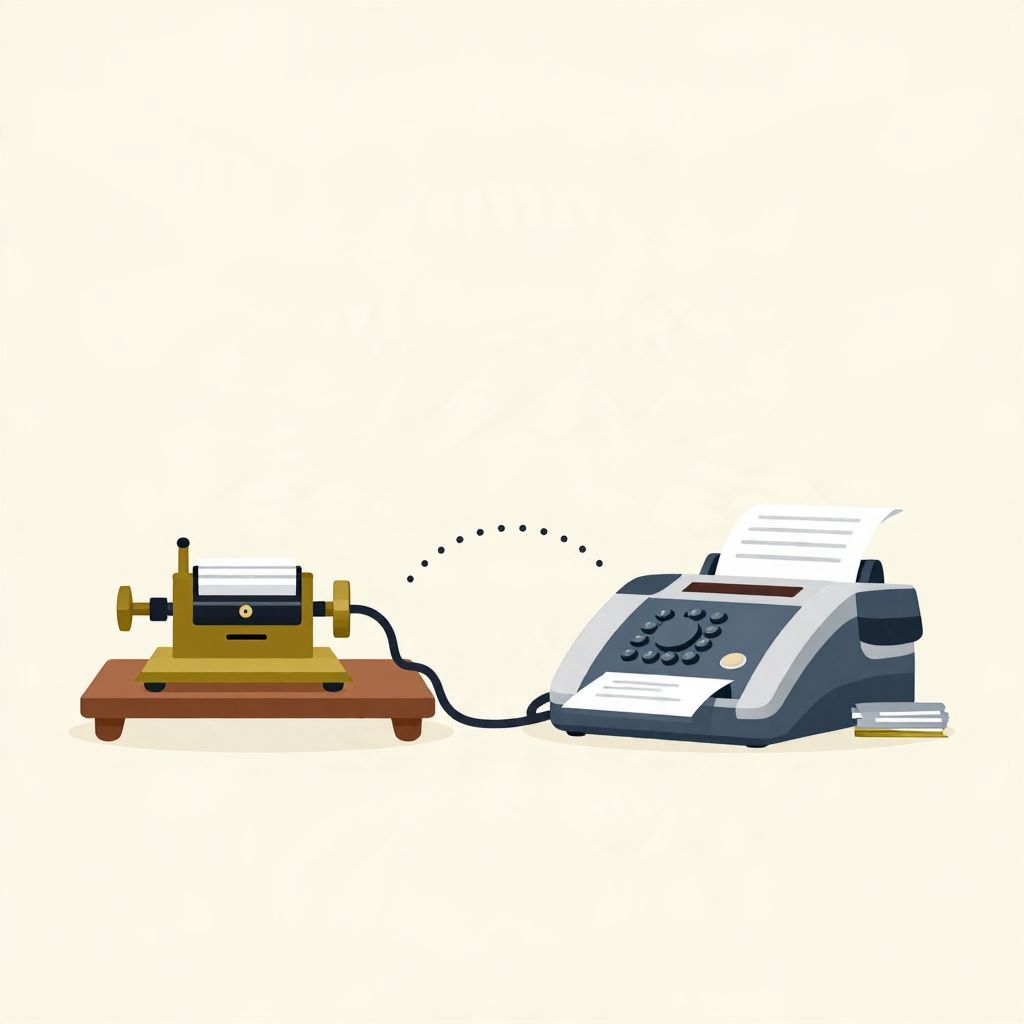
The fax machine was not invented in a single moment by one person. Its history stretches from the mid-19th century, when inventors first experimented with sending images electrically, to the 20th century, when fax technology became practical for business use.
If you are asking when the fax machine was invented in the modern sense, the best answer is that its key foundations were laid in the 1840s and 1850s, while the familiar office fax machine became commercially useful much later, especially in the 1960s and 1970s.
When Was Fax Machine Invented?
The fax machine’s origin dates to the 1840s, when Scottish inventor Alexander Bain patented an early image-transmitting device in 1843. However, the fax machine as most people know it did not become practical until the 20th century. In other words, the invention was a long process, not a single date.
The earliest fax-like inventions
Before the word “fax” existed, inventors were trying to solve a difficult problem: how to send writing, drawings, or signatures over distance using electricity. This was far more complicated than sending coded text, because an image had to be broken into signals and then rebuilt at the other end.
Alexander Bain and the first patent
In 1843, Alexander Bain patented a device that could scan a surface and reproduce it elsewhere using synchronized mechanical movement. Bain’s machine is often treated as the first true fax ancestor because it aimed to transmit images electrically. It was ingenious, but it was not yet reliable enough to transform communication.
Why early versions were limited
Early image transmission depended on precise timing, stable electrical signals, and accurate mechanical parts. Nineteenth-century technology could not yet deliver the speed, consistency, and convenience needed for widespread use. As a result, these early machines remained experimental or niche devices rather than everyday tools.
A brief timeline of fax machine history
The history of the fax machine is best understood as a series of milestones rather than one invention date. Each step improved the ability to transmit images over distance.
- 1843 — Alexander Bain patents an early image-transmitting device in Britain.
- 1850s — Further experiments refine the idea of electrically sending images.
- 1860s — Giovanni Caselli develops the pantelegraph, one of the first practical fax-like systems.
- 1900s–1930s — Fax technology improves through telegraph and telephone networks, but remains specialized.
- 1960s — Commercial fax systems become much more practical for offices and news services.
- 1970s–1980s — Fax machines spread widely in business, becoming a standard office tool.
Who really invented the fax machine?
There is no single universally accepted “inventor” of the fax machine, because several people contributed to its development. If one name is usually associated with the earliest patent, it is Alexander Bain. If the question is about a more practical working system, Giovanni Caselli deserves major credit. If the question is about the office fax machine, later engineers and manufacturers were equally important.
Giovanni Caselli and the pantelegraph
In the 1860s, Italian physicist and inventor Giovanni Caselli created the pantelegraph, an early fax system used for sending handwritten messages and drawings. It was more successful than Bain’s early design and was used in limited commercial settings. For many historians of technology, Caselli’s work marks the first genuinely practical fax service.
Why invention credits are complicated
Technological inventions often emerge through many hands over decades. One inventor may create the first patent, another the first workable machine, and others later make it affordable and reliable. The fax machine is a classic example of this process. Its history belongs to a chain of improvements, not a lone genius story.
How the fax machine developed over time
Fax technology advanced slowly because it had to combine several fields: electrical engineering, mechanical precision, telegraphy, and later telephone transmission. Each improvement made the system easier to use and more dependable.
From telegraph to telephone lines
Early fax systems were closely tied to telegraph networks. Over time, the rise of telephone infrastructure made image transmission more flexible and scalable. This shift mattered because fax machines needed a communication network that could carry stable signals over long distances.
Standardization and office use
By the mid-20th century, businesses wanted faster ways to send contracts, reports, and signed documents. Fax machines answered that need because they could transmit a paper document quickly without requiring a postal delay. Standardization of transmission methods helped the technology spread more widely across offices, newspapers, and government agencies.
When did fax machines become common?
Although the technology existed much earlier, fax machines became truly common in the 1970s and 1980s. That was the period when they moved from specialized business equipment to a familiar office appliance. Lower costs, better reliability, and wider access to telephone lines all helped drive adoption.
Why the 1980s mattered
The 1980s were the fax machine’s peak era in many countries. Businesses valued speed, and a faxed document could be treated as an immediate copy of a signed page. This made faxing especially useful for law offices, hospitals, newsrooms, and international trade. In many places, the fax machine became a symbol of modern office life.
What made the fax machine historically important?
The fax machine changed how people handled documents. Before email and digital scanning, it offered one of the fastest ways to send an exact copy of a page across distance. That made it an important bridge between older paper communication and newer digital communication.
Speed, trust, and paperwork
Faxing mattered because it combined speed with visual accuracy. A typed page, signature, or handwritten note could be transmitted in a form that looked nearly identical to the original. This gave faxed pages a practical authority in business and legal settings, even if the original paper still mattered in many cases.
Its role before the internet age
Before email became widespread, fax machines were one of the fastest tools available for document transmission. They helped offices coordinate across cities and countries, reducing delays in commerce and administration. In that sense, the fax machine was a major step in the modernization of communication.
Did the fax machine replace older forms of communication?
Not entirely. Fax machines did not eliminate letters, telegraphs, or phone calls. Instead, they filled a specific gap: the need to send a visible document quickly. For urgent paperwork, faxing was often better than mail and more concrete than a phone conversation.
Why fax remained useful for so long
Even after email arrived, fax remained in use because many organizations trusted paper-based workflows. Some industries valued faxed signatures and records, and in certain regions or legal systems faxing stayed important well into the 21st century. The machine’s longevity shows how durable paper communication remained in the digital age.
Historical facts about the fax machine
A few key facts help place the invention in context:
- The fax machine’s roots go back to the 1840s, not the late 20th century.
- Alexander Bain is commonly credited with the earliest patent in 1843.
- Giovanni Caselli developed one of the first practical fax systems in the 1860s.
- Modern office fax machines became common much later, especially in the 1970s and 1980s.
- The word “fax” comes from “facsimile,” meaning an exact copy.
So, when was the fax machine invented?
If you want one direct answer, the fax machine was first invented in concept in the 1840s, especially with Alexander Bain’s 1843 patent. But if you mean the practical office fax machine, that belongs to the 20th century, with mass use arriving mainly in the 1970s and 1980s. The invention was therefore a long evolution, not a single breakthrough.
Understanding that timeline helps explain why the fax machine became so important: it was one of the first technologies to make paper documents travel almost instantly. For more context on the era when fax machines became widespread, see what happened in 1986, and for a broader look at early human history, explore the first year on Earth with humans.