
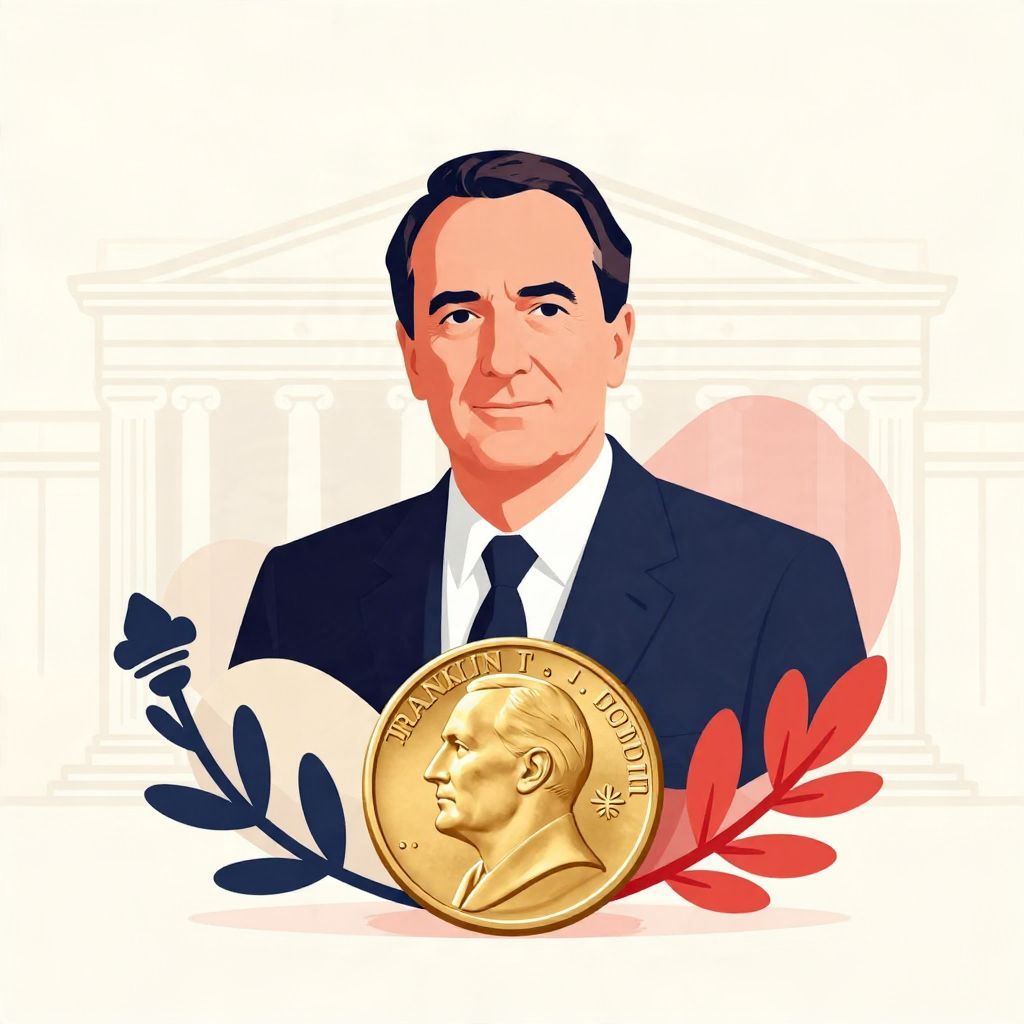
Who is on the dime? In the United States, the dime bears the portrait of Franklin D. Roosevelt, the 32nd president, since 1946. His image replaced the earlier “Mercury” dime design after his death, and the coin has remained one of the most familiar pieces of American currency ever since.
The dime is more than a small silver-colored coin: it reflects American political memory, wartime history, and the way the United States chooses to honor national leaders. Understanding who appears on it also means understanding why Roosevelt was selected and how the coin’s design evolved.
Who is on the dime?
Franklin D. Roosevelt is on the U.S. dime. His profile has appeared on the coin since 1946, a year after his death. The choice honored Roosevelt’s leadership during the Great Depression and World War II, and it also recognized his connection to the fight against polio, which inspired the March of Dimes campaign.
Why Franklin D. Roosevelt was chosen
Roosevelt was selected for the dime because he was widely admired at the time of his death in April 1945, and because the dime had a special association with the March of Dimes, a fundraising effort to combat polio. The Treasury Department approved the design change in 1946, and the new dime entered circulation that same year.
The March of Dimes connection
The link between Roosevelt and the dime is often explained through the March of Dimes, a public campaign that encouraged Americans to send small donations to support polio research and patient care. Roosevelt himself had suffered from polio, and his personal struggle made him a powerful symbol in the campaign, though the dime design was not created simply as a tribute to the charity. Rather, the association made Roosevelt a natural and meaningful choice.
A memorial coin after a president’s death
Roosevelt became the first U.S. president to appear on a dime, and the decision followed a broader American tradition of placing presidents and other major figures on coins and currency. In the immediate postwar period, the government wanted a design that would honor his legacy without waiting for a long commemorative process. The result was a practical memorial that entered everyday use.
What the dime looked like before Roosevelt
Before Roosevelt’s portrait appeared, the dime carried the famous Winged Liberty Head design, created by sculptor Adolph A. Weinman and issued from 1916 to 1945. Because the figure wore a winged cap, many people mistakenly called it the “Mercury dime,” though it was not meant to depict the Roman god Mercury. It represented Liberty in a classical style.
From Liberty to a president
The change from Liberty to Roosevelt marked a shift in American coin design. Earlier U.S. coins often featured allegorical figures such as Liberty, Columbia, or other symbolic images rather than named individuals. By the mid-20th century, however, presidential portraits had become increasingly common on circulating coinage, and Roosevelt’s image fit that trend.
How the dime’s design changed over time
The Roosevelt dime has remained in circulation for decades, but its metallic composition and some design details changed over time. The original 1946 dimes were struck in 90% silver, matching earlier U.S. coinage standards. In 1965, after rising silver prices and coin shortages, the U.S. Mint switched to a copper-nickel clad composition for regular circulation dimes.
Key design features
- Obverse: Roosevelt’s portrait
- Reverse: A torch, olive branch, and oak branch
- Meaning: Liberty, peace, and strength
The reverse design symbolizes values associated with the United States. The torch represents liberty, the olive branch stands for peace, and the oak branch signifies strength and endurance. These elements helped make the dime a compact expression of national ideals.
Why the dime matters in American history
The dime may be one of the smallest denominations in U.S. currency, but it has an outsized place in American life. For generations, it has passed through the hands of nearly everyone in the country, making it one of the most familiar forms of public imagery. Because Roosevelt was on the dime for so long, his face became part of everyday visual culture.
Coins as historical memory
Coins often serve as miniature monuments. They circulate widely, survive for years, and quietly teach history through repeated exposure. The Roosevelt dime is a good example: it commemorates a president, recalls the New Deal era, and preserves the memory of wartime leadership. In this sense, the dime is both money and public history.
Common confusion about the dime
People sometimes ask who is on the dime because the answer is easy to forget or because older slang and coin designs create confusion. Some also confuse the dime with other coins that feature presidents, especially the penny, nickel, and quarter. The dime is distinct because Roosevelt has appeared on it continuously since 1946.
Not the same as the “Mercury dime”
A frequent misconception is that the dime once showed Mercury, the Roman messenger god. In reality, the earlier coin depicted Liberty wearing a winged cap. The resemblance to Mercury led to the nickname, but the official design was symbolic rather than mythological. Roosevelt succeeded that design after World War II.
Historical context: Roosevelt’s legacy
Franklin D. Roosevelt served as president from 1933 until his death in 1945, leading the nation through the Great Depression and most of World War II. His New Deal programs reshaped the federal government’s role in American life, while his wartime leadership helped guide the Allied victory. These achievements made him one of the most influential presidents in U.S. history.
Why his image endured
Roosevelt’s image endured on the dime because it fit both historical memory and public sentiment. The coin honored a leader associated with resilience, reform, and national recovery. Unlike some commemorative designs that appear only briefly, the Roosevelt dime became a lasting part of the currency system, ensuring his face would remain visible to millions.
Timeline of the dime’s modern history
- 1916: The Winged Liberty Head dime begins circulation.
- 1945: Franklin D. Roosevelt dies in office.
- 1946: The Roosevelt dime is introduced.
- 1965: The dime changes from silver to clad composition.
- Present: Roosevelt remains on the dime in everyday circulation.
Answer in one sentence
The person on the U.S. dime is Franklin D. Roosevelt, whose portrait has appeared on the coin since 1946 in honor of his presidency, his wartime leadership, and his association with the March of Dimes.
The dime’s story shows how a small object can carry a large historical meaning: it preserves the memory of a transformative president while reflecting changing American values and coinage practices. For more on U.S. coin history, see who is on the dime coin and which president is on the dime.