
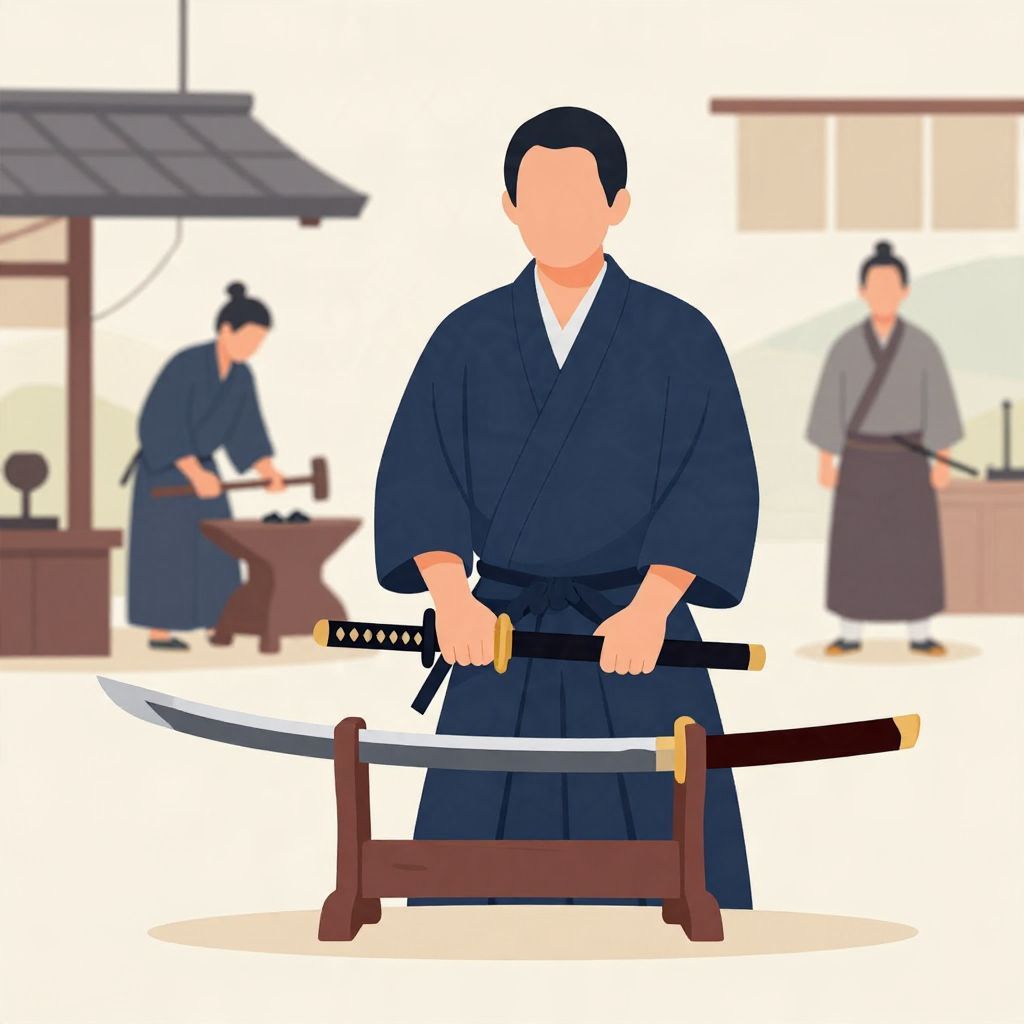
What is a katana? In the simplest historical sense, a katana is a Japanese sword with a curved, single-edged blade, a long grip, and a design optimized for drawing and cutting. It became the most famous sword associated with Japan’s warrior class, especially the samurai, but its history is broader than popular images suggest.
The katana was not a timeless symbol from Japan’s earliest past. It emerged through centuries of weapons development, warfare, and changing social order, and it gained its classic form in medieval Japan. Understanding the katana means looking at technology, status, combat, and the cultural meanings later attached to it.
What Is Katana?
A katana is a traditionally made Japanese sword, usually defined by its curved blade, single cutting edge, and ability to be worn edge-up through the belt. It developed in Japan’s medieval period as a practical weapon for mounted and foot combat, and later became a powerful symbol of samurai identity and Japanese craftsmanship.
Where Did the Katana Come From?
The katana did not appear all at once. It developed from earlier Japanese swords, especially straight blades and later curved swords used by warriors from the Heian period onward. By the late medieval era, roughly the 15th and 16th centuries, swordsmiths had refined the form into what is now recognized as the classic katana.
From straight blades to curved swords
Early Japanese swords were influenced by continental Asian metalworking traditions. Over time, Japanese smiths adapted sword design to local warfare. As mounted combat became more important, curved blades proved effective for drawing cuts. The katana’s shape reflects these practical needs rather than a purely ceremonial origin.
The rise of the samurai sword
By the Kamakura period and especially the Muromachi period, the sword had become central to warrior culture. The katana was often paired with a shorter companion blade, creating the famous daishō set associated with samurai status. Still, the sword was not just a badge of rank; it was a weapon shaped by battlefield use.
What Does “Katana” Mean?
The Japanese word katana generally means “sword” or “blade,” but in English it usually refers to the specific long, curved sword most closely associated with samurai Japan. In historical Japanese usage, the term could be broader than modern popular usage, which often treats “katana” as a single, fixed sword type.
Meaning in historical context
Language matters here because modern collectors, martial artists, and historians do not always use the term in exactly the same way. In everyday English, “katana” usually means the iconic long sword with a curved blade. In historical Japanese contexts, sword terminology was more nuanced, with different names for blade lengths, mounting styles, and periods of use.
How Was a Katana Made?
Traditional katana making was a highly skilled process involving forged steel, repeated folding, careful heat treatment, and detailed finishing. The goal was not simply beauty, but a blade that balanced hardness and flexibility. The smith’s work was only part of the process; polishing and mounting were also essential to the finished sword.
Tamahagane and forging
Many traditional swords were made from tamahagane, a steel produced in a Japanese smelting process. Swordsmiths folded and forged the metal to manage impurities and improve performance. Popular culture sometimes exaggerates folding as if it alone made the sword superior, but the real value lay in the smith’s overall control of the material and heat treatment.
Hamon, polish, and mounting
The visible temper line, or hamon, was created through differential hardening and became one of the katana’s most admired features. The blade was then polished to reveal its structure and sharpen the edge. Finally, it was mounted with a hilt, guard, scabbard, and fittings that could be functional, decorative, or both.
Why Was the Katana Important in Japanese History?
The katana mattered because it was both a weapon and a social symbol. On the battlefield, it was one tool among many, not the only weapon samurai used. Over time, however, it became closely tied to samurai identity, rank, and discipline. In the early modern era, it also came to represent authority and tradition.
The sword and samurai status
During the Tokugawa period, when large-scale warfare declined, the sword’s symbolic importance grew. Samurai were increasingly administrators as well as warriors, and the sword became a visible mark of class. Carrying a katana signaled membership in the warrior estate, even when actual combat was rare.
More than a battlefield weapon
It is a mistake to imagine the katana as a lone hero’s weapon used in constant duels. Japanese warfare involved bows, spears, firearms, and massed troops. The katana was important, but it worked within a broader military system. Its later fame partly reflects how peace transformed a practical weapon into a cultural emblem.
How Did the Katana Evolve Over Time?
The katana’s form changed with military needs, political stability, and taste. Its development was gradual, not a single invention. Different periods produced different blade lengths, curvatures, and mountings. What people now call a “classic katana” is the result of centuries of refinement rather than one fixed original model.
- Heian to Kamakura periods: curved swords became more common for mounted warriors.
- Muromachi period: warfare intensified, and sword production expanded.
- Sengoku period: mass conflict encouraged more practical, battle-ready blades.
- Tokugawa period: swords became stronger symbols of samurai identity.
- Meiji era: sword-wearing was restricted as Japan modernized.
Firearms and changing warfare
When firearms spread in Japan in the 16th century, the katana did not disappear, but its battlefield role changed. Large armies increasingly relied on spears, arquebuses, and tactics suited to mass warfare. The sword remained important for close combat and status, yet it was no longer the dominant battlefield weapon in the way popular imagination often suggests.
What Role Did the Katana Play in Samurai Culture?
The katana was deeply tied to samurai ideals of loyalty, discipline, and honor, though those ideals changed over time and were often more complicated in practice. The sword became a moral and social symbol as much as a weapon, especially in literature, ceremony, and later national memory.
Honor and identity
Samurai culture placed great value on martial readiness, composure, and service to a lord. The sword came to embody these values. In later centuries, stories and ideals about the katana sometimes overshadowed the more ordinary realities of administration, taxation, and political service that occupied many samurai.
Myth and reality
Popular culture often presents the katana as an almost magical blade, unmatched by all others. Historically, that is too simple. The katana was an excellent weapon within its own context, but its reputation grew through later romanticism, nationalism, and modern media. Its fame is real; its mythic aura is also a historical product.
Did the Katana Have Religious or Cultural Meaning?
Yes. In Japan, swords could carry spiritual and ceremonial significance, and the katana was sometimes treated as an object of reverence. In Shinto-influenced traditions, craftsmanship, purity, and ritual care contributed to the sword’s prestige. However, this should not be confused with the idea that every katana was a sacred object.
Sword as symbol, not just tool
Elite swords were sometimes offered as gifts, displayed in homes, or preserved as heirlooms. Famous blades could be associated with lineage, legitimacy, and memory. Over time, the katana became part of Japan’s artistic heritage as well as its military history.
What Happened to the Katana in Modern Japan?
The katana’s everyday military role declined sharply after the Meiji Restoration in the late 19th century, when Japan modernized its army and restricted the public carrying of swords. Yet the katana did not vanish. It survived as an art form, a ceremonial object, and later a cultural icon in Japan and around the world.
From weapon to heritage
Modern swordsmiths continue traditional techniques, and many blades are valued as works of art and historical craftsmanship. At the same time, the katana has become one of the most recognizable symbols of Japanese culture globally, often appearing in films, anime, martial arts, and museums. That popularity, however, often simplifies its long and varied history.
Why Is the Katana So Famous Today?
The katana is famous because it combines striking design, technical sophistication, and strong cultural symbolism. It represents the samurai in the global imagination, even though real samurai history was more complex than the image of a lone sword-wielding warrior. Its fame comes from history, but also from later storytelling.
Popular culture and historical memory
Movies, novels, games, and martial arts traditions have all helped fix the katana in modern memory. These portrayals often emphasize elegance, precision, and honor. While those qualities are part of the sword’s legacy, historians also stress that the katana was a product of warfare, class society, and changing political order.
Key Facts About the Katana
- A katana is a curved, single-edged Japanese sword.
- It became especially prominent in medieval Japan.
- It is strongly associated with the samurai class.
- Its design reflects practical combat needs and skilled metallurgy.
- Its modern fame is shaped by both history and later legend.
So, What Is Katana in Historical Terms?
Historically, the katana is a Japanese sword that evolved over centuries into a practical weapon and a powerful cultural symbol. It was not simply “the samurai sword” from the beginning, nor was it a magical blade apart from ordinary history. It was a real weapon shaped by war, craftsmanship, and social change.
To understand the katana is to understand how objects can move from battlefield use to cultural icon. If you want to place it within the broader world of Japanese warrior history, you may also want to read about what a ronin was and the social role of the samurai.