
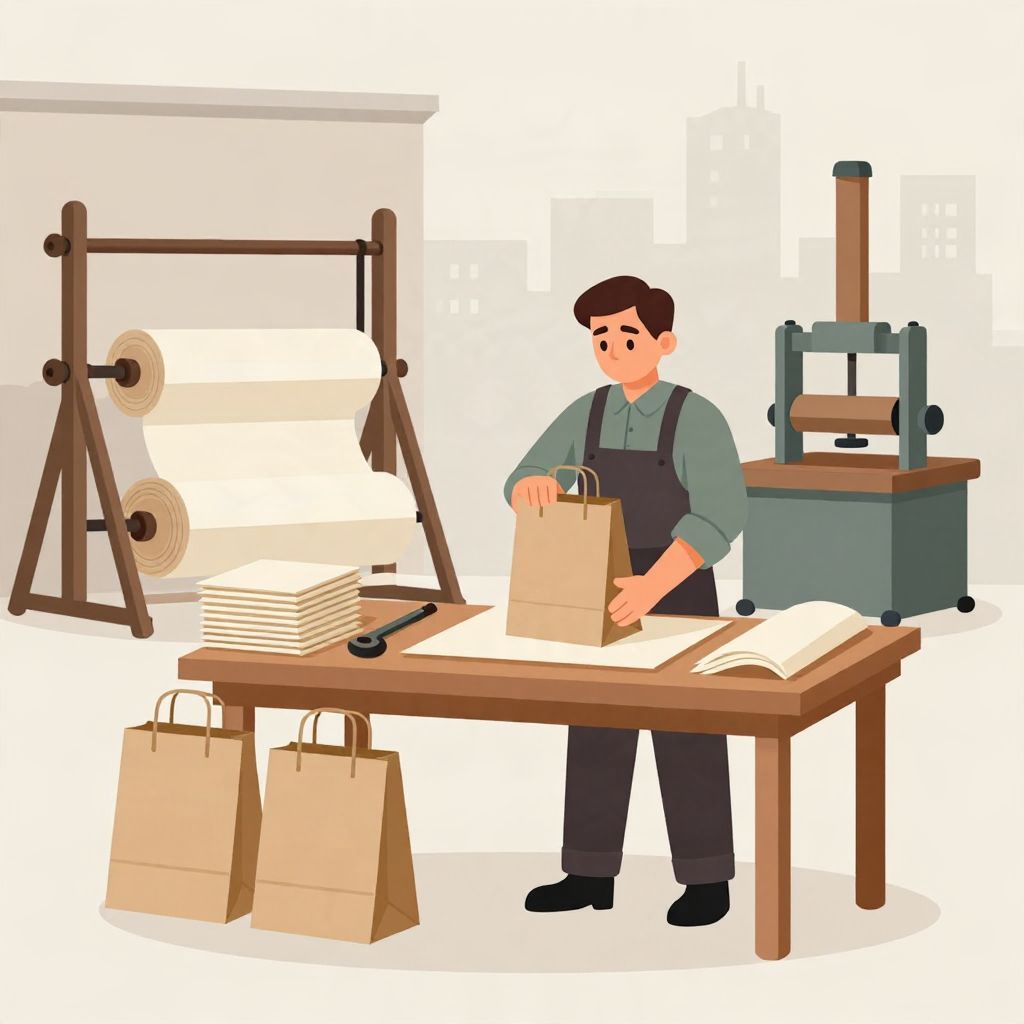
Where do paper bags come from? The short answer is that they emerged in the 19th century as a practical packaging invention, first developed in industrializing Europe and then improved in the United States. Their history is tied to the rise of machine-made paper, new manufacturing methods, and the growth of mass retail.
Paper bags did not appear all at once in one single place. They were the product of a longer story about paper production, industrial machinery, and changing consumer habits. By the mid-1800s, paper bags had become a familiar part of everyday commerce, especially in cities where merchants needed cheap, light, and disposable containers.
Where do paper bags come from?
Paper bags come from the 19th-century industrial transformation of papermaking and packaging. The earliest commercially successful paper bags were made in England and the United States, where inventors and manufacturers developed machines that could fold, cut, and glue paper into usable bags. Their origin is not ancient; it is closely linked to modern industrial retail.
The historical origins of paper bags
Paper itself came first
Paper bags could only exist after paper became widely available. Paper was invented much earlier, in ancient China, and later spread through the Islamic world and into Europe. But for centuries, paper remained relatively expensive and was used mainly for writing, printing, and bookkeeping. Only when industrial papermaking lowered costs in the 18th and 19th centuries did paper become practical for packaging in large quantities.
That broader history matters because paper bags were not simply a clever design. They depended on an industrial supply chain: cheaper paper, faster printing and cutting, and new machines that could produce standardized goods. In other words, paper bags are a modern invention built on an older material.
Early paper bags in the 1800s
By the early 19th century, shopkeepers were already using paper wrappers and simple folded containers for small goods. These early bags were often handmade and varied in shape. The real breakthrough came when inventors began designing machines specifically for making bags on a larger scale. That shift turned paper bags from a niche convenience into a mass-market product.
Who invented the paper bag?
No single person invented the paper bag in the modern sense, but several inventors made important contributions. The best-known early name is Francis Wolle, an American teacher and inventor who patented a machine for making flat-bottom paper bags in 1852. His invention made paper bags more useful because they could stand upright and hold more items than simple folded sleeves.
Wolle’s machine is often treated as a turning point in the history of paper bags, but it was not the final form. Later inventors improved the design and the production process. The most famous of these was Margaret E. Knight, who developed a machine in the 1860s that could cut, fold, and glue flat-bottom bags more efficiently. Her work helped make the modern grocery bag possible.
Francis Wolle and the first bag-making machine
Wolle’s 1852 patent is important because it marks the first successful machine designed specifically for bag production. Before that, paper bags were generally made by hand, which was slower and more expensive. His machine helped standardize the process and made bags more practical for stores and manufacturers.
However, Wolle’s bags were still relatively simple. They were useful for dry goods and small purchases, but they were only one stage in the evolution of paper packaging. The history of paper bags is therefore best understood as a sequence of improvements rather than a single invention moment.
Margaret E. Knight and the flat-bottom bag
Margaret Knight is often remembered because her design solved a major problem: how to make a bag that was both cheap and sturdy. Her machine created flat-bottom bags that could be filled more easily and held shape better than earlier versions. This was especially valuable for grocery stores, which needed efficient packaging for flour, sugar, and other household staples.
Knight’s contribution also reflects a broader industrial pattern. The paper bag was not just a consumer item; it was part of the machinery of modern commerce. Her invention fit the needs of expanding cities, growing retail chains, and increasingly standardized goods.
Where were paper bags first made and used?
Paper bags were first made commercially in England and the United States, where industrial papermaking and machine manufacturing advanced rapidly in the 19th century. England was an important center of early papermaking and industrial production, while the United States became especially significant for bag-making machinery and large-scale retail use.
In practical terms, paper bags spread wherever stores sold loose goods that needed quick, inexpensive packaging. Urban merchants, grocers, and dry-goods sellers were among the first to use them widely. As rail transport and mass distribution expanded, paper bags became useful across a larger commercial network.
Why cities adopted them first
Cities created the conditions paper bags needed. Shops in urban areas sold many small items to many customers, often in bulk or by weight. A paper bag was faster than wrapping goods in cloth or paper by hand each time. It was also cheap enough to be treated as disposable, which suited the pace of industrial retail.
Rural areas adopted paper bags more gradually, since local trade often relied on different packaging habits. The spread of paper bags therefore mirrors the broader urbanization of the 19th century.
How industrialization changed packaging
Machine-made paper made bags affordable
One of the biggest reasons paper bags became common was the rise of machine-made paper. Earlier paper had been labor-intensive to produce, but industrial papermaking increased output and reduced cost. That change made paper suitable for everyday commercial use, not just books and documents.
As paper became cheaper, manufacturers could experiment with packaging formats. The paper bag benefited from this environment because it was simple, lightweight, and easy to produce in large numbers. It was an ideal product for the industrial age.
The rise of mass retail
Paper bags also grew because shopping itself changed. In the 19th century, more people bought goods from stores rather than making or growing everything at home. Merchants needed packaging that was fast, sanitary, and standardized. Paper bags answered that need better than many older methods.
They also supported the emerging idea of the packaged consumer good. Instead of carrying loose items in baskets, cloth sacks, or wrapped bundles, customers could leave with a ready-made paper container. That small convenience became part of modern shopping culture.
What were paper bags used for at first?
Early paper bags were used mainly for dry goods and small retail purchases. Grocers filled them with flour, sugar, tea, coffee, candy, and other staples. They were also useful for pharmacies, hardware shops, and general stores. Because they were lightweight and inexpensive, they worked well for items that did not need airtight or waterproof packaging.
At first, paper bags were not ideal for every product. They tore more easily than cloth sacks and did not protect against moisture. But their low cost and convenience outweighed those weaknesses for many merchants. Over time, improvements in paper strength and bag design made them even more practical.
How paper bags evolved in the modern era
From plain containers to branded packaging
As printing improved, paper bags became more than simple containers. Businesses began to use them for branding, advertising, and store identity. A bag could carry a shop’s name, logo, or slogan, turning packaging into a form of marketing. This was especially important in the late 19th and early 20th centuries, when competition among retailers increased.
The paper bag thus became both a tool and a message. It carried goods home, but it also carried the merchant’s identity into the street and the customer’s home.
Environmental debates came much later
In the 20th century, paper bags were often seen as a cleaner and more respectable alternative to reusable cloth sacks or, later, plastic bags. But environmental debates about paper production, deforestation, and waste eventually complicated that image. Those concerns belong to a much later era than the bag’s invention, yet they show how an everyday object can acquire new meanings over time.
Why the origin of paper bags matters
The history of paper bags shows how ordinary objects often depend on major historical changes. Their origin reflects the spread of industrial production, the growth of cities, and the transformation of shopping into a mass consumer activity. What looks like a simple bag is actually a product of papermaking history, mechanical invention, and commercial modernization.
So, if you are asking where paper bags come from, the most accurate answer is this: they come from 19th-century industrial Europe and America, especially from the machine-driven world of England and the United States, with key inventions by people like Francis Wolle and Margaret E. Knight. Their deeper background reaches back to the earlier invention of paper itself, first made in China and later transformed by industrial technology. For related background, see where paper was invented and the manufacturing method that made mass production possible.