
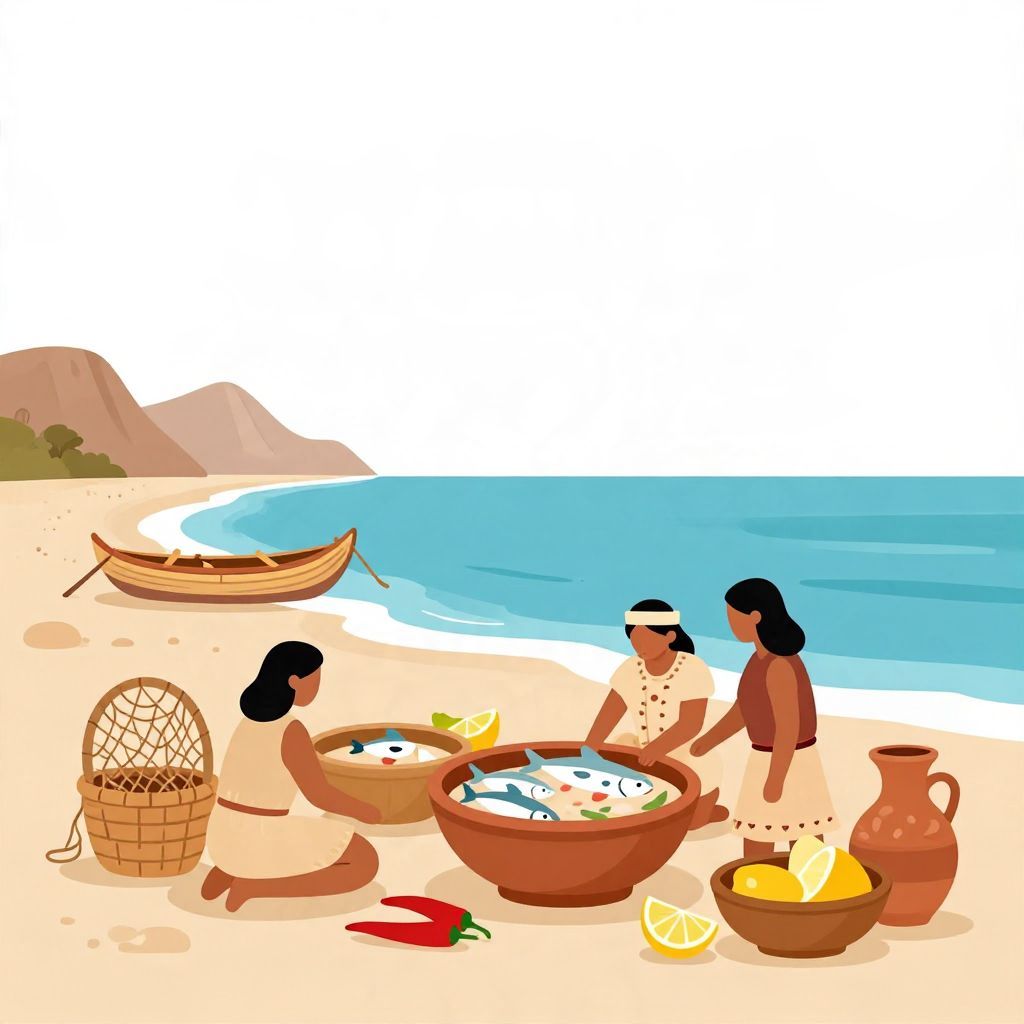
Where did ceviche originate? The short answer is that ceviche emerged on the Pacific coast of South America, most strongly associated with ancient and later Peruvian coastal cultures. Its exact “birthplace” cannot be pinned to one village or year, but the dish’s roots clearly lie in pre-Columbian fishing communities that used local fish, salt, and acidic ingredients.
Over time, ceviche changed as new ingredients arrived through trade and conquest, especially citrus brought by the Spanish. What began as a practical coastal method of preserving and flavoring seafood became one of Latin America’s best-known dishes, with Peru often recognized as its historical center.
Where Did Ceviche Originate?
Ceviche originated on the Pacific coast of South America, especially in the area of present-day Peru, long before the modern dish took shape. Historians generally agree that Indigenous coastal peoples were preparing fish with salt and acidic plant juices centuries before Spanish contact, and Peru later became the most influential center of ceviche culture.
The strongest historical evidence points to coastal Peru
The best-supported origin story places ceviche in ancient Peruvian coastal societies, where fishing was central to daily life. Archaeological and historical evidence suggests that people along the coast used fresh fish and local acidic ingredients to cure or “cook” seafood without heat. Because these communities lived near rich marine resources, seafood preservation was both practical and culturally important.
The modern word ceviche is Spanish, but the practice behind it is older than the name. That distinction matters: the dish as eaten today is the result of a long historical process, not a single invention with a precise founding date.
Why Peru is usually called the birthplace
Peru is most often identified as ceviche’s birthplace for two reasons. First, the country has deep pre-Columbian coastal culinary traditions tied to fishing and preservation. Second, Peru developed a particularly strong national ceviche identity over time, making it the place where the dish became most celebrated, standardized, and internationally recognized.
This does not mean ceviche was unknown elsewhere on the Pacific coast. Similar seafood preparations existed in neighboring regions, and historical exchange along the coast likely shaped the dish. Still, when people ask where ceviche originated, Peru is the most defensible historical answer.
The Pre-Columbian Roots of Ceviche
Before the arrival of Europeans, Indigenous peoples on the Pacific coast already had sophisticated food traditions. They relied on fish, shellfish, salt, and native acidic fruits or fermented liquids to preserve food and improve flavor. In warm coastal climates, such methods were especially useful because fresh fish spoiled quickly.
Food preservation before refrigeration
Ceviche should be understood partly as a preservation technique. Long before modern refrigeration, coastal communities needed ways to keep seafood edible. Salt slowed spoilage, while acidic ingredients altered the texture and taste of the fish. The result was not identical to modern ceviche, but it belonged to the same culinary logic: raw seafood transformed by acid and seasoning.
In historical terms, this is important because many famous dishes began as practical solutions. Ceviche was not originally a restaurant specialty or a luxury food. It was a coastal method shaped by environment, resources, and necessity.
Local ingredients shaped the earliest versions
The earliest ceviche-like dishes likely used ingredients available in the region, such as local peppers, salt, and acidic juices from native plants. These ingredients varied by place and period. What remained consistent was the basic principle: fresh seafood combined with sour or salty elements that changed its flavor and texture.
Because written records from pre-Columbian societies are limited, scholars must reconstruct these traditions from archaeology, later colonial accounts, and the continuity of food practices. That means some details remain uncertain, but the broad picture is strong.
How Spanish Contact Changed Ceviche
The arrival of the Spanish in the 16th century transformed many Indigenous foodways, including ceviche. One of the most important changes was the introduction of citrus fruits such as limes and lemons, which eventually became central to the dish in many regions. This was a major turning point in ceviche’s history.
The role of citrus
Modern ceviche is usually associated with citrus juice, but that ingredient was not part of the original pre-Columbian version. Citrus came from the Old World and spread through Spanish colonial networks. Once it became available in the Americas, it offered a bright, reliable sourness that worked extremely well with fish.
Over time, citrus helped define the ceviche that people recognize today. The acid “cooks” the fish by denaturing proteins, changing the texture while keeping the seafood uncooked by heat. This method made the dish both flavorful and visually distinctive.
Colonial exchange and culinary blending
Ceviche is a good example of culinary exchange after European contact. Indigenous preservation methods met imported ingredients, and the dish evolved through everyday cooking rather than by formal invention. This blending is one reason ceviche has such a layered history: it is both deeply Indigenous and shaped by colonial-era global exchange.
That history also helps explain why ceviche appears in several Latin American cuisines. Regional variations developed as people adapted the basic idea to local fish, produce, and tastes.
Was Ceviche Invented in One Place?
Probably not in the strict sense. Asking where ceviche originated can suggest a single inventor or exact moment, but the historical reality is more complex. Ceviche developed gradually over centuries, and similar seafood preparations may have existed in multiple coastal communities. The dish is best understood as a regional tradition that matured over time.
Why origin stories are often simplified
Food history often gets compressed into neat stories because people want a clear answer. But many dishes emerge from long cultural processes. In ceviche’s case, the combination of seafood, salt, and acid likely appeared in different forms across the Pacific coast. Peru became the most famous center, but the dish’s deeper roots are broader than a single origin point.
Scholars therefore tend to speak cautiously: ceviche is strongly associated with Peru, yet its exact origin is not documented with the precision of a modern recipe’s first publication.
Peru’s later national identity
By the modern era, ceviche had become a powerful symbol of Peruvian cuisine and identity. That national prominence can make it seem as though ceviche was invented entirely in Peru, but the better historical view is that Peru inherited, shaped, and elevated an older coastal tradition.
This distinction matters. It respects the long Indigenous history of the dish while recognizing Peru’s central role in preserving and popularizing it.
How Ceviche Spread Across Latin America
As people moved, traded, and shared culinary practices along the Pacific coast and beyond, ceviche spread into many regional cuisines. Each place adapted the dish to local ingredients and preferences, creating a family of related foods rather than one fixed recipe.
Regional variations
- Peru: Often considered the classic form, usually made with fresh fish, lime juice, onion, chili, and salt.
- Ecuador: Frequently includes shrimp or combinations of seafood, sometimes with tomato-based elements.
- Chile and other coastal areas: Feature local fish and regional seasonings, reflecting different maritime traditions.
- Central America and Mexico: Developed their own ceviche styles, often with local seafood, citrus, and herbs.
These variations show that ceviche is not a single frozen recipe. It is a culinary tradition that adapted to geography, trade, and taste.
Sea routes and cultural exchange
Coastal trade made it easier for food traditions to travel. Fishing communities shared techniques, ingredients, and preferences across ports and regions. Later, migration further spread ceviche into urban centers and international restaurants. Today, ceviche is a global dish, but its historical heart remains tied to the Pacific coast of South America.
What Makes Ceviche Historically Important?
Ceviche matters because it preserves a record of Indigenous knowledge, colonial exchange, and regional identity in one dish. It shows how people adapted to coastal environments and how food traditions survive by changing. Rather than being a static “ancient recipe,” ceviche is a living example of cultural continuity.
A dish shaped by environment and history
The story of ceviche reflects the realities of life on the coast: abundant seafood, the need for preservation, and the creative use of local ingredients. Later, global contact added citrus and other influences, but the dish retained its core identity. That continuity is what makes ceviche historically remarkable.
It also helps explain why debates over its origin can become emotionally charged. For many people, ceviche is not just food; it is part of national heritage, regional pride, and ancestral memory.
So, Where Did Ceviche Originate?
Ceviche originated on the Pacific coast of South America, with the strongest historical connection to ancient and later Peruvian coastal cultures. It began as a pre-Columbian seafood preparation using salt and acidic ingredients, then evolved after Spanish contact when citrus became part of the recipe. In short, ceviche is a Peruvian-centered coastal tradition with deep Indigenous roots and a long history of adaptation.
For readers interested in food history, ceviche is a great example of how a dish can carry centuries of cultural change. You may also want to explore where ceviche is from or compare it with another global food tradition in where sushi originated.