
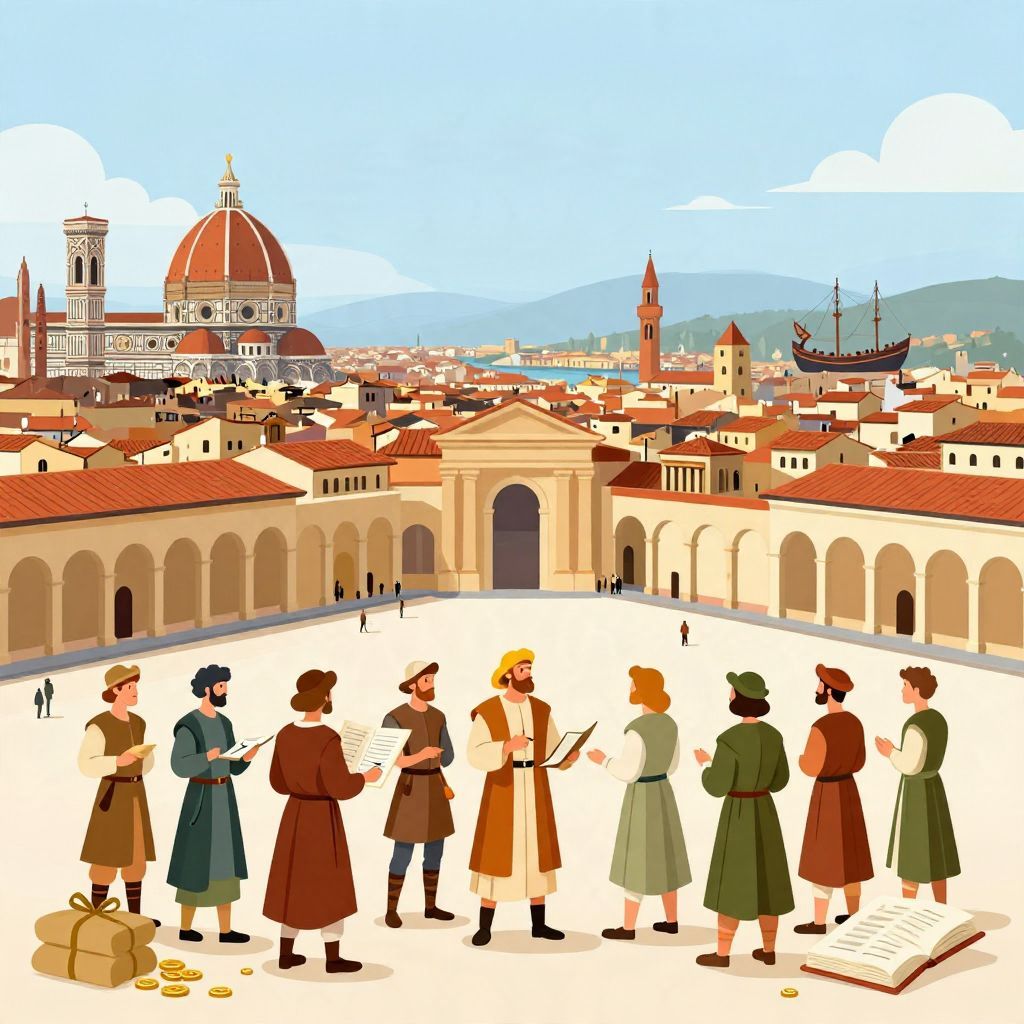
The Renaissance began in Italy because the peninsula combined wealth, city-based competition, access to classical learning, and contact with the wider Mediterranean world. In the fourteenth and fifteenth centuries, these conditions helped Italian thinkers, artists, and patrons revive interest in ancient Greek and Roman culture while developing new approaches to art, politics, and scholarship.
It was not a sudden event or a single invention. The Renaissance emerged gradually, first in places such as Florence, and then spread across Italy before influencing much of Europe.
Why Did the Renaissance Start In Italy?
The Renaissance started in Italy because Italian city-states were unusually rich, politically competitive, and connected to trade routes that brought in money, manuscripts, ideas, and artistic influence. Italy also preserved more visible remains of ancient Rome than most of Europe, which encouraged educated people to look back to classical antiquity as a model for renewal.
Italy’s Wealthy City-States Created the Right Conditions
Unlike much of medieval Europe, Italy was not dominated by one strong monarchy in the late Middle Ages. Instead, it was divided into powerful city-states such as Florence, Venice, Milan, Genoa, and later Rome. These cities grew rich from banking, manufacturing, shipping, and trade, and their elites spent money on education, architecture, and art.
Competition encouraged innovation
Because these cities competed with one another for prestige, rulers and merchant families often used culture as a display of power. A beautiful church, a grand palace, or a famous painting could signal civic pride and status. This competition gave artists and scholars more opportunities than they might have had in a more centralized kingdom.
Florence became an early center
Florence is often identified as the birthplace of the Renaissance because it produced influential writers, artists, and patrons in the fourteenth and fifteenth centuries. Wealthy banking families, especially the Medici in the fifteenth century, supported painters, sculptors, architects, and humanist scholars. Their patronage did not create the Renaissance by itself, but it helped turn cultural ambition into lasting achievement.
Trade and Commerce Brought Money and New Ideas
Italian cities sat at the crossroads of Mediterranean trade. Merchants from Venice and Genoa linked Italy to the Byzantine Empire, the Islamic world, North Africa, and northern Europe. This trade brought profits, but it also brought books, scientific knowledge, luxury goods, and artistic techniques.
The Mediterranean connection mattered
Italy was especially well placed to absorb ideas from many directions. Contacts with Greek-speaking scholars and eastern Christian traditions helped preserve and transmit classical learning. Trade with the Islamic world also mattered because Arabic scholars had preserved and expanded on ancient Greek philosophy, medicine, mathematics, and astronomy. Renaissance Italy did not simply “rediscover” the ancient world in isolation; it encountered it through a network of exchange.
Banking supported cultural life
Financial innovation also played a role. Italian bankers developed more sophisticated credit systems and commercial practices, which helped accumulate wealth in urban hands. Rich merchants and bankers were more likely to fund libraries, schools, chapels, and workshops. In this way, economic growth supported cultural production.
The Legacy of Ancient Rome Was Visible in Italy
One reason the Renaissance began in Italy rather than elsewhere in Europe is that Italy was the physical heart of the Roman Empire. Ruins, inscriptions, statues, roads, and buildings were part of everyday life. Educated Italians could see ancient Rome around them, not just read about it in books.
Classical ruins inspired imitation
Artists and architects studied Roman remains to recover proportions, styles, and techniques. Writers studied Latin texts to improve grammar, rhetoric, and historical understanding. The presence of ancient material culture made classical antiquity feel immediate and usable, not distant and abstract.
Humanism gave the past new meaning
Renaissance humanism was a scholarly movement focused on grammar, rhetoric, history, poetry, and moral philosophy, especially through classical texts. Humanists did not reject Christianity, but they believed that studying the literature and history of Greece and Rome could improve civic life and personal virtue. This intellectual program took root strongly in Italian cities, where educated elites valued eloquence and public service.
Political Fragmentation Encouraged Civic Culture
Italy’s political fragmentation was another major reason the Renaissance began there. In a divided landscape of republics, princely states, papal territories, and foreign-influenced regions, political life was often unstable. That instability encouraged careful diplomacy, public debate, and a new interest in history and politics.
Civic identity mattered
In republics such as Florence and Venice, citizens and elites often saw themselves as participants in the fate of the city. This helped create a culture that valued public achievement, persuasive language, and historical memory. Writers such as Leonardo Bruni argued that active civic life was a worthy ideal, blending classical models with contemporary politics.
Rivalries pushed cultural patronage
Rulers and families used art and learning to legitimize their authority. In a fragmented political world, culture could serve as soft power. A patron who sponsored a chapel, university, or palace was also shaping the image of the state or family behind it.
The Black Death and Social Change Opened New Possibilities
The Black Death of the mid-fourteenth century devastated Italy, as it did much of Europe. The pandemic killed large numbers of people and disrupted older social structures. Yet the long-term aftermath also created conditions that favored change.
Labor shortages altered society
With fewer workers available, wages could rise in some places and social mobility could increase for survivors. Some families accumulated wealth, while traditional hierarchies were weakened or challenged. This did not make life easy, but it did create a society in which old assumptions could be questioned.
Reflection on human life deepened
The catastrophe also encouraged a stronger awareness of human fragility, fortune, and individual achievement. Writers and artists increasingly explored earthly life, personal fame, and the dignity of human action. These themes fit well with Renaissance humanism and helped distinguish the period from earlier medieval traditions.
Byzantine Scholars and Greek Learning Strengthened the Movement
Italian interest in classical learning intensified after contact with Byzantine scholars, especially in the fourteenth and fifteenth centuries. Greek texts were less common in western Europe than Latin ones, so scholars who knew Greek were especially valuable.
Greek manuscripts arrived in Italy
As the Byzantine Empire weakened, scholars and manuscripts moved westward. The fall of Constantinople in 1453 is often seen as a turning point, though Greek learning had already been entering Italy before then. The arrival of Greek scholars in Italian cities strengthened study of Plato, Aristotle, and other ancient authors.
This was a broad intellectual revival
The Renaissance was not only about painting and sculpture. It also involved philology, philosophy, history, and education. Italian scholars compared manuscripts, corrected errors, and tried to recover the original meaning of ancient texts. That scholarly method became one of the great intellectual achievements of the age.
Why Not Somewhere Else in Europe First?
The Renaissance did eventually spread across Europe, but Italy had a head start because several favorable conditions overlapped there at once. Other regions had some of these features, but not all of them together.
- Urban wealth: Italian cities were unusually prosperous and independent.
- Classical proximity: Italy contained the most visible remains of ancient Rome.
- Mediterranean links: Italian ports connected Europe with Byzantium and the Islamic world.
- Patronage culture: Elites spent heavily on public art and learning.
- Humanist scholarship: Italian intellectuals developed methods for studying classical texts.
For these reasons, Italy became the most fertile ground for the early Renaissance, even though its later spread to France, the Low Countries, Germany, Spain, and England transformed it into a broader European movement.
What the Renaissance in Italy Changed
The Renaissance in Italy changed art, literature, education, and politics. Artists developed more naturalistic techniques, including perspective, anatomical realism, and careful observation of the human body. Writers revived classical forms and explored the capabilities of human reason and expression. Political thinkers became more interested in history, reputation, and statecraft.
Art and architecture transformed
Figures such as Giotto in the early stages, and later Brunelleschi, Donatello, Leonardo da Vinci, Michelangelo, and Raphael, helped define Renaissance art and design. Their work was shaped by patronage, competition, and the study of antiquity, but it also pushed beyond ancient models in original ways.
The movement spread beyond Italy
By the late fifteenth and sixteenth centuries, printing, travel, war, diplomacy, and scholarly exchange carried Renaissance ideas across Europe. What began in Italian city-states became part of a wider transformation in European culture.
In short, the Renaissance started in Italy because the peninsula offered a rare combination of wealth, urban rivalry, classical inheritance, and international exchange. Those conditions made it possible for new ideas about art, learning, and human potential to flourish first there, before spreading outward. For related reading, see more history articles and political engagement in historical context.