
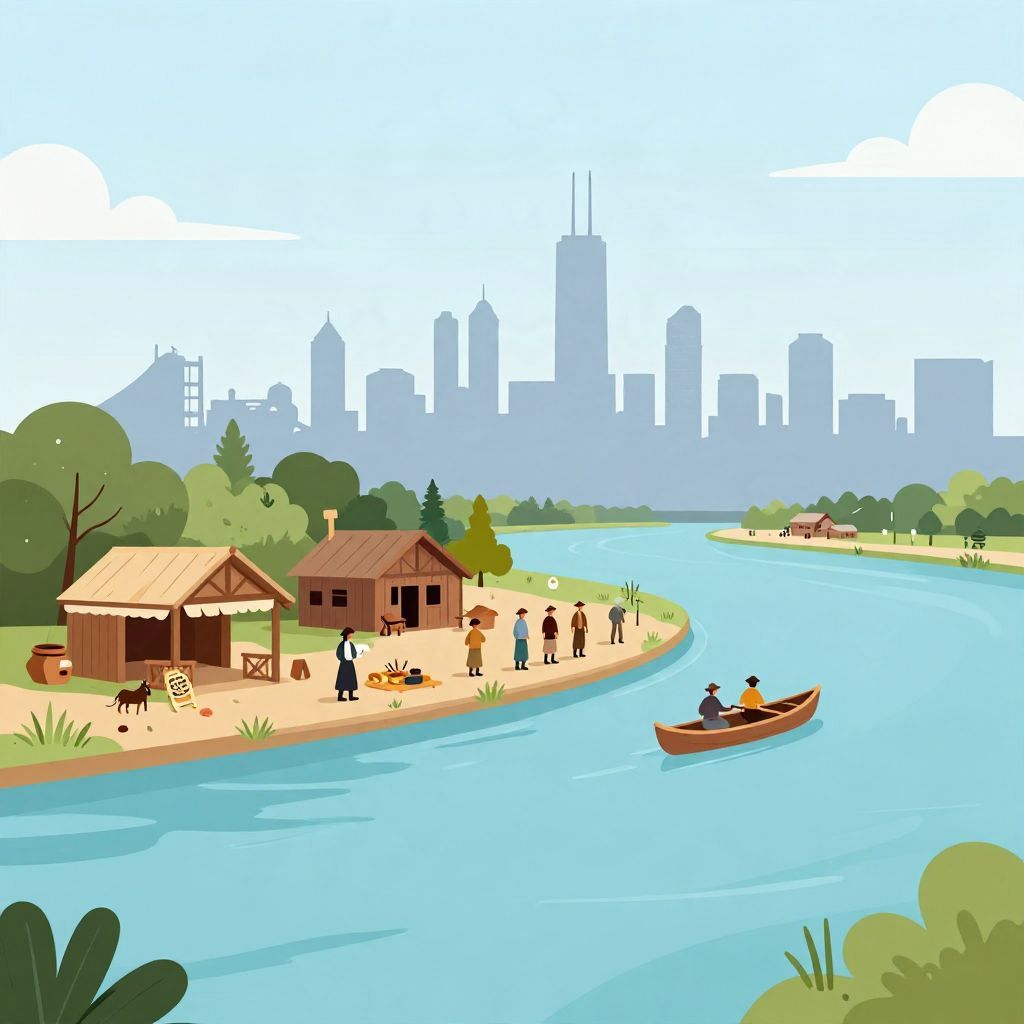
What is Chicago about? At its simplest, Chicago is about place: a city shaped by water, railroads, immigration, industry, and reinvention. It began as a strategic settlement near a short portage between the Great Lakes and the Mississippi River system, then grew into one of the most important urban centers in the United States.
Its history is also about resilience. Chicago has been rebuilt after fire, transformed by waves of newcomers, and repeatedly redefined by architecture, labor, commerce, and culture. The city’s meaning comes from how those forces combined over time.
What Is Chicago About?
Chicago is about the rise of a modern American city at the crossroads of transportation, trade, and migration. Founded in the early 19th century and incorporated in 1837, it became a national hub for railroads, meatpacking, finance, and culture. Its story is one of rapid growth, disaster, rebuilding, and lasting influence.
Where Chicago Began
Chicago’s origins lie in geography. Long before it was a city, the area around the Chicago River mattered because it linked the Great Lakes basin to the Illinois and Mississippi river systems through a relatively short overland portage. That made the site valuable to Native peoples, fur traders, soldiers, and later American settlers.
Native presence and early contact
Before European-American settlement, the region was home to Indigenous peoples, including the Potawatomi, Miami, and others connected to the broader Great Lakes world. The name “Chicago” is generally understood to come from an Algonquian word referring to wild leeks or onions growing in the marshy area, though spelling and exact language forms varied. This is a linguistic origin, not a single fixed legend.
French explorers and traders reached the area in the 17th century. By the late 18th and early 19th centuries, the site had become strategically important to the expanding United States, especially after the region came under American control following the Northwest Indian War and later treaties.
From outpost to town
A key early figure was Jean Baptiste Point du Sable, a fur trader of African and French descent who established a trading post near the mouth of the Chicago River in the late 18th century, often dated to the 1770s or 1780s. He is widely recognized as Chicago’s earliest non-Indigenous permanent resident, though the exact details of his settlement remain partly uncertain because the documentary record is limited.
The U.S. government built Fort Dearborn in 1803 to secure the area. The fort became a focal point of conflict during the War of 1812, and its evacuation ended in the Fort Dearborn Massacre of 1812, a tragic event in which departing soldiers and civilians were attacked. The fort was later rebuilt, and a settlement slowly developed around it.
Why Chicago Grew So Fast
Chicago’s explosive growth was not accidental. It was driven by transportation geography, especially the connection between the Great Lakes and the interior of North America. The city became a hinge between eastern markets, western farmland, and the expanding railroad network of the 19th century.
The canal and the railroads
The completion of the Illinois and Michigan Canal in 1848 was a turning point. It linked the Great Lakes to the Illinois River, making Chicago a crucial transfer point for goods moving between the East Coast, the Midwest, and beyond. Soon afterward, railroads multiplied and made Chicago an even more powerful transportation center.
By the mid-19th century, Chicago was no longer just a frontier town. It was becoming a city of warehouses, stockyards, grain elevators, and wholesale markets. The city’s location allowed it to gather agricultural products from the Midwest and distribute manufactured goods in return. That exchange helped define Chicago’s identity as a commercial engine of the United States.
Immigration and urban expansion
Chicago’s population expanded rapidly because of immigration and migration. Irish, German, Scandinavian, Polish, Italian, Jewish, Czech, and many other communities arrived in the 19th and early 20th centuries. Later, African American migrants from the South arrived in large numbers during the Great Migration, especially in the early 20th century, reshaping the city’s neighborhoods, politics, music, and social life.
This diversity was not just demographic; it was structural. Chicago grew through ethnic neighborhoods, labor networks, churches, mutual aid societies, and political organizations. Like many industrial cities, it offered opportunity and hardship at the same time: jobs, but also overcrowding, segregation, exploitation, and periodic violence.
The Great Fire and Rebuilding
One of the most famous episodes in Chicago history is the Great Chicago Fire of 1871. The fire destroyed a large portion of the city, killed many people, and left tens of thousands homeless. Its exact causes became the subject of legend, especially the story of Mrs. O’Leary’s cow, but that tale is not reliable history; it is a popular myth that became attached to the disaster.
The fire matters because of what followed. Chicago rebuilt quickly and ambitiously. In the decades after 1871, the city became a laboratory for modern architecture and urban planning. Engineers and architects experimented with steel-frame construction, elevators, and taller commercial buildings. This helped give Chicago a central place in the history of the skyscraper.
Architecture as identity
Chicago’s rebuilt downtown became a symbol of modernity. The city’s architecture was not merely decorative; it reflected economic power, technological change, and confidence after catastrophe. The Chicago School of architecture, associated with figures such as Louis Sullivan, helped shape the look of the modern American city. Later, architects such as Frank Lloyd Wright drew on Chicago’s urban environment while also reacting against it.
Chicago’s skyline came to represent more than height. It represented a belief that a city could reinvent itself after destruction and still become stronger. That idea remains central to how Chicago is remembered.
Industry, Labor, and Power
Chicago was also about industry on a massive scale. The city became famous for meatpacking, grain trading, manufacturing, and rail commerce. The Union Stock Yards, opened in 1865, turned Chicago into a national center for livestock processing. Grain elevators and futures markets linked the city to global commodity systems.
Labor conflict and reform
Industrial growth brought harsh working conditions and labor unrest. Chicago played a major role in the history of American labor movements. The Haymarket affair of 1886, sparked by a labor protest and a bomb explosion, became a defining event in the struggle over workers’ rights, policing, and political radicalism. It also helped shape May Day traditions around the world, though those traditions developed in complex ways beyond Chicago itself.
The city’s labor history continued into the 20th century through union organizing, strikes, and reform movements. Chicago’s industrial power created wealth, but it also produced inequality and conflict. That tension is part of what Chicago is about historically: a city where economic dynamism and social struggle developed side by side.
Politics, Neighborhoods, and the Machine City
Chicago’s political history is often associated with machine politics, especially the Democratic organizations that dominated much of the city’s 20th-century governance. Political machines were not unique to Chicago, but the city became one of the best-known examples in the United States. They provided services, jobs, and patronage, while also encouraging corruption and entrenched power.
At the neighborhood level, Chicago’s politics were shaped by ethnicity, class, religion, and race. Communities often organized around local ward structures, parishes, and settlement houses. This gave the city a strong local identity, but it also reinforced divisions. Over time, urban reformers, civil rights activists, and grassroots organizers challenged the old political order.
Race and segregation
Chicago’s history cannot be understood without race. The Great Migration brought hundreds of thousands of Black southerners to the city, especially during World War I and after. They found jobs and new possibilities, but also restrictive housing practices, discrimination, and racial violence. Segregated housing patterns hardened over time, shaping the South Side and other parts of the city.
These patterns had long-lasting consequences for schools, wealth, health, and political power. Chicago became a major center of Black culture, activism, journalism, and music, but also a city deeply marked by inequality. Understanding Chicago means understanding both its opportunities and its exclusions.
Chicago as a Cultural City
Chicago is about more than commerce and politics. It is also about culture. The city helped shape blues, jazz, gospel, soul, house music, theater, literature, and visual art. Migrants carried traditions into the city, and urban life transformed them into new forms.
Music and the arts
In the 20th century, Chicago became a major center for blues, especially as southern Black musicians moved north. The city’s clubs, radio stations, and recording industry helped popularize Chicago blues, which later influenced rock and roll. Jazz flourished as well, and later house music emerged from Chicago’s club culture in the 1980s.
Literature and journalism also found a strong home in Chicago. Writers used the city to explore modern life, labor, race, ambition, and urban realism. The city’s cultural significance lies partly in this: Chicago has often been a place where national trends became visible in concentrated form.
What Chicago Means Today
Historically, Chicago means the making of a great inland metropolis out of a marshy, strategic crossing point. It stands for transportation networks, industrial capitalism, immigrant communities, racial change, political power, and architectural innovation. It also stands for survival after crisis.
Chicago’s story is not a simple success narrative. It includes displacement of Native peoples, labor exploitation, segregation, corruption, and urban inequality. Yet it also includes creativity, civic ambition, and repeated reinvention. That combination is what gives Chicago its historical importance.
So, what is Chicago about? It is about how a city can grow from geography, be remade by migration and industry, suffer catastrophe, and still become one of the defining urban places in American history. If you want to explore related urban histories, see why Hell’s Kitchen got its name and why Milwaukee is called Cream City.