
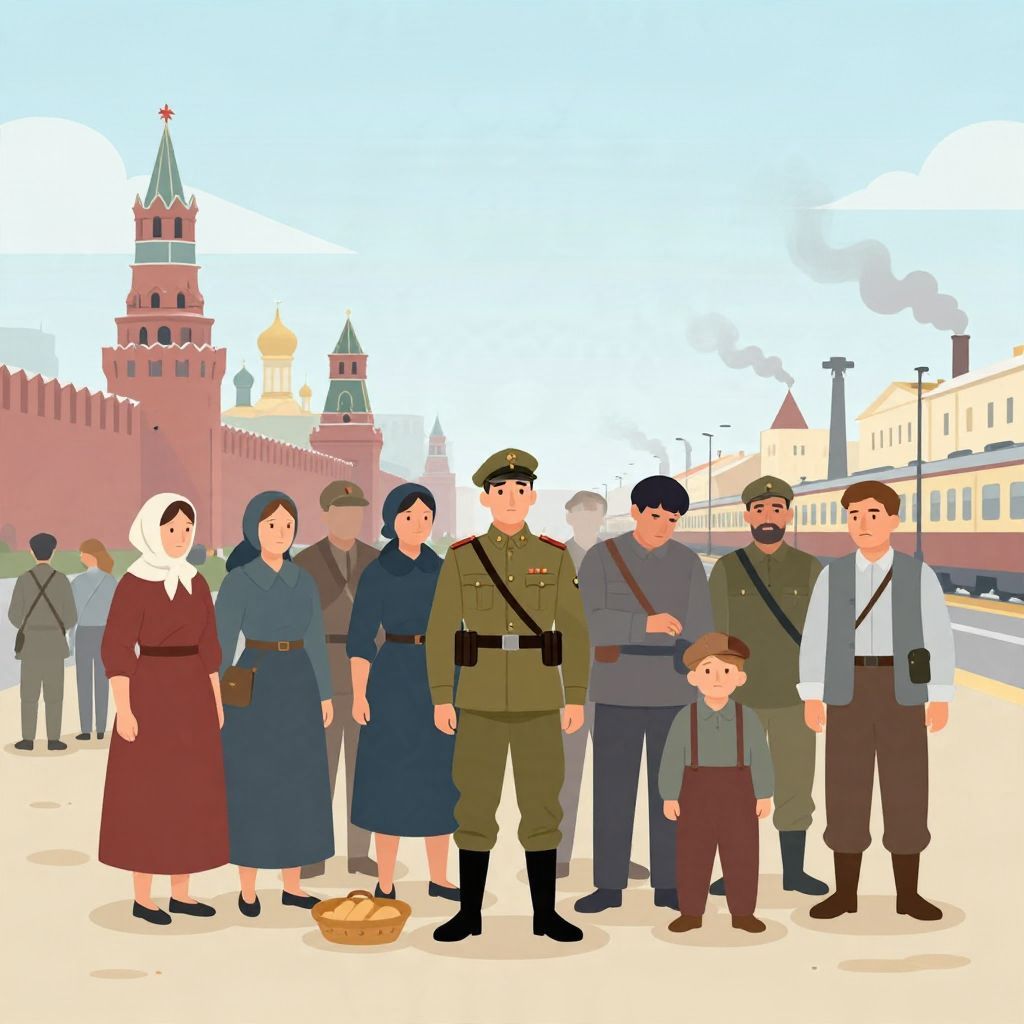
As World War I dragged on, Russian attitudes toward the war changed dramatically. What began in 1914 as a wave of patriotic support and loyalty to the tsar soon gave way to exhaustion, anger, and distrust as casualties mounted, food grew scarce, and the government seemed unable to explain or win the conflict.
By 1917, many Russians no longer saw the war as a noble defense of the nation. Instead, they viewed it as a disaster that deepened poverty, exposed the weaknesses of the old regime, and helped trigger revolution.
As Time Went On, How Did the Russian People View Their Country’s Participation in World War I?
Russian opinion shifted from early patriotic enthusiasm in 1914 to widespread disillusionment by 1916 and open hostility in 1917. At first, many people accepted the war as necessary and even uplifting, but repeated military defeats, massive losses, inflation, hunger, and political incompetence convinced millions that Russia’s participation was ruinous and should end.
The Early War Mood: Patriotism, Fear, and Loyalty
When war began in August 1914, many Russians responded with a burst of patriotic feeling. In the cities, crowds gathered, public ceremonies were held, and some people believed Russia was defending Slavic peoples and national honor. The mood was not uniform, but the opening months produced real support for the war effort among many social groups.
Why support seemed strong at first
Several factors helped create early backing for the war. The government framed the conflict as a defense of Serbia and of Russia’s status as a great power. Nationalist ideas, loyalty to the monarch, and fear of German aggression all played a role. For some educated Russians, war also seemed like a chance to strengthen national unity.
At the same time, early enthusiasm should not be exaggerated. Russia was a vast empire with deep social divisions, and many peasants had limited understanding of international politics. Their support was often passive rather than passionate. Still, in 1914, most Russians had not yet experienced the full human and economic cost of modern industrial warfare.
Why Russian Views Changed So Quickly
The war soon became a grinding catastrophe. Russia suffered severe defeats, including the disastrous Battle of Tannenberg in 1914 and other setbacks in East Prussia and Galicia. The army was large, but it lacked enough rifles, artillery, shells, rail coordination, and trained officers. As losses rose, confidence in the war collapsed.
Military failure and mass casualties
Millions of Russian soldiers were killed, wounded, captured, or missing over the course of the war. Families across the empire felt the loss directly. Soldiers at the front endured poor supplies, weak leadership, and brutal conditions. Many began to believe they were being sacrificed for goals they did not understand.
These battlefield experiences mattered politically. A war that had once been presented as a patriotic duty increasingly looked like a senseless slaughter. The more the government insisted on victory, the less convincing it sounded to ordinary people who were burying sons, husbands, and brothers.
Economic hardship at home
War also shattered daily life in the rear. Inflation made wages worth less, food shortages spread, transport broke down, and cities struggled to feed workers and families. Women often stood in long bread lines, while industrial workers faced harsh conditions and declining living standards. The war touched nearly every household.
As conditions worsened, many people blamed the tsarist government for incompetence and indifference. The sense that the state could not manage either the front or the home front became central to public anger. Participation in the war was no longer seen as sacrifice for the nation; it was increasingly seen as sacrifice for a failing system.
How Soldiers and Civilians Saw the War by 1916
By 1916, Russian attitudes had hardened. Among soldiers, morale declined sharply. Many wanted peace, land, and survival more than victory. Among civilians, resentment grew as shortages deepened and the government appeared unable to solve basic problems. Support for the war became thin, conditional, and often openly hostile.
The soldier’s viewpoint
Russian soldiers were mostly peasants in uniform, and many were already weary of hardship before the war even began. On the front, they faced long periods of misery, shortages of weapons and boots, and commanders who often seemed detached from their suffering. Letters from home, when they arrived, brought news of hunger and disruption.
For many soldiers, the war lost any clear meaning. They were not simply tired of fighting; they were losing faith that the sacrifices had a purpose. This did not mean all soldiers became revolutionaries, but it does explain why discipline weakened and why many were receptive to antiwar ideas in 1917.
The civilian viewpoint
Civilians experienced the war through prices, queues, rumors, and grief. Workers in Petrograd and Moscow faced shortages and instability. Peasants often saw little reason to support a war that removed labor from farms and brought little visible benefit. The government’s promises rang hollow when bread, fuel, and stability were disappearing.
Public opinion did not turn overnight. Some Russians still hoped for victory or feared German invasion. But by late 1916, the dominant feeling in many places was not patriotic confidence. It was frustration, fatigue, and a growing belief that the war was destroying the country from within.
The Turning Point of 1917: From Discontent to Rejection
The year 1917 transformed Russian opinion from disillusionment into active rejection of the war. The February Revolution overthrew Nicholas II, and many Russians initially hoped that a new government would bring reform while continuing the war more effectively. That hope proved short-lived.
The Provisional Government and the war problem
The Provisional Government chose to keep Russia in the war, partly because it feared losing allies and partly because leaders believed abandoning the front would be disastrous. But this decision was deeply unpopular. Many ordinary Russians wanted peace immediately, not another round of sacrifice for promises of future reform.
This gap between government policy and public feeling widened rapidly. The war had become tied to the old order in the minds of many people. Even when the monarchy fell, the fighting continued, and so did the suffering. That made the war itself a target of anger, not just the tsarist regime.
Soldiers, workers, and peasants in 1917
By 1917, soldiers increasingly deserted, mutinied, or refused orders. Workers in the cities demanded bread and peace. Peasants wanted land and an end to wartime disruption. These were not identical groups, but they shared a common conclusion: Russia’s participation in the war was no longer bearable.
The Bolsheviks were able to exploit this mood with slogans calling for peace. Their appeal was powerful because it matched what many people already felt. The war had become the clearest symbol of state failure, and ending it seemed inseparable from broader social change.
Why the War Became So Unpopular in Russia
Several connected causes explain the change in public opinion. Russian people did not simply “lose faith” in the abstract; they reacted to concrete experiences that made the war feel pointless and destructive.
- Military defeats undermined confidence in victory.
- Huge casualties brought grief into nearly every family.
- Food and fuel shortages made daily survival harder.
- Inflation reduced wages and savings.
- Poor leadership made the government look incapable.
- Political repression deepened mistrust of authority.
These pressures reinforced one another. A military setback was not just a battlefield event; it worsened shortages, increased fear, and damaged faith in the state. Over time, the war ceased to be one issue among many and became the central reason people believed Russia was falling apart.
Historical Impact: The War, Revolution, and Russia’s Exit
Russian rejection of the war had enormous consequences. The collapse of public support helped bring down the Romanov dynasty, weakened the Provisional Government, and created the conditions for the Bolshevik seizure of power in October 1917. Once in power, the Bolsheviks moved quickly to end Russia’s involvement in the conflict.
The peace settlement
Russia signed the Treaty of Brest-Litovsk in March 1918, leaving the war at a heavy territorial cost. This was a dramatic outcome, but it reflected the depth of antiwar feeling that had developed over the previous three years. Many Russians accepted harsh peace terms because they wanted the war to end at almost any price.
The war’s legacy was therefore not limited to military defeat. It reshaped Russian politics, society, and memory. The experience convinced many people that the old imperial system had failed catastrophically. It also showed how modern war could destroy a government’s legitimacy when the population no longer believed sacrifice was meaningful.
So, What Did Most Russians Ultimately Think?
In the end, most Russian people came to see their country’s participation in World War I as a tragic mistake or an unbearable burden. Early patriotic support gave way to anger at the state, sympathy for peace, and deep resentment over the cost in lives and hardship. By 1917, the war had lost legitimacy in the eyes of much of the population.
The Russian experience is a powerful reminder that public opinion in wartime can change quickly when military failure, economic collapse, and political mistrust combine. For readers interested in the broader causes of Russia’s withdrawal, see why Russia left World War I and the wider context of how militarism helped lead to World War I.