
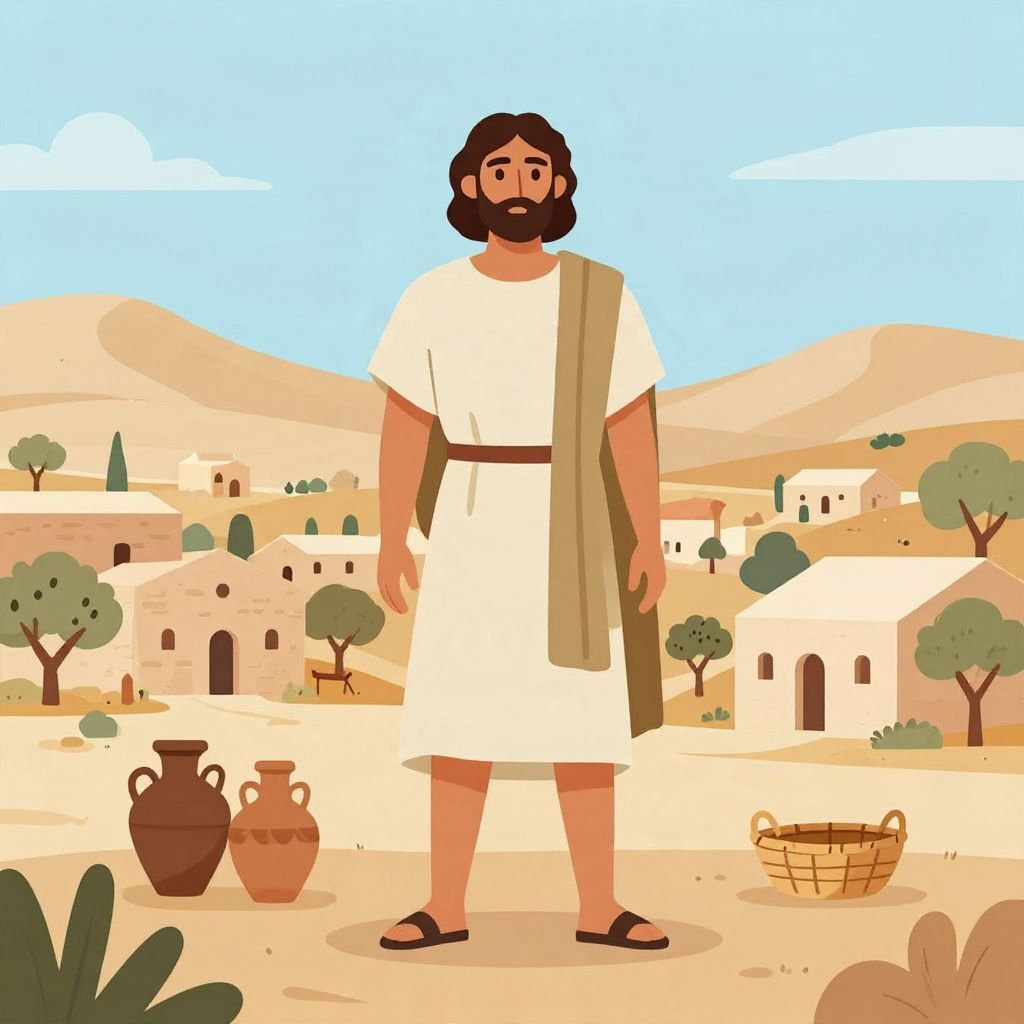
What did Jesus really look like? The honest historical answer is that no one can know his exact face, but historians can say a great deal about how a Jewish man from Roman Judea in the early first century would likely have appeared. That means moving beyond later paintings and icons to the social, geographic, and archaeological context of his world.
Jesus was almost certainly a Middle Eastern Jewish man of his time: likely with dark hair, brown eyes, olive-to-brown skin, and the physical build shaped by manual labor, travel, and outdoor life. The familiar pale, long-haired European image is a much later artistic tradition, not a historical portrait.
What Jesus Really Looked Like Historically
Historically, Jesus would have looked like a first-century Jewish man from Galilee, not like the blond, fair-skinned figure common in Western art. He likely wore simple local clothing, kept a short beard, had dark features, and showed the worn appearance of someone who lived in an agrarian, Roman-occupied society.
What We Can and Cannot Know About Jesus’ Appearance
The limits of the evidence
No contemporary portrait of Jesus survives, and the New Testament does not describe his face in detail. That means any claim about his exact nose, eye shape, height, or hairline is speculative. Historians work instead from what is known about first-century Judean life, Jewish customs, and comparable skeletal and artistic evidence from the region.
The strongest historical clues
The best evidence comes from the world Jesus inhabited: Galilee and Judea under Roman rule. People there were Semitic-speaking Jews, living in a Mediterranean and Near Eastern environment. Their diet, labor, clothing, grooming habits, and climate all help narrow the range of what Jesus likely looked like.
What a First-Century Jewish Man from Galilee Likely Looked Like
Jesus probably had a face and body typical of working-class Jewish men in early Roman Palestine: medium to short stature by modern standards, a lean build, dark hair, and a beard. His skin would likely have been weathered by sun exposure, and his clothing would have been plain and practical rather than ornate.
Skin tone and facial features
Jesus almost certainly did not have the very light skin often shown in European religious art. As a native of the eastern Mediterranean, he would likely have had brown or olive-toned skin. His facial features would have reflected the population of ancient Judea, though we cannot reconstruct them precisely without a body or portrait.
Hair and beard
Most scholars think Jesus would have worn his hair and beard in the style common to Jewish men of his era. A beard was normal and culturally expected. His hair was likely dark, probably black or dark brown, and not the long flowing hairstyle popularized in later Christian imagery. The long-haired Jesus became standard in art centuries later, especially in Byzantine and medieval traditions.
Height and build
He was probably shorter than the average modern adult in many countries. Studies of ancient remains suggest that men in the eastern Mediterranean often stood around the low-to-mid 160 cm range, though nutrition and local conditions varied. As a carpenter or builder’s son and an itinerant teacher, Jesus likely had a lean, physically active body rather than a soft or aristocratic one.
The Historical Jesus in His Own World
Galilee and Judea in the early first century
Jesus lived in a rural, economically mixed region shaped by agriculture, fishing, taxation, and Roman political control. Galilee was not isolated, but it was also not the center of imperial wealth. Most people lived simply, and appearance was shaped more by labor and climate than by fashion.
Clothing and footwear
Jesus likely wore a tunic, a cloak, and sandals, which were standard garments in the region. His clothing would have been homespun or modestly made, not luxurious. The Gospels’ references to garments fit the social world of an ordinary Jewish teacher rather than a wealthy elite.
Grooming and social identity
Jewish identity in the Roman period was marked not by a single “look,” but by a combination of language, custom, diet, worship, and daily practice. Jesus would have been recognizable as a Jewish man from Galilee through accent, dress, and manner more than through any dramatic physical feature.
Why the Famous Image of Jesus Looks So Different
Artistic tradition, not eyewitness portraiture
The image many people know today—light skin, long brown hair, blue or light eyes, and a serene European face—developed over centuries of Christian art. Artists often depicted Jesus in the likeness of the people around them, which made him increasingly resemble Europeans in medieval and Renaissance works.
The role of Byzantine and Western art
Early Christian art did not settle on one uniform face for Jesus. Over time, Byzantine icons emphasized solemnity and divinity, while Western European art often gave him local features. By the late medieval and Renaissance periods, the “standard” Jesus in Western culture had become culturally European, even though that did not match his historical setting.
Modern reconstructions
In recent decades, historians and forensic artists have tried to create more plausible reconstructions of Jesus based on first-century Judean skulls, regional anthropology, and historical context. These reconstructions are still educated approximations, not proof, but they usually portray a shorter, darker, more rugged man than traditional Western paintings do.
How Scholars Reconstruct Jesus’ Appearance
Archaeology and anthropology
Archaeological finds from first-century Judea help historians understand average height, diet, and health. Skeletal evidence from the region suggests that many people were relatively short and physically worn by hard labor. This supports the idea that Jesus would not have looked like a refined, aristocratic figure.
Textual clues
The Gospels provide indirect clues. Jesus was not described as visually striking in a way that would set him apart from everyone else. In the Passion narratives, identification often had to be made through context, speech, or betrayal rather than obvious distinctive features. That suggests he could have blended into the crowd.
What cannot be reconstructed
Historians cannot confidently determine Jesus’ exact facial proportions, nose shape, eye color, or hairstyle with certainty. Any image that claims to be “the real Jesus” is really a historically informed interpretation. The most responsible reconstructions emphasize probability, not certainty.
Common Myths About Jesus’ Appearance
Myth: Jesus looked European
This is the most widespread misconception. A Jewish man from Roman Judea would not have had the appearance of a northern European. The Europeanized Jesus emerged from artistic convention, not historical evidence.
Myth: Jesus had very long hair
Long hair is possible, but not the most likely historical choice. In the ancient Mediterranean world, adult men often wore hair at a practical length. The long-haired image became popular in later Christian art and devotional culture.
Myth: Jesus was physically unlike other Jews of his time
Nothing in the historical record suggests that Jesus had a radically unusual appearance. He was likely typical of his social and regional background. His significance in history came from his teachings, movement, and later religious impact, not from a visibly extraordinary body.
Why Jesus’ Appearance Matters Historically
It reveals how history is remembered
How people picture Jesus says as much about later societies as it does about the first century. Different eras reshaped him to match local ideals of holiness, ethnicity, power, and beauty. Studying those images helps historians understand how religious memory evolves.
It helps separate history from devotion
For believers and nonbelievers alike, distinguishing the historical Jesus from artistic tradition is important. Devotional art can be meaningful without being literal. Historical inquiry asks a different question: what would a man from Jesus’ time and place most likely have looked like?
It connects Jesus to his Jewish and Near Eastern context
Recognizing Jesus as a Jewish man of ancient Judea places him firmly in his own world. That context matters because it clarifies his language, customs, conflicts, and audience. His appearance was part of that setting, not separate from it.
So, What Did Jesus Really Look Like?
The most historically accurate answer is that Jesus likely looked like an ordinary first-century Jewish man from Galilee: dark-haired, bearded, brown- or olive-skinned, modestly dressed, and physically shaped by a life in a rural Roman province. We cannot know his exact face, but we can say with confidence that the familiar Western image is not historically reliable.
In the end, the real historical Jesus is best understood through context rather than fantasy. If you want to explore more about the chronology of his life, see how old Jesus was when he was crucified and how old Mary was when Jesus was born.