
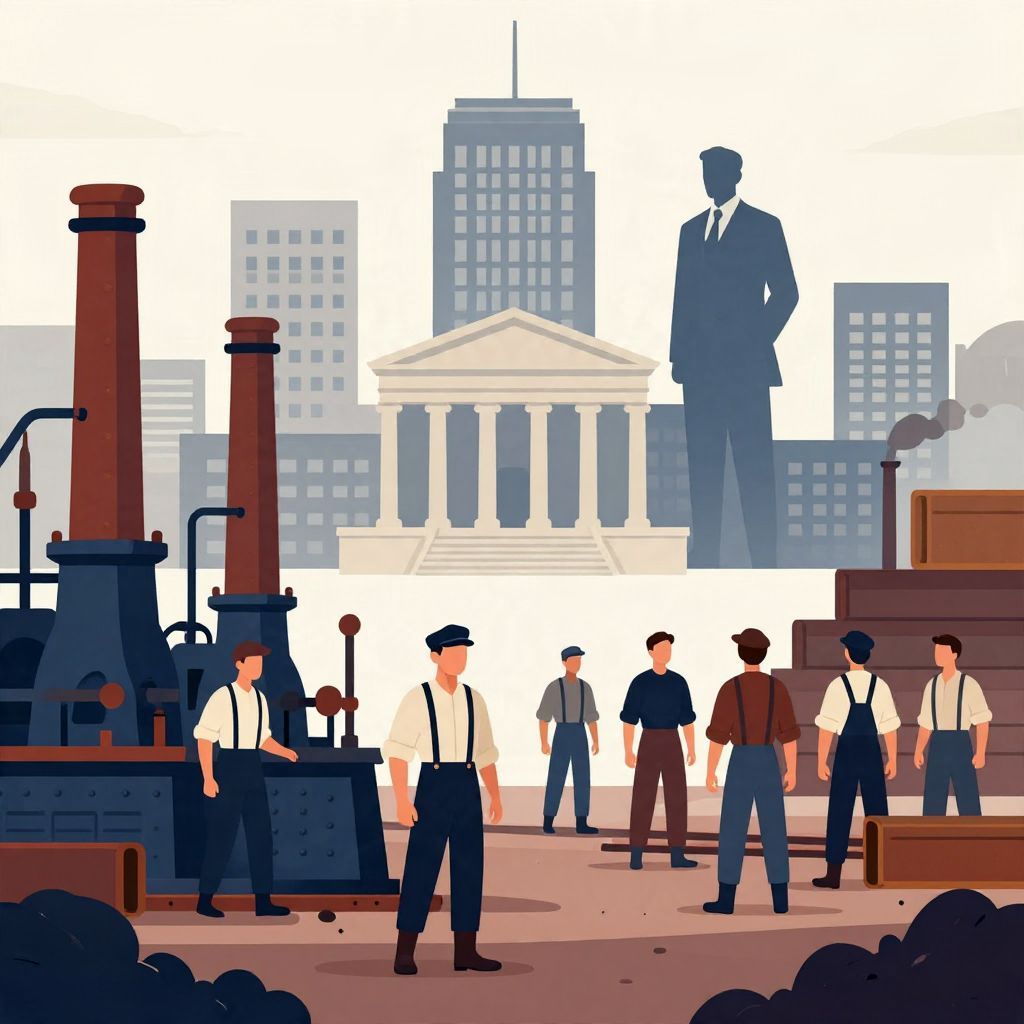
How did J.P. Morgan treat his workers? The short answer is that he was not known as a hands-on employer who shaped daily factory life himself, but the companies he controlled often reflected the hard realities of late-19th- and early-20th-century industrial capitalism: long hours, strict discipline, low bargaining power, and little concern for worker comfort or safety by modern standards.
At the same time, Morgan was a financier, not a mill owner in the ordinary sense. His influence came through banking, corporate consolidation, and control over major firms such as U.S. Steel, where labor relations were usually managed by industrial executives rather than by Morgan personally.
How Did J.P. Morgan Treat His Workers?
J.P. Morgan generally treated workers as part of a business system to be managed for efficiency, profit, and stability rather than as partners in the modern sense. He was associated with a corporate culture that favored order, hierarchy, and cost control. That often meant low sympathy for labor demands, even if he was less publicly combative than some industrialists.
Morgan’s role was indirect, but powerful
Morgan did not run most workplaces day to day. He was a banker and dealmaker who helped finance railroads, steel, and other large enterprises. His influence came from ownership stakes, boardroom power, and the ability to reorganize companies. Because of that, the treatment of workers in Morgan-linked firms usually depended on managers and industrial leaders under his financial umbrella.
Still, Morgan’s approach to business shaped labor conditions. He believed in large-scale consolidation, centralized control, and stable profits. In practice, that often strengthened management over labor. Workers in the firms he backed were expected to accept the rules set by executives, and unions were frequently viewed as obstacles to efficiency.
What workers experienced in Morgan-era industry
In the industries Morgan helped finance, many workers faced the standard conditions of the Gilded Age and Progressive Era: long shifts, dangerous machinery, limited job security, and weak legal protections. Industrial accidents were common, and wages were often kept under pressure by competition and management demands. These were not unique to Morgan’s companies, but they were part of the environment his corporate system reinforced.
In steel especially, labor relations were harsh. The drive for productivity often meant intense work pace and resistance to unionization. Workers could be disciplined, replaced, or locked out if they challenged management. The broader system rewarded financial control and punished labor militancy.
Why Morgan’s Business Style Mattered to Workers
Morgan’s treatment of workers cannot be understood apart from the way he thought about business. He believed that large, well-organized corporations could bring order to chaotic markets. That philosophy helped create giant firms, but it also concentrated power in the hands of executives and financiers, leaving workers with little leverage.
Consolidation favored management over labor
Morgan was famous for “reorganizing” industries. He helped merge competing firms, reduce duplication, and stabilize prices. From a financial perspective, this could make companies stronger. For workers, however, consolidation often meant fewer opportunities to bargain with employers, because a larger corporation could coordinate labor policy across many plants or rail lines.
This mattered because labor disputes were no longer just local conflicts. In a consolidated company, a strike at one site could be met with broader corporate resistance. The result was a more powerful employer and a weaker workforce.
He valued stability more than labor rights
Morgan’s priority was usually financial stability, not social reform. He wanted companies to remain profitable and predictable. When labor unrest threatened production or investor confidence, the likely response was to restore order, not to redesign the workplace around workers’ needs. That does not mean he personally orchestrated every anti-union action, but his system rewarded that outcome.
In the late 1800s and early 1900s, many business leaders saw unions as disruptive. Morgan was part of that world. Even when he preferred negotiation over public spectacle, his side of the class divide was clear: capital should govern business.
Key Events That Reveal Morgan’s Labor Legacy
Several major episodes help explain how Morgan’s corporate power affected workers. These events show not only his personal influence, but also the labor climate of the era in which he operated.
The Homestead Strike and the steel world Morgan later helped shape
The Homestead Strike of 1892 took place before Morgan’s direct control over U.S. Steel, but it is important background. At Carnegie Steel’s Homestead plant in Pennsylvania, workers fought wage cuts and union-busting. The conflict turned violent and became one of the most famous labor battles in American history.
Morgan was not the central figure in that strike, but the episode illustrates the industrial culture that later fed into Morgan-financed steel consolidation. The lesson many employers drew was that labor needed to be contained. That mindset carried into the giant corporate structures Morgan helped build.
The creation of U.S. Steel in 1901
In 1901, Morgan helped create U.S. Steel, the first billion-dollar corporation in American history. This was a landmark in industrial finance. It also marked a new level of corporate concentration, with enormous implications for workers.
U.S. Steel was designed to bring order to a volatile industry. But large-scale corporate coordination often meant disciplined labor policy, resistance to unionization, and a strong preference for managerial control. Morgan himself was not a shop-floor overseer, yet the company’s structure reflected his belief in centralized authority.
Labor conflict in the steel industry continued
Steelworkers continued to face difficult conditions after Morgan’s consolidation. One of the most significant later struggles was the Great Steel Strike of 1919, after Morgan’s peak years but within the corporate system he helped create. Workers demanded better wages, shorter hours, and recognition of unions. The strike failed, showing how entrenched corporate resistance to labor had become.
That defeat was not caused by Morgan alone, but it revealed the legacy of the business world he helped establish: huge firms, strong management, and weak worker power.
Was J.P. Morgan Cruel to Workers?
Calling Morgan personally “cruel” can oversimplify the record. He was not known for personally confronting workers in the way some industrialists did, and he did not leave behind a reputation as a factory boss who micromanaged labor. But from a historical perspective, his system was unsympathetic to workers and often damaging to their interests.
He was not a reformer of labor conditions
Morgan did not make worker welfare a central priority. He did not become known for shorter hours, higher wages, or union rights. If a company under his influence improved conditions, that was usually because of broader reform pressures, public criticism, or internal business decisions, not because Morgan championed labor rights as a principle.
That said, it is important to distinguish between personal behavior and structural power. Morgan’s greatest impact was structural. He helped create businesses whose scale made it easier for management to dominate labor.
He was more concerned with order than justice
In the industrial age, many elites believed strikes threatened civilization itself. Morgan shared the assumption that business stability mattered more than labor activism. He was willing to use finance and reorganization to solve industrial problems, but not to empower workers in a meaningful way. In that sense, his treatment of workers was shaped by class interests rather than personal hostility alone.
How Morgan Compared with Other Industrialists
Morgan is often grouped with “robber barons,” though historians debate that label because it can flatten important differences among businessmen. Compared with some contemporaries, he was less flamboyant and less publicly aggressive. Yet that does not make his labor record benign.
Not a factory owner in the usual sense
Unlike a mill owner who directly supervised labor, Morgan operated through finance. This made his role less visible, but often more far-reaching. His decisions could affect thousands of workers without his ever setting foot on the shop floor. That distance sometimes made his power harder to challenge.
His influence was systemic, not personal
Some industrialists were remembered for direct abuse, strikebreaking, or paternalistic control. Morgan’s legacy is different: he helped build the corporate architecture in which those practices could flourish. Workers did not necessarily encounter him personally, but they lived under the economic order he supported.
What Historians Emphasize Today
Modern historians usually avoid reducing Morgan to a simple villain or hero. They recognize that he helped stabilize finance and organize huge industries, but they also stress that this came at a cost to labor. His world was one in which workers had little legal protection and business leaders held enormous power.
He represented high finance, not labor reform
Morgan’s historical significance lies in the rise of corporate capitalism. He was a central figure in the movement toward giant trusts and financial control. That system brought investment and industrial coordination, but it also concentrated wealth and authority upward. Workers were expected to adapt to the needs of capital.
The labor question exposed the limits of his model
The repeated clashes between workers and big business in the late 19th and early 20th centuries showed that efficiency alone could not solve industrial inequality. Morgan’s model could build powerful companies, but it did not answer the demands of labor for dignity, safety, and fair treatment. That tension helped drive the growth of labor reform, union organizing, and progressive regulation.
Conclusion: The Historical Answer
J.P. Morgan treated his workers indirectly but decisively: he supported a corporate system that prioritized control, efficiency, and profit over worker power. He was not a hands-on factory boss, but the companies he financed and reorganized often operated in ways that left workers with long hours, limited rights, and little leverage. If you are interested in related Gilded Age business power, you may also want to explore the rise of U.S. Steel and the labor conflicts of the Gilded Age.