
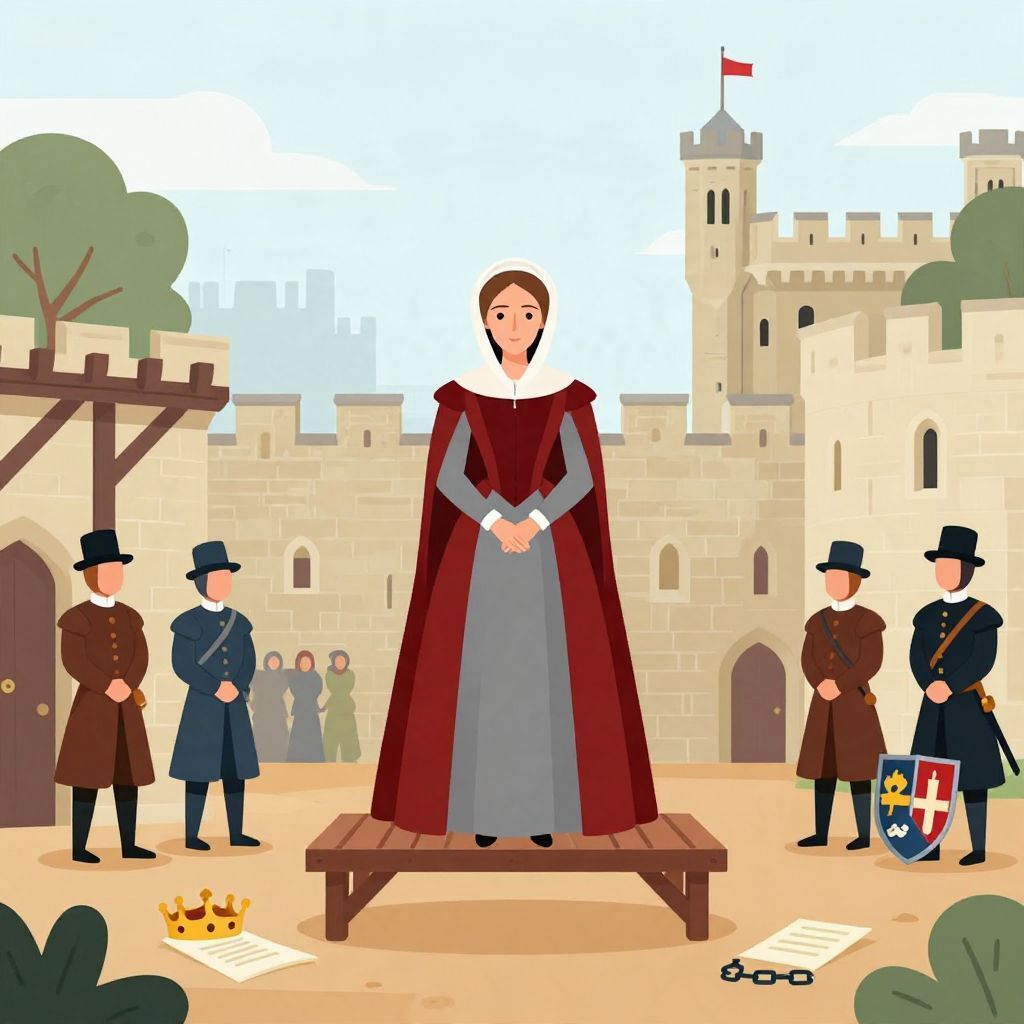
Lady Jane Grey was executed because she was seen as a political threat after the collapse of the Protestant coup that briefly placed her on the English throne in 1553. Although she was young and did not personally drive the scheme, her claim to the crown made her dangerous to Mary I’s new government.
Her death was not simply punishment for a child caught in events beyond her control. It was the result of dynastic conflict, religion, and fears of rebellion in Tudor England. Understanding why she was executed means tracing how she became queen, why Mary I treated her as a rival, and why mercy gave way to state security.
Why Was Lady Jane Grey Executed?
Lady Jane Grey was executed because Mary I’s government regarded her as a legitimate claimant to the English throne and a possible focus for rebellion. After Jane’s nine-day reign collapsed in July 1553, the authorities initially spared her, but the Wyatt’s Rebellion of 1554 convinced Mary that Jane could become a rallying point for Protestant opponents. Her execution was therefore a political decision rooted in dynastic insecurity, not a simple criminal sentence.
How Lady Jane Grey Became a Threat
The succession crisis after Edward VI
Lady Jane Grey entered the center of power because England had no straightforward Protestant heir when Edward VI, Henry VIII’s son, was dying in 1553. Edward was committed to Protestant reform and wanted to prevent his Catholic half-sister Mary from inheriting the throne. Under pressure from powerful advisers, especially John Dudley, Duke of Northumberland, he altered the succession in Jane’s favor.
Jane was Henry VIII’s great-niece through his younger sister Mary Tudor. She was also married to Northumberland’s son, Guildford Dudley, which made her useful to the political faction trying to preserve influence after Edward’s death. Jane herself was highly educated and strongly Protestant, but the evidence suggests she was not the architect of the succession plan.
The nine-day reign and its collapse
When Edward died on 6 July 1553, Jane was proclaimed queen. Yet support for her was fragile. Mary Tudor quickly gathered backing in East Anglia and elsewhere, while many nobles and officials judged that Henry VIII’s will and the broader political reality favored Mary. Within days, Jane’s regime lost control. By 19 July, Mary had been proclaimed queen in London.
Jane was then imprisoned in the Tower of London. Her father, Henry Grey, Duke of Suffolk, had also supported the failed attempt to keep her on the throne. Northumberland was executed in August 1553, but Jane remained alive. At first, Mary appeared willing to show clemency, likely because Jane was young, inexperienced, and not the main instigator.
Why Mary I Changed Her Mind
Political security mattered more than sympathy
Mary I’s decision to execute Jane was shaped by the practical problem of rule. A deposed claimant, even a teenage one, could become a symbol for revolt. In Tudor politics, legitimacy was not only a legal matter but also a matter of public obedience and military support. As long as Jane lived, some opponents of Mary could imagine restoring her in the future.
Mary initially preferred restraint. She understood that punishing Jane too harshly might look vindictive, especially because Jane had been used by others. But the government’s concerns deepened when unrest broke out against Mary’s planned marriage to Philip of Spain. That rebellion, known as Wyatt’s Rebellion, transformed Jane from an imprisoned former queen into a potential political weapon.
Wyatt’s Rebellion and the fear of a Protestant alternative
In early 1554, opponents of Mary’s marriage plan rose in rebellion. Although the rebellion had multiple causes, anti-Spanish feeling and fear of Catholic restoration were central. Rebel leaders and sympathizers could point to Jane as a Protestant alternative to Mary. Even if Jane herself had no role in the uprising, her existence made the crown less secure.
Mary and her advisers concluded that mercy had become too risky. Jane’s father, Henry Grey, became involved in the rebellion and was executed on 23 February 1554. Jane’s husband, Guildford Dudley, was also condemned. Jane’s own fate followed soon after, not because she had committed new crimes, but because the government believed that leaving her alive invited future instability.
The Legal and Political Logic Behind the Execution
Was she executed for treason?
Formally, yes: Jane was condemned for treason. In Tudor law, challenging the monarch’s title or supporting a rival claimant could be treated as treason, even if the person was young or acted under pressure. Jane had accepted the crown and had been proclaimed queen, which made her more than a passive bystander in the eyes of the state.
Still, historians generally emphasize that her execution was less about ordinary criminal guilt than about dynastic politics. The government needed to eliminate a rival claimant and deter future plots. Jane’s high birth made her especially dangerous because she could attract noble support. In a period when rebellion and succession disputes could trigger civil war, that mattered enormously.
Religion also shaped the decision
Jane’s Protestant faith added another layer to the crisis. Mary was Catholic and intended to restore Catholic worship in England. Jane, by contrast, was associated with the Protestant reform movement. This did not mean she was executed solely for religion, but it did mean that her continued existence could inspire religious opposition to Mary’s rule.
The Tudor state was not yet a modern bureaucracy with stable succession rules. Religion, dynasty, and personal loyalty were tightly intertwined. A Protestant claimant to the throne could become the center of both political and confessional resistance. That combination made Jane unusually threatening despite her youth.
What Happened to Lady Jane Grey Before Her Death?
Imprisonment in the Tower of London
Jane spent her final months in the Tower, where she was held with her husband. Contemporary accounts suggest she continued to reflect on scripture and her faith. Popular retellings sometimes romanticize her as a pure martyr, but the historical record is more cautious. She was certainly pious and well educated, yet she was also a political prisoner in a highly charged succession crisis.
Mary delayed the execution for months. That delay matters because it shows the government did not immediately want Jane dead. The decision hardened only after the rebellion made her too dangerous to keep alive. In that sense, her execution was a response to changing political circumstances rather than a preplanned act of vengeance.
The execution in February 1554
Lady Jane Grey was executed on 12 February 1554, at the Tower of London, aged about 16 or 17. Her husband Guildford Dudley was executed the same day, though separately. Jane reportedly faced death with composure. Later Protestant tradition turned her into a martyr, but the surviving evidence should be handled carefully, since many later accounts were shaped by religious propaganda.
Her father had already been executed, and her mother, Frances Brandon, survived. Mary’s government thus removed the Grey family as a political threat. The execution was meant to close the chapter on the failed coup and reinforce Mary’s authority.
Historical Interpretation: Was Jane a Victim or a Rebel?
Why historians see her as both involved and manipulated
Modern historians usually avoid reducing Jane to either a scheming usurper or a helpless victim. She did accept the crown, which gave the coup a legal and symbolic basis. But she was also very young, under intense family pressure, and placed in a situation shaped by powerful men around her. Her personal agency was real, but limited.
That balance helps explain why her story remains compelling. Jane was not executed because she ruled badly; she was executed because her very existence threatened the settlement Mary I was trying to build. Her death reflects the brutal logic of Tudor succession politics, where bloodline and belief could be fatal.
Why her execution still matters
Lady Jane Grey’s execution reveals how unstable the Tudor succession remained even after Henry VIII’s reign. It also shows how quickly a political compromise could turn into a death sentence when the government feared rebellion. Her case is one of the clearest examples of the dangers faced by royal claimants in 16th-century England.
Her story also shaped later memory. Protestant writers often portrayed her as an innocent martyr, while Catholic and royalist accounts emphasized her role in a treasonous coup. The truth lies between those poles: she was a young noblewoman caught in a struggle over who had the right to rule England.
Conclusion
Lady Jane Grey was executed because Mary I’s government believed she remained a dangerous rival claimant whose survival could encourage rebellion, especially after Wyatt’s Rebellion. Her death was the product of dynastic insecurity, religious division, and Tudor fears of civil unrest. For related context, see why Anne Boleyn was executed and what a lady in waiting was in Tudor England.