
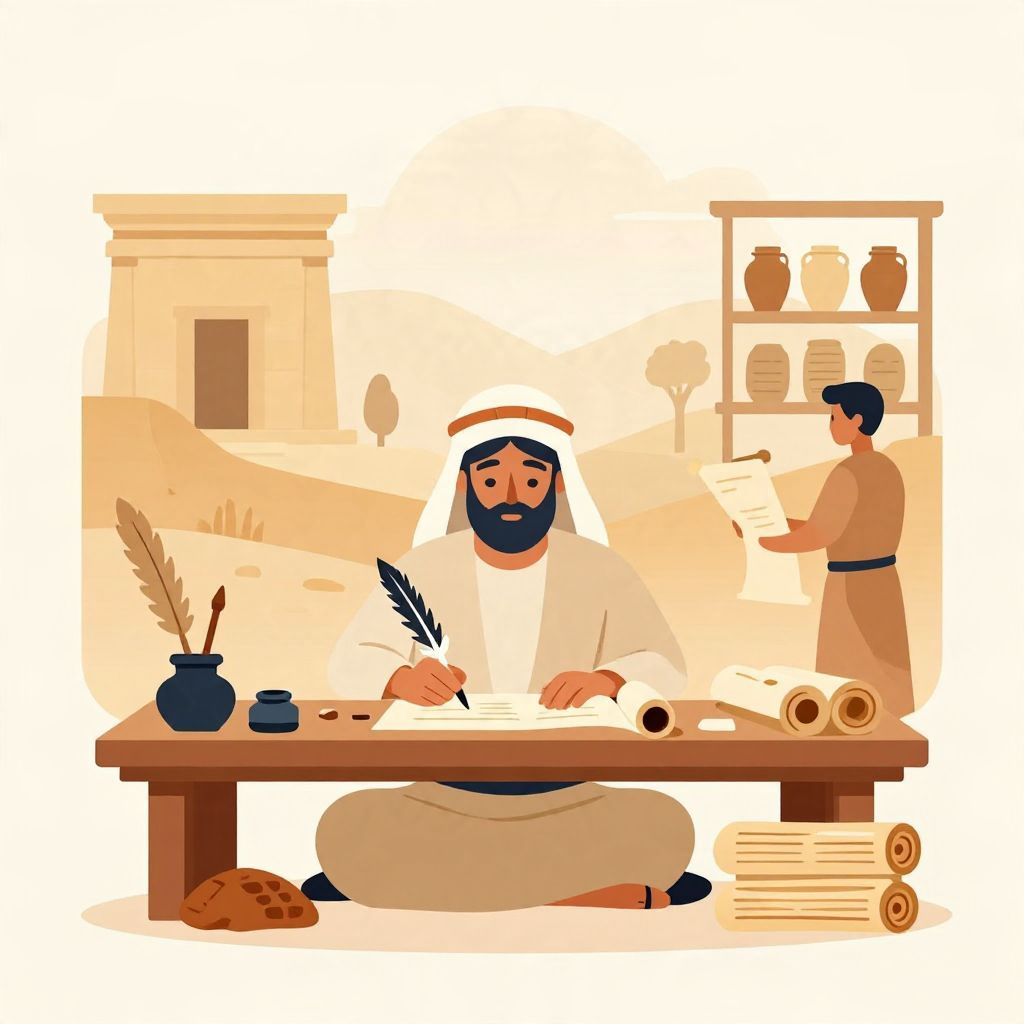
How was the Bible written? The short answer is that it was not written at one moment by one author. It emerged over many centuries, beginning as oral traditions and separate texts in ancient Israel and Judah, then expanding through editing, translation, and collection into a sacred library used by Jewish and Christian communities.
Its formation reflects long historical change: monarchy, exile, diaspora, and the spread of new religious communities. Understanding how the Bible was written means tracing both the composition of its books and the later process by which those books were selected, copied, and preserved.
How Was the Bible Written?
The Bible was written over roughly a thousand years, in Hebrew, Aramaic, and Greek, by many different writers, editors, and scribes. Its books began as laws, poems, prophecies, letters, and narratives. These texts were copied, revised, and gathered over time into the Hebrew Bible and, later, the Christian Old and New Testaments.
From Oral Tradition to Written Text
Before many biblical books existed in written form, stories and teachings were passed down orally. Ancient societies commonly preserved law, genealogy, ritual, and national memory by speaking, reciting, and memorizing them. In Israel and Judah, these traditions likely circulated for generations before being written down in fuller form.
Why oral tradition mattered
Oral transmission was not simply a temporary stage before writing; it was a major part of how ancient knowledge survived. Priests, scribes, and teachers could preserve songs, legal sayings, and stories about ancestors, kings, and divine action. Writing later fixed some of these traditions in more stable form, but oral performance continued alongside texts.
The rise of scribal culture
Writing became more important as ancient kingdoms developed administration, taxation, diplomacy, and temple institutions. Scribes were trained specialists who copied records and composed documents. In the biblical world, they helped preserve royal annals, legal collections, and religious instructions. Their work made it possible for traditions to be compiled into larger books.
The Hebrew Bible: A Long Process of Composition
The Hebrew Bible, also called the Tanakh in Jewish tradition, did not appear all at once. Its books were composed, revised, and arranged over many centuries, from the monarchic period through the Persian and Hellenistic eras. Scholars generally see it as a library of texts rather than a single authored book.
Early foundations: law, story, and memory
Some of the oldest biblical material may preserve very early traditions, though exact dating is often debated. Legal collections, poems, and court stories likely circulated before being incorporated into larger works. The Pentateuch, or first five books, contains material shaped by multiple hands and traditions, including priestly and non-priestly strands.
Exile and the need to preserve identity
A major turning point came with the Babylonian conquest of Judah in the 6th century BCE and the destruction of Jerusalem in 586 BCE. Exile forced elites, priests, and scribes to rethink national identity without a temple or king. In this period and after, older traditions were gathered, interpreted, and written in ways that emphasized covenant, law, and memory.
Persian-period editing and collection
After the Persian Empire allowed some Judeans to return and rebuild, biblical writing continued. Many scholars place important stages of editing and compilation in the Persian period, roughly the 5th to 4th centuries BCE. Texts were organized, expanded, and linked together, producing more coherent narrative and legal frameworks.
Prophets, Psalms, and wisdom literature
Not all biblical books were written in the same way. Prophetic books often preserve the words of historical prophets, but they were also shaped by later followers who arranged and interpreted those words. Psalms reflect worship in temple and community settings. Proverbs, Job, Ecclesiastes, and related writings belong to wisdom traditions that explored ethics, suffering, and the meaning of life.
How the New Testament Was Written
The New Testament was written much later, in the 1st century CE, within the early Christian movement. Its books were composed in Greek and reflect communities spread across the eastern Roman Empire. Like the Hebrew Bible, it was not written by one person at one time, but by several authors responding to specific needs.
Jesus traditions before the Gospels
The earliest Christians preserved sayings, stories, and teachings about Jesus orally. These traditions circulated in preaching, worship, and instruction before being written down. The Gospels later drew on this material, along with earlier written sources and the authors’ own theological aims.
The letters of Paul
Some of the earliest New Testament writings are the letters of Paul, written roughly in the 50s CE. These letters addressed disputes, worship, ethics, and community organization in young Christian congregations. They are valuable historical evidence because they show Christianity in an early stage, before the Gospels were completed in their final forms.
The Gospels and Acts
Most scholars date the Gospels of Mark, Matthew, Luke, and John between about 70 and 100 CE, though exact dates are uncertain. Mark is often considered the earliest. Matthew and Luke appear to use Mark and other traditions, while John reflects a distinct theological perspective. Acts continues the story of the early church and is usually linked with Luke.
Other New Testament books
Letters such as James, Peter, John, and Jude, along with Revelation, were written in different settings and for different purposes. Some were accepted widely early on; others took longer to gain broad recognition. The New Testament therefore represents a collection of writings from multiple communities, not a single unified draft.
Key Stages in the Bible’s Formation
The Bible’s written form developed through several broad stages rather than one decisive event. These stages help explain why the Bible contains different genres, voices, and historical layers.
- Oral tradition: Stories, laws, prayers, and teachings were preserved by memory and recitation.
- Early writing: Individual laws, poems, records, and sayings were written down by scribes.
- Compilation: Smaller texts were gathered into larger works such as the Torah, prophetic collections, and Gospel traditions.
- Editing and revision: Later writers adapted older material to new historical circumstances.
- Canonization: Religious communities gradually recognized certain books as authoritative.
- Copying and translation: Texts were preserved through manuscripts and rendered into other languages.
What Caused the Bible to Be Written?
Several historical forces pushed biblical writing forward. Political crisis, religious reform, exile, and the need to preserve identity all encouraged communities to record their traditions. Writing helped people remember their past, define their laws, and explain suffering or hope in changing circumstances.
Political upheaval
The fall of kingdoms often leads societies to preserve what they fear may be lost. The destruction of the northern kingdom of Israel in 722 BCE and Judah in 586 BCE likely intensified efforts to collect traditions and explain national disaster. Biblical texts often interpret history through covenant and faithfulness, showing how communities made sense of catastrophe.
Religious reform and centralization
Some biblical material reflects efforts to centralize worship in Jerusalem and distinguish proper worship from local practices. These reforms may be associated with kings such as Hezekiah and Josiah, though the historical details are debated. Whatever the exact sequence, religious reform encouraged the recording of law and tradition.
Community identity in exile and diaspora
When people live outside their homeland, written texts become especially important. They can preserve language, ritual, and collective memory across distance. For Jews in exile and later diaspora communities, scripture helped maintain identity. For Christians spread across the Roman Empire, letters and Gospels unified belief and practice.
Who Actually Wrote the Bible?
There is no single answer to who wrote the Bible. Some books are attributed to named figures in tradition, but modern scholarship usually sees multiple authors and editors behind the final text. In many cases, the traditional attribution reflects religious memory rather than provable historical authorship.
Traditional authorship and historical scholarship
Jewish and Christian traditions often connect biblical books to Moses, David, Solomon, Isaiah, Matthew, John, or Paul. These attributions mattered for authority and interpretation. Historians, however, examine language, style, historical references, and manuscript evidence, and they often conclude that many books were shaped by communities over time rather than written by one identifiable person.
The role of editors
Editors were crucial. They selected material, arranged chapters or sections, inserted explanations, and linked older texts to newer concerns. This means the Bible is best understood as a layered work. Earlier sources remained visible, but later hands gave them new context and meaning.
How the Bible Was Preserved and Standardized
Writing a text was only the beginning. To survive, biblical books had to be copied accurately by hand for centuries. This process created variations, but it also preserved the text through careful scribal traditions. Different communities sometimes used slightly different versions, especially before standardization.
Manuscripts and textual variation
Ancient biblical manuscripts do not all match exactly. Copyists occasionally made mistakes, harmonized passages, or updated wording. The discovery of the Dead Sea Scrolls in the 20th century showed that multiple textual forms circulated in antiquity. This evidence confirms that the Bible’s written history was dynamic, not fixed from the start.
Translation into other languages
As Judaism and Christianity spread, the Bible was translated. The Septuagint, a Greek translation of Jewish scriptures, became influential in the Hellenistic world. Later, Latin, Syriac, Coptic, and other translations extended biblical reach. Translation was not just a technical task; it shaped how communities understood scripture.
When Did the Bible Become the Bible?
The Bible became “the Bible” gradually, as communities recognized certain books as sacred and authoritative. For Judaism, the process of canon formation likely developed over centuries and was not finalized in a single council or year. For Christianity, the New Testament canon also emerged slowly, with broad agreement forming over time.
Canon was a process, not an event
People sometimes imagine a single meeting where leaders chose the Bible, but history is more complicated. Communities used texts before they were formally listed, and different groups accepted slightly different collections for a time. Canonization was the result of long usage, debate, and religious authority.
Why the Bible’s Writing History Matters
Knowing how the Bible was written helps explain why it contains different literary forms, repeated stories, and occasional tensions between passages. It also shows that scripture grew out of real historical experiences: monarchy, exile, empire, mission, and community life. The Bible is both a religious text and a historical archive of many centuries of belief and memory.
In the end, the Bible was written through a long, layered process involving oral tradition, scribes, editors, translators, and communities that preserved and interpreted sacred texts across generations. If you want to go deeper, related topics include what language the Bible was originally written in and where the Bible came from.