
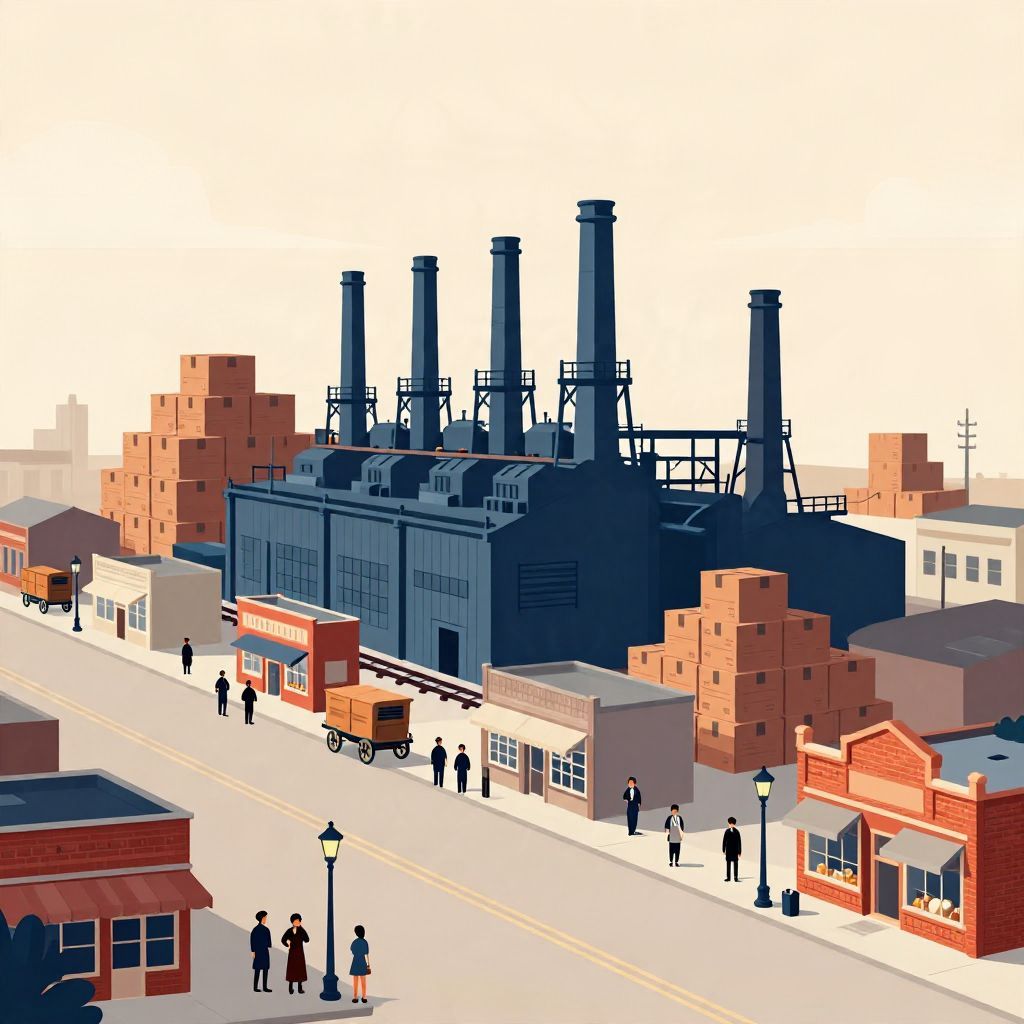
In the Gilded Age, monopolies transformed the American economy by concentrating power in a few giant corporations and making it much harder for many small businesses to survive. Railroads, oil, steel, meatpacking, and other industries increasingly came under the control of trusts and large firms that could set prices, secure favorable shipping rates, and crush local competitors.
For small shopkeepers, independent manufacturers, and family-run firms, this meant squeezed profits, limited access to markets, and in many cases bankruptcy or absorption into larger companies. The result was one of the defining tensions of the era: rapid industrial growth alongside widening inequality and fierce debate over fair competition.
In The Gilded Age, How Did Monopolies Affect Many Small Businesses?
Monopolies and trust-controlled corporations often hurt small businesses by undercutting prices, controlling transportation costs, restricting access to suppliers and markets, and using their size to absorb or eliminate rivals. Many small firms could not match the capital, networks, or political influence of giant enterprises, so they were pushed out, forced to merge, or reduced to dependent local sellers.
Why Monopolies Became So Powerful in the Gilded Age
The Gilded Age, roughly from the 1870s to the early 1900s, was an era of explosive industrial expansion in the United States. Railroads linked distant regions, new technologies increased production, and national markets replaced many local ones. In that environment, large firms gained advantages that smaller competitors could not easily replicate.
Industrial growth favored scale
Mass production lowered costs for companies that could build huge factories, buy in bulk, and operate year-round. A business with deep capital reserves could survive temporary losses in a way a small competitor could not. This made size itself a competitive weapon.
Trusts and combinations reduced competition
By the late 19th century, many industries were dominated by trusts, holding companies, and other forms of corporate consolidation. These arrangements allowed leading firms to coordinate prices, divide markets, or centralize control. The famous examples included Standard Oil under John D. Rockefeller and major railroad combinations that shaped freight rates and access to markets.
Railroads were especially influential
Railroads were not just transportation companies; they were the arteries of the national economy. A large railroad system could favor certain shippers with lower rates while charging more to smaller customers. This practice, often called rate discrimination, gave big firms a major advantage and left small businesses paying more to move goods.
How Monopolies Hurt Small Businesses Day to Day
For many small businesses, the problem was not one single dramatic act but a steady squeeze. Large corporations could lower prices temporarily, control key inputs, and use their market power to make independent firms unprofitable. The effects were felt in stores, workshops, farms, and local manufacturing across the country.
1. They could undercut prices until rivals failed
A large company with access to more capital could sell goods below cost for a time to drive out competitors. Small businesses, with thin margins and limited credit, often could not endure such price wars. Once rivals disappeared, the dominant firm could raise prices again or expand its control further.
2. They controlled access to transportation
Many small producers depended on railroads to ship their products. If a railroad offered better rates to a large customer, a small business might pay much more per mile for the same service. That made it harder to compete even when the small business produced a quality product at a fair local price.
3. They influenced suppliers and wholesalers
Large corporations often bought raw materials in enormous quantities, giving them lower input costs. They could also pressure wholesalers and distributors to deal exclusively with them. Small firms then faced higher costs for the same materials or had to buy through middlemen at less favorable terms.
4. They narrowed market access
As national brands expanded, local businesses found it harder to reach customers beyond their immediate communities. Department stores, chain operations, and large manufacturers increasingly dominated distribution networks. Small firms could remain viable in some towns, but they often lost the chance to grow beyond a local scale.
5. They forced consolidation or closure
Some small businesses were bought out by larger firms. Others closed after years of declining profits. In practice, monopoly power often turned independent owners into employees, subcontractors, or franchise-like dependents rather than equal competitors.
Which Small Businesses Were Most Affected?
The impact of monopolies varied by industry, but certain kinds of businesses were especially vulnerable. Those that depended on shipping, raw materials, or national distribution were at greater risk than businesses serving only a local neighborhood.
- Independent manufacturers: Small factories struggled to buy materials at competitive prices and to sell into markets dominated by large corporations.
- Local merchants and wholesalers: Big firms could bypass them or use chain distribution to reduce their role.
- Farmers and grain sellers: Although not always “small businesses” in the strict sense, many operated as independent producers and suffered from railroad pricing and market concentration.
- Service businesses tied to industry: Repair shops, suppliers, and transport-related firms often depended on the decisions of large industrial customers.
Urban shops were not always destroyed, but they were pressured
Not every small business disappeared. Some survived by serving specialized local needs, offering personal service, or operating in niches large firms ignored. Still, even surviving businesses often had to accept lower profits and less independence than before.
The Role of “Robber Baron” Criticism and Public Debate
People in the Gilded Age did not all agree on how to interpret monopoly power. Supporters of big business argued that large-scale enterprise produced efficiency, lower consumer prices, and technological progress. Critics replied that these gains came at the expense of fair competition and democratic opportunity.
Small business owners often became reformers
Many independent merchants and producers supported anti-monopoly politics because they felt the system was stacked against them. Their complaints helped shape the broader Populist and Progressive movements, which demanded regulation of railroads, antitrust laws, and limits on corporate concentration.
Consumers sometimes benefited, but unevenly
It is true that large firms could sometimes lower the price of finished goods through economies of scale. But the benefits were not evenly shared. If a monopoly crushed local competition, it might later charge higher prices or reduce choices. For many communities, the loss of local businesses mattered as much as any temporary savings.
Key Developments in the Timeline of Monopoly Power
The rise of monopolies did not happen all at once. It developed over several decades as the national economy became more interconnected and corporate organization became more sophisticated.
- 1860s–1870s: Railroad expansion and post-Civil War industrial growth created new opportunities for large-scale business.
- 1870s–1880s: Major firms in oil, steel, railroads, and finance expanded rapidly, often using trusts and aggressive competition.
- 1880s–1890s: Public backlash grew as small businesses, farmers, and consumers complained about unfair rates and corporate power.
- 1890: The Sherman Antitrust Act became the first major federal law aimed at restraining monopolies, though enforcement was initially limited.
- Early 1900s: Progressive reformers pushed stronger regulation and legal action against trusts, marking a shift toward more active government oversight.
Why the Government Response Mattered
By the end of the 19th century, many Americans concluded that the market alone could not protect small businesses from giant corporations. The federal government began to intervene, though slowly and unevenly. Antitrust laws, railroad regulation, and later Progressive reforms were meant to restore some balance.
The Sherman Antitrust Act was important but imperfect
The law of 1890 signaled that the federal government recognized monopoly power as a public issue. However, courts and presidents did not always enforce it vigorously at first. Some large firms continued to dominate markets, and small businesses still faced steep competition. Even so, the law marked a turning point in the national debate.
Regulation changed expectations
Over time, the idea that government should regulate railroads and corporate concentration became more accepted. That shift did not eliminate the challenges small businesses faced, but it did create a framework for challenging the most abusive practices.
Historical Significance: More Than an Economic Story
The struggle between monopolies and small businesses was about more than profit. It shaped ideas about fairness, democracy, and opportunity in industrial America. When a few companies controlled access to markets, many Americans feared that economic power would also become political power.
This concern helped define the modern American state. The Gilded Age debate over monopolies led to antitrust policy, stronger regulation, and a lasting suspicion of unchecked corporate power. It also revealed a central truth of the era: industrial progress brought growth, but not everyone shared equally in its rewards.
Conclusion
In the Gilded Age, monopolies affected many small businesses by driving down their profits, raising their costs, limiting their access to transportation and markets, and often forcing them out of competition altogether. Some survived by adapting, but many were absorbed or destroyed as large corporations reshaped the economy. For a broader view of the era’s economic changes, see what the Market Revolution was and how it helped prepare the way for industrial capitalism, or explore the Homestead Act to understand another major force shaping business and opportunity in 19th-century America.