
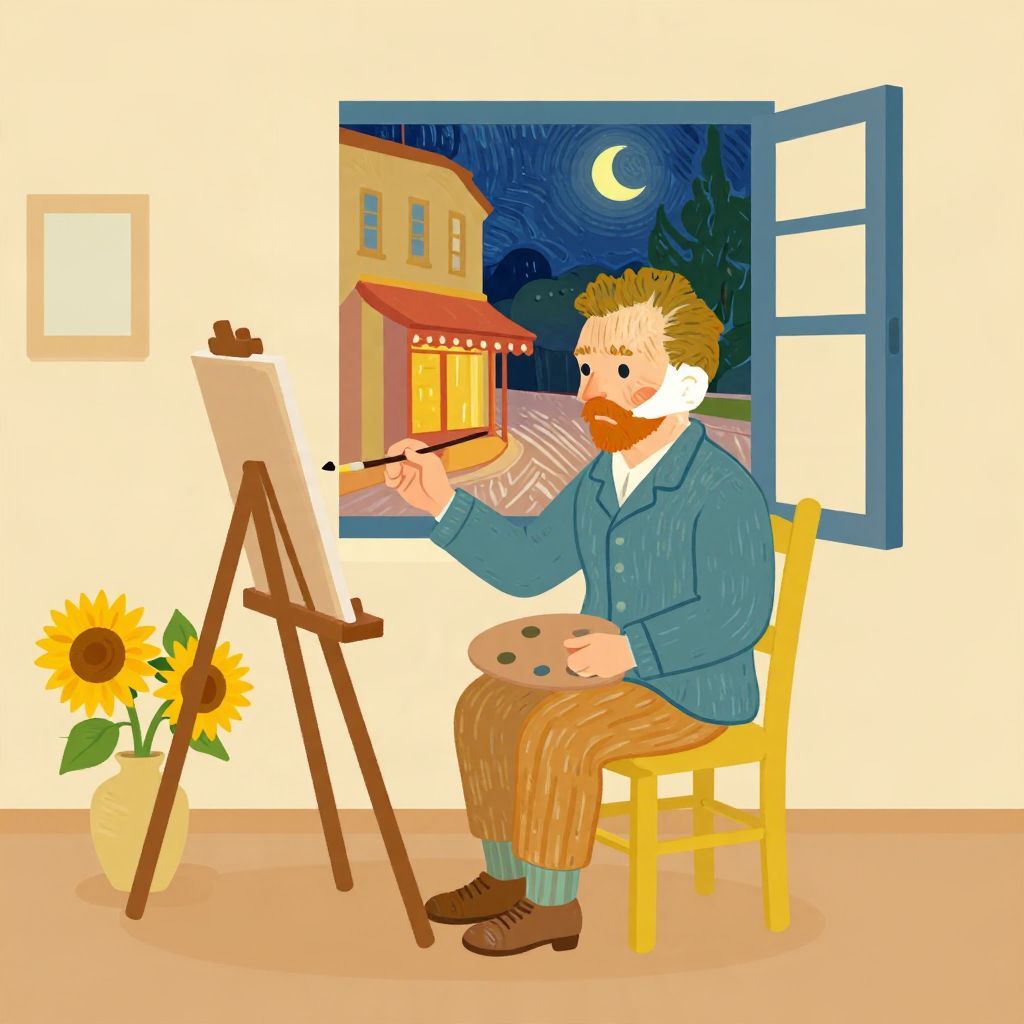
If you have ever wondered, “What artist cut off his ear?” the answer is Vincent van Gogh. He is the Dutch Post-Impressionist painter most famously associated with the incident, which took place in Arles, France, in December 1888. The story has become one of the most enduring legends in art history, but the exact details remain partly disputed.
Van Gogh’s ear injury is more than a dramatic anecdote. It reveals the pressures of his life, his fragile mental health, and the turbulent relationship between artistic genius and public myth. Understanding what happened means separating documented history from later retellings.
What artist cut off his ear?
Vincent van Gogh is the artist most closely linked to cutting off his ear. The widely accepted historical account is that he severed part of his left ear in late December 1888 after a breakdown in Arles. However, scholars still debate the full circumstances, including whether he cut off the entire ear or only part of it, and what role Paul Gauguin may have played.
Who was Vincent van Gogh?
Vincent van Gogh (1853–1890) was a Dutch painter whose work later became central to modern art. During his lifetime, he sold very few paintings and lived much of his life in financial and emotional distress. Today, he is known for vivid color, expressive brushwork, and emotionally charged subjects such as Sunflowers, The Starry Night, and Wheatfield with Crows.
Van Gogh did not begin as a celebrated artist. He worked in art dealing, taught briefly, and even considered religion before turning seriously to painting in his late twenties. His career was short, but intensely productive. The ear incident became famous partly because it seemed to fit the later image of the “tormented genius,” though that image can oversimplify his life.
What happened to van Gogh’s ear?
The best-known version says that after an argument with fellow artist Paul Gauguin, van Gogh suffered a severe mental crisis and mutilated his own ear in Arles. He then wrapped the injured ear and delivered it, or part of it, to a woman at a local brothel. This account has been repeated for generations, but the historical record is not perfectly clear.
The established facts
- Van Gogh lived in Arles in 1888 and invited Gauguin to join him.
- The two artists had a tense and difficult relationship.
- On or around 23 December 1888, van Gogh suffered a serious ear injury.
- He was treated afterward and later admitted to a hospital.
What is uncertain?
There is debate over whether van Gogh cut off the entire ear or only a portion of the ear lobe and outer ear. Some historians also question whether he acted entirely alone. A later theory suggests Gauguin may have wounded him with a sword during a confrontation and that the two men agreed to keep silent. This idea remains controversial and is not universally accepted.
What is not in doubt is that van Gogh was deeply unwell at the time. Whether the injury came from self-harm alone or from a violent encounter, it occurred during a period of psychological crisis.
The timeline of the ear incident
The story is best understood in sequence. Van Gogh’s ear injury was not an isolated event; it followed months of intense artistic ambition, conflict, and emotional strain in southern France.
- February 1888: Van Gogh moves to Arles, hoping for a productive artistic life in the south of France.
- October 1888: Paul Gauguin arrives and stays with him in the “Yellow House.”
- Autumn 1888: The two artists work together but argue frequently over art, temperament, and daily life.
- 23 December 1888: Van Gogh’s ear is cut or severely injured during a crisis.
- Late December 1888: He is hospitalized in Arles.
- January 1889: He is released, but his mental health remains unstable.
Why did van Gogh cut off his ear?
No single cause explains the event. Most historians see it as the result of a combination of psychological vulnerability, loneliness, conflict with Gauguin, and intense stress. Van Gogh’s letters show a man who was often reflective and disciplined, but also prone to periods of severe distress. He may have been experiencing a psychiatric episode, though modern diagnoses are necessarily speculative.
Mental health and artistic pressure
Van Gogh’s life in Arles was shaped by hope and disappointment. He wanted to build an artists’ community in the south, but the reality was isolating. Gauguin’s visit was supposed to help, yet their relationship became strained. Van Gogh’s emotional instability may have been worsened by exhaustion, alcohol, poor sleep, and other health problems, though historians avoid reducing his life to a single diagnosis.
The role of Paul Gauguin
Gauguin’s presence matters because the two men were both ambitious and incompatible. They respected each other’s talent but clashed over artistic direction and personal habits. Some later accounts portray Gauguin as a witness to van Gogh’s breakdown; others suggest a more active role. The historical evidence does not conclusively settle the question, so responsible history treats the matter as disputed rather than certain.
How did the public learn about the incident?
The ear injury became famous because it entered both local records and later biography. Van Gogh was treated by doctors, and the event was noted by people in Arles. Over time, biographers and journalists transformed it into a defining episode. As van Gogh’s reputation grew after his death, the ear story became one of the most repeated details in his life.
This is a good example of how history and legend can merge. A real event happened, but repeated retellings often simplified it into a dramatic symbol of madness. In reality, the incident was part of a larger and more complicated life story.
What happened after the ear incident?
Van Gogh’s injury did not end his career, but it marked a turning point. He spent time in the hospital and later entered an asylum at Saint-Rémy-de-Provence in 1889. Even during periods of illness, he continued to paint. Some of his most admired works were created after the Arles crisis, showing that the ear incident did not define the totality of his artistic output.
He died in 1890 at the age of 37, apparently by suicide, though even this has been discussed by some historians. His brother Theo died shortly afterward. Only later did van Gogh become one of the most celebrated artists in Western art history.
Why does the ear story matter historically?
The story matters because it shows how biographies can become myths, especially when a famous artist’s life seems to fit a dramatic narrative. Van Gogh’s ear injury has often been used to explain his art, but that can be misleading. His paintings were not simply the product of suffering; they also reflected study, discipline, observation, and technical growth.
Myth versus evidence
Popular culture often turns van Gogh into a symbol of the “mad artist.” That stereotype is powerful, but it can obscure the real person. Van Gogh was not only a troubled genius; he was also a careful thinker, a reader, a correspondent, and a determined craftsman. The ear incident is historically significant, but it should not eclipse the rest of his life.
Impact on art history
Van Gogh’s posthumous fame changed how people understood modern art. His life story helped shape the romantic idea of the misunderstood artist, while his paintings influenced Expressionism and later twentieth-century art. The ear incident became part of that legacy because it seemed to embody the emotional intensity people later saw in his work.
What is the most accurate answer to the question?
The most accurate answer is that the artist who cut off his ear was Vincent van Gogh, though the precise details of the event remain debated. It happened in Arles in late 1888, during a period of emotional crisis and conflict with Paul Gauguin. The story is historically real, but the most sensational versions are not always reliable.
Van Gogh’s ear injury remains famous because it sits at the intersection of fact, biography, and legend. If you want to explore more about artists and public myths, you may also be interested in why Hitler was rejected from art school and why Frida Kahlo is famous.