
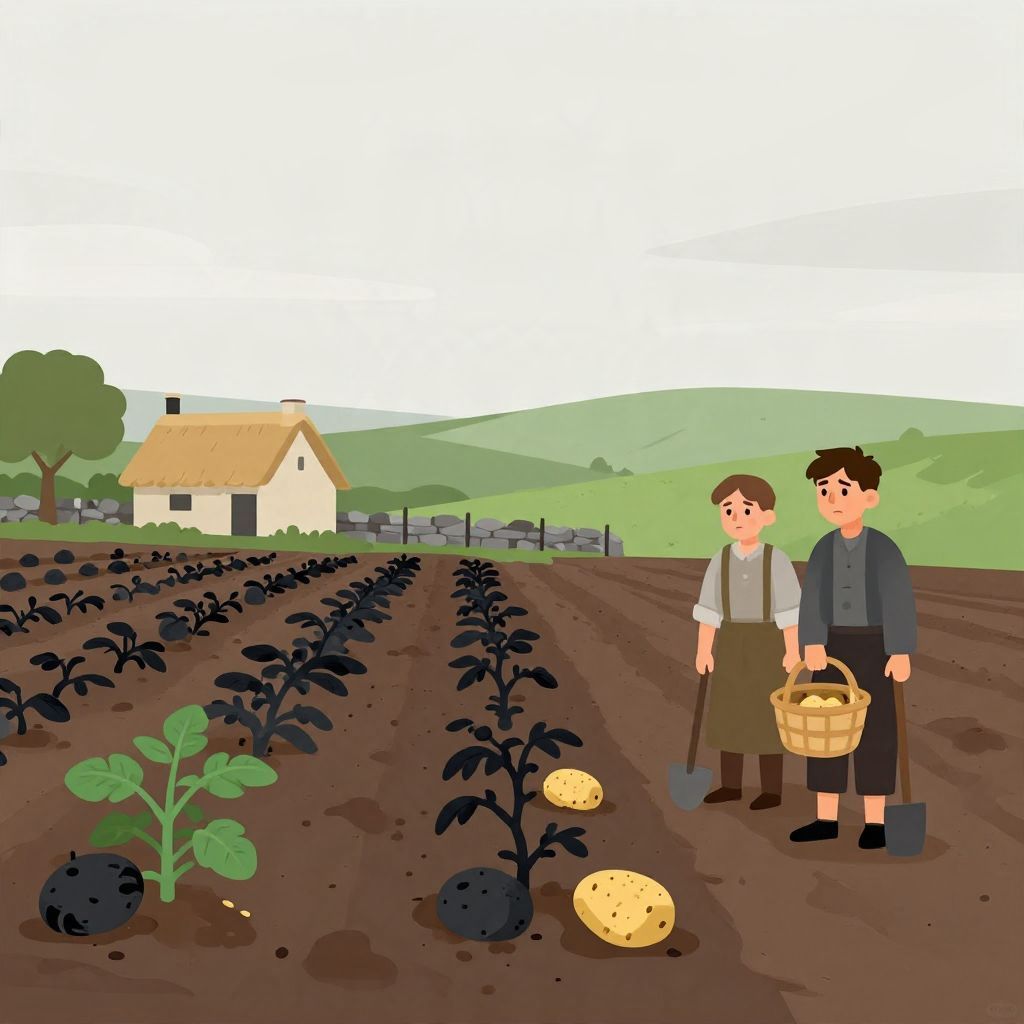
What caused the Irish Potato Famine? The short answer is that a potato disease called late blight destroyed Ireland’s main food crop in the 1840s, but the disaster became a famine because of deeper social and political conditions. Millions of poor Irish tenants depended on potatoes for survival, while land ownership, poverty, and British policy made the crisis far worse.
The Great Famine was therefore not caused by blight alone. It was the result of a biological crop failure colliding with an unequal agrarian system, limited relief, and a government response that many historians judge as inadequate.
What caused the Irish Potato Famine?
The Irish Potato Famine was caused by potato blight, a fungal-like plant disease that struck Ireland’s potato crop beginning in 1845. But the scale of death and emigration came from deeper causes: widespread rural poverty, dependence on a single crop, insecure tenancy, and British policies that failed to protect the poorest Irish people.
The immediate cause: potato blight
How the disease spread
The immediate trigger was Phytophthora infestans, the organism that causes potato late blight. It spread rapidly through damp, cool conditions and could ruin a field in days. In 1845, Ireland’s potato harvest was hit hard; in 1846, the failure was far more severe and widespread. The blight returned in later years, preventing recovery.
Potatoes were especially vulnerable because many Irish farmers grew only a few varieties. Once the disease arrived, it moved quickly through the crop. A healthy-looking field could collapse almost overnight, leaving blackened plants and rotten tubers underground.
Why the potato mattered so much
By the 1840s, the potato had become the staple food of millions of Irish rural poor, especially cottiers and small tenant farmers. It produced more calories per acre than grain and could sustain large families on very small plots. That made it ideal for survival on marginal land, but it also created dangerous dependence on one crop.
When the potato failed, many families had almost no backup food source. They might still have grown oats or kept livestock nearby, but these were often controlled by landlords, sold for rent, or exported. The poor were left with little access to the food produced around them.
Why the blight became a famine
Land ownership and rural poverty
Ireland in the mid-19th century had a highly unequal land system. Much of the land was owned by Protestant landlords, many of whom lived in Britain or in Irish towns rather than on their estates. Catholic tenants often rented small plots and had little security. Subdivision of land among heirs had created tiny holdings, so many families survived only because potatoes yielded so much food from little ground.
This meant the famine was not simply a natural disaster. It struck a society already shaped by poverty and vulnerability. A crop failure in a more diversified agricultural economy would have been serious; in Ireland, it was catastrophic.
Dependence on one crop
Monoculture was a major structural weakness. The Irish poor relied heavily on one crop because of land pressure, rent demands, and limited alternatives. If the potato failed, there was no equally affordable substitute. Bread, meat, and dairy were too expensive for many families, and local labor opportunities were limited.
That dependence made the blight uniquely destructive. It did not just reduce food supply; it removed the foundation of everyday life for millions of people.
British policy and the scale of the disaster
Free-market ideas and limited relief
British government policy played a major role in turning crop failure into mass death. Officials in London were influenced by laissez-faire economic thinking, which favored limited state intervention. Relief was provided, but often too slowly, too narrowly, or with conditions that made it difficult for starving people to benefit.
Public works programs required exhausted laborers to do hard work for food or wages. Soup kitchens were later established and helped many people, but they were temporary. At the same time, authorities were reluctant to interfere with grain markets or halt exports on a large scale.
Food exports and the problem of access
One of the most painful features of the famine was that food continued to leave Ireland even as people starved. Grain, livestock, butter, and other produce were still sold and exported. This did not mean there was no food in Ireland at all; rather, the poor had lost the means to buy or keep it. Hunger was therefore a crisis of access as much as of supply.
Historians debate the extent to which exports could have been stopped without causing other problems, but there is broad agreement that the government did not do enough to protect the most vulnerable. The state’s response reflected the priorities and assumptions of the time, not modern welfare principles.
Evictions and landlord pressures
Some landlords evicted tenants who could not pay rent, especially during the worst years. In a few cases, estates organized assisted emigration, but many families were simply removed from their homes. Evictions deepened the crisis by stripping people of shelter and land just when they needed them most.
Landlords were not all identical in behavior; some tried to help tenants, while others were harsh or financially constrained themselves. Still, the overall system gave tenants little protection when disaster struck.
Chronology of the famine years
The famine unfolded over several years, and each stage made the next worse:
- 1845: Potato blight appears and causes the first major crop failure.
- 1846: The harvest fails again, this time much more severely; hunger spreads rapidly.
- 1847: Known as “Black ‘47,” this is one of the deadliest years, with widespread destitution, disease, and mass displacement.
- 1848–1849: Blight continues intermittently, while poverty, eviction, and illness remain severe.
- 1850s: The famine gradually eases, but its demographic and social effects continue for decades.
Disease such as typhus, dysentery, and cholera also killed many people weakened by malnutrition. In this sense, the famine was not only a story of hunger but also of epidemic illness and social collapse.
Was the Irish Potato Famine caused by overpopulation?
The older explanation
Older interpretations sometimes blamed overpopulation or Irish farming habits alone. There is some truth in the idea that population pressure had increased dependence on the potato. Ireland’s population had grown strongly in the early 19th century, and small farms were common. But overpopulation was not the root cause of the famine, and it does not explain why people starved while food continued to be produced and exported.
A more complete view
Most historians now see the famine as a combination of immediate biological disaster and long-term structural vulnerability. Population growth mattered because it increased pressure on land, but the decisive factors were poverty, land tenure, and political choices. The famine was therefore not inevitable, even after the blight arrived.
How historians understand responsibility
Natural disaster and human failure
The Irish Potato Famine is best understood as both a natural and a human-made catastrophe. The blight was real and devastating, and no 19th-century government could have instantly cured it. Yet governments can reduce suffering through policy, and in Ireland the response was too limited for the scale of the emergency.
Some historians emphasize structural inequality and colonial rule; others stress the constraints and beliefs of Victorian policymakers. These interpretations are not mutually exclusive. The famine became so lethal because disease struck a society with very little resilience and because those in power did not fully meet the crisis.
Consequences of the famine
Death, emigration, and demographic change
The famine caused enormous loss of life and triggered mass emigration, especially to Britain, the United States, Canada, and Australia. Ireland’s population fell sharply and never returned to its pre-famine level. The social structure of rural Ireland changed as small holdings declined and migration became a defining part of Irish life.
Political and cultural impact
The famine also transformed Irish politics and memory. It intensified resentment toward British rule and became a central event in Irish nationalist history. In the long term, it shaped debates about land reform, self-government, and the relationship between Ireland and Britain.
Culturally, the famine left a deep scar in Irish family memory and diaspora identity. It remains one of the defining tragedies of modern Irish history because it combined starvation, eviction, disease, and exile on a vast scale.
Conclusion
The Irish Potato Famine was caused by potato blight, but it became a mass catastrophe because millions of people depended on one crop, lived under an unequal land system, and received insufficient protection from government. Its history shows how environmental shocks become disasters when social and political structures are fragile. For related context, you may also want to read about what caused the Dark Ages and what caused the Spanish-American War.