
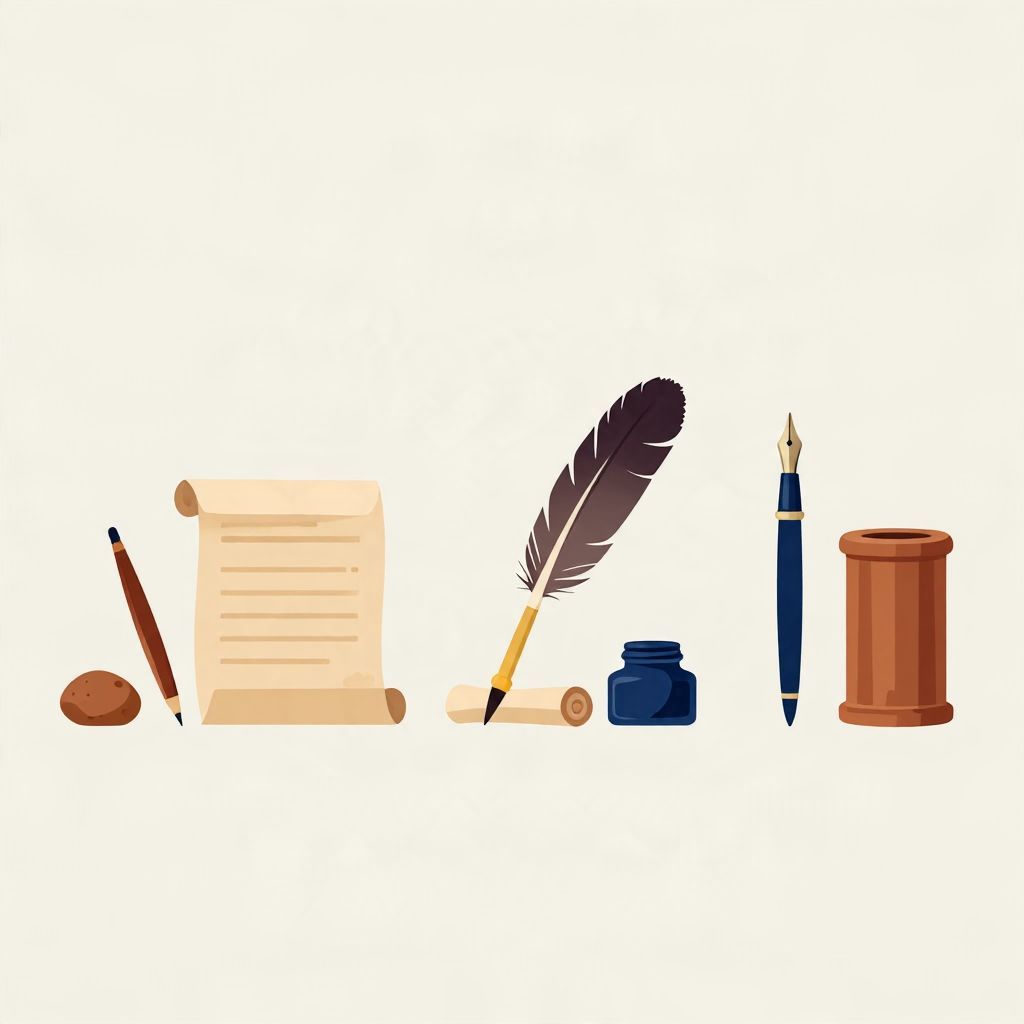
When were pens invented? The short answer is that pens did not appear all at once. People first used reed pens and quills in antiquity, while the modern metal-nib pen emerged in the 19th century and the fountain pen followed soon after. In other words, the “pen” has a long history, shaped by changing writing materials and the need for cleaner, faster writing.
Because different kinds of pens were invented at different times, the best historical answer depends on which pen you mean. The story begins in ancient Egypt and Mesopotamia, moves through medieval Europe, and reaches industrial-age inventions that transformed everyday writing.
When Were Pens Invented?
Pens were not invented in a single year. The earliest writing pens—such as reed pens—were used in ancient Egypt and the ancient Near East more than 4,000 years ago. Quill pens became common in Europe by the early medieval period, while durable metal pens were developed in the late 18th and early 19th centuries. Fountain pens followed in the 19th century, and the ballpoint pen arrived in the 20th century.
The Earliest Pens in Ancient Civilizations
Reed pens in Egypt and Mesopotamia
The first pens were simple tools made from reeds or rushes. Scribes in ancient Egypt used cut reed pens dipped in ink to write on papyrus as early as the third millennium BCE. Similar writing tools were also used in Mesopotamia, where scribes recorded administrative and literary texts on clay tablets and other surfaces. These early pens were not “pens” in the modern sense, but they served the same basic purpose: controlled application of ink or marking material.
These tools mattered because writing was becoming central to government, religion, trade, and recordkeeping. A reliable pen made it easier to keep accounts, copy sacred texts, and preserve laws. In this sense, the history of pens is tied directly to the rise of literate bureaucracies.
How ancient pens worked
Reed pens were usually sharpened or cut at an angle to form a nib. The writer dipped the tip into ink and wrote with repeated reloading. This made writing slower than with modern pens, but it was effective for the materials of the time. The design also shows an early understanding of how a writing tip could control line thickness and ink flow.
From Reed to Quill: The Medieval Pen
Why quill pens replaced reeds
By the early Middle Ages, especially in Europe, quill pens made from bird feathers became the dominant writing tool. Goose, swan, and crow feathers were especially valued. Quills were lighter and more flexible than reeds, and they could be shaped into finer points, which made them useful for writing on parchment and vellum.
Quill pens were not invented on a single date, but they became widespread roughly between the 6th and 8th centuries CE and remained standard in Europe for many centuries. Monasteries, royal chanceries, and later universities all depended on them. The quill was so important that the image of the scholar or clerk with pen in hand became a lasting symbol of learning.
The limits of quill writing
Quills required constant trimming and regular dipping in ink. They wore out quickly and could splinter. Still, they were the best available tool for centuries. Their limitations helped drive later invention: as literacy expanded and writing demands increased, people wanted a pen that could hold more ink and write more smoothly without constant interruption.
When Did Modern Pens Get Invented?
The first metal pens
The modern era of pen history began in the late 18th century, when inventors started experimenting with metal nibs. One of the earliest known patents for a steel pen nib was granted in England in the 1780s, and by the early 19th century metal pens were being produced commercially. These early steel pens were more durable than quills and eventually became mass-produced in large numbers.
The shift to metal nibs was important because it marked the beginning of the pen as an industrial product rather than a handcrafted one. Steel nibs could be standardized, sold cheaply, and used by a much wider public. That helped spread writing beyond elite clerical circles.
The fountain pen and self-contained ink supply
The fountain pen was the next major breakthrough. Unlike a dip pen, it stored ink inside the pen body and fed it gradually to the nib. Early versions appeared in the late 18th and early 19th centuries, but reliable fountain pens became practical only after important improvements in ink flow, materials, and manufacturing during the 19th century. By the late 1800s, fountain pens were becoming widely used.
The fountain pen solved one of the oldest problems in writing: the need to constantly dip the pen into ink. This made writing faster, cleaner, and more portable. It was especially useful for business, journalism, education, and correspondence in an increasingly connected world.
A simple timeline of pen development
- c. 3200 BCE onward: Reed pens used in ancient Egypt and the Near East
- Early medieval period: Quill pens become common in Europe
- Late 18th century: Early metal nibs and pen patents appear
- 19th century: Steel pens are mass-produced; fountain pens improve and spread
- 20th century: Ballpoint pens become common and eventually dominant
Why the History of Pens Matters
Writing technology changed society
Pens may seem ordinary, but they shaped how people recorded history. Better writing tools made it easier to manage states, run businesses, educate students, and preserve literature. The pen helped turn writing from a specialized craft into a routine part of daily life.
As pens improved, so did access to written communication. Cheaper, more durable pens helped expand literacy and made handwriting more efficient. That had consequences far beyond the page: it affected administration, commerce, science, and personal correspondence.
From elite scribes to everyday users
In ancient and medieval societies, writing was often limited to trained specialists. The rise of metal pens and later fountain pens reduced the skill and maintenance needed to write regularly. By the 19th century, more people could afford and use a dependable pen, which helped normalize writing in schools, offices, and homes.
This democratization of writing tools is one reason the history of pens is also a history of communication. The pen did not just record culture; it helped broaden who could participate in it.
What About the Ballpoint Pen?
A later invention, not the first pen
The ballpoint pen is often what people imagine when they ask when pens were invented, but it is actually a much later development. Ballpoints were perfected in the 20th century, especially through the work of László Bíró in the 1930s and 1940s. Their rolling ball tip reduced smudging and made pens more reliable for everyday use.
Ballpoints did not replace earlier pens overnight, but they eventually became the most common writing tool in the world because they were cheap, portable, and low-maintenance. Still, they belong to the long afterlife of pen history rather than its beginning.
So, What Is the Best Answer?
If you want one clear answer, pens were first invented in ancient times, with reed pens used by Egyptians and other early civilizations around 3200 BCE or earlier. But if you mean the modern pen, the most important milestones came much later: metal nib pens in the late 18th and early 19th centuries, fountain pens in the 19th century, and ballpoint pens in the 20th century.
That layered history is what makes the question interesting. “The pen” is not one invention but a long chain of improvements, each responding to the needs of its age.
For more on the materials behind writing history, see where ink came from, and for a broader look at the origins of written communication, explore what the first word ever said. The history of pens shows how a simple tool can shape civilization for thousands of years.