
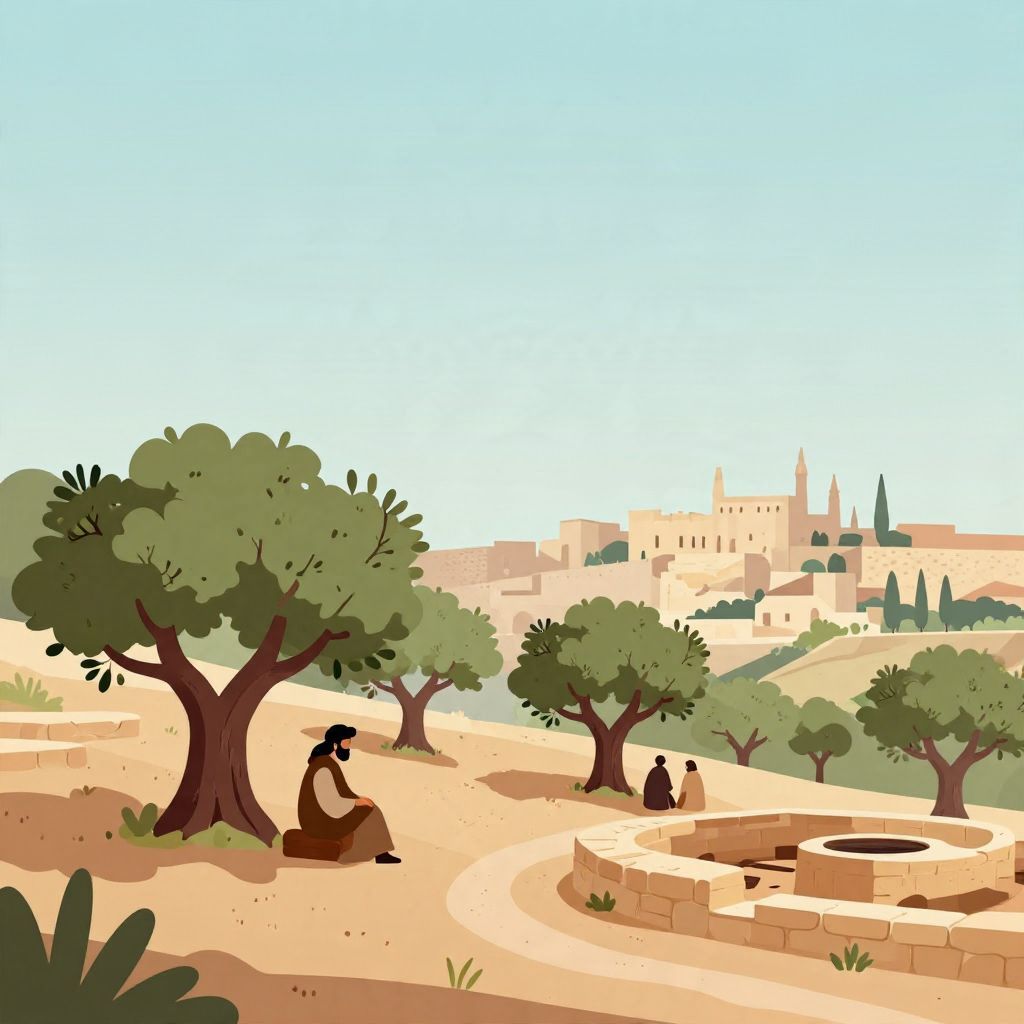
What does Gethsemane mean? The word most likely comes from Aramaic or Hebrew and means “oil press” or “olive press.” In the New Testament, Gethsemane is the name of the garden on the Mount of Olives where Jesus prayed before his arrest, making the place central to Christian memory, liturgy, and art.
Because the site appears in the Gospels at a decisive moment in the Passion narrative, its name has carried both geographic and symbolic weight for nearly two millennia.
What does Gethsemane mean?
Gethsemane most likely means “oil press” or “olive press,” from a Semitic root associated with pressing olives for oil. The name points to the agricultural landscape of the Mount of Olives near Jerusalem, where olive groves and presses would have been common in antiquity. In Christian tradition, it is the garden where Jesus prayed in anguish before his arrest.
The linguistic origins of the name
The word “Gethsemane” is usually understood as a transliteration of an Aramaic or Hebrew place name. Scholars commonly connect it to a phrase meaning “oil press” or “olive press,” though the exact original form is not preserved with complete certainty. The Gospels were written in Greek, so the name reached later readers through Greek spelling and then into Latin and modern languages.
Why “oil press” makes historical sense
The Mount of Olives, east of Jerusalem, was well suited to olive cultivation in the late Second Temple period. Olive oil was a staple for cooking, lighting, ritual use, and trade. A place called “oil press” would therefore fit the local economy and geography. The name is not unusual in a biblical landscape where many places were identified by physical features or agricultural activity.
How the name entered Christian tradition
In the New Testament, Gethsemane appears as the location of Jesus’ prayer and arrest in the hours before the crucifixion. Because of that association, the name became fixed in Christian memory even though the exact boundaries of the garden are not known with certainty. Over time, “Gethsemane” came to signify not only a place but also suffering, surrender, and spiritual struggle.
Where was Gethsemane located?
Gethsemane is traditionally associated with a garden or grove on the western slope of the Mount of Olives, just outside ancient Jerusalem. The Gospels place Jesus there after the Last Supper. While the precise ancient site cannot be identified with absolute certainty, the general location is historically plausible and consistent with the topography described in the biblical texts.
The Mount of Olives in the first century
The Mount of Olives stood across the Kidron Valley from the Temple Mount. In the first century CE, this area was linked to pilgrimage, burial, agriculture, and movement in and out of the city. A quiet olive grove on the slopes would have provided a natural place for retreat, prayer, and gathering away from the crowded city center.
Archaeology and later tradition
Modern visitors often encounter churches and shrines marking Gethsemane, but these are later commemorations rather than proof of the exact ancient spot. Christian communities began venerating the area relatively early, and by the Byzantine period it had become a major sacred landscape. Historical caution matters here: the tradition is ancient, but the precise location remains uncertain.
Gethsemane in the Gospel timeline
The name Gethsemane matters historically because it appears at a turning point in the Passion narrative. The Gospels place Jesus there after the Last Supper and before his arrest. This sequence anchors Gethsemane in the final hours of Jesus’ life and explains why the name became so important in Christian theology and devotion.
- Last Supper — Jesus shares a final meal with his disciples.
- Journey to the Mount of Olives — the group leaves the city after the meal.
- Prayer in Gethsemane — Jesus prays in distress and asks that “this cup” pass from him.
- Arrest — Judas arrives with armed men, and Jesus is taken away.
- Trials and crucifixion — the Passion continues through the night and the following day.
Differences among the Gospels
The Synoptic Gospels—Matthew, Mark, and Luke—explicitly name Gethsemane or closely identify the place on the Mount of Olives. John’s Gospel emphasizes the same general setting but uses different wording and does not foreground the garden scene in the same way. These differences are important for historical reading: the core event is shared, while the narrative presentation varies by author.
Why Gethsemane became historically significant
Gethsemane became significant because it represents a moment of intense human fear and obedience in Christian memory. The prayer there is interpreted as a struggle between dread and acceptance, making the site a powerful symbol of suffering before redemption. For centuries, Christians have treated Gethsemane as both a literal place and a spiritual metaphor.
A place of anguish and resolve
In Christian interpretation, Gethsemane is where Jesus confronts the coming crucifixion. The scene has been read as a model of faithful endurance, but also as a deeply human moment of sorrow. This dual meaning helped the name travel far beyond geography and into theology, worship, poetry, and visual art.
Influence on liturgy and art
Gethsemane appears frequently in hymns, sermons, paintings, and devotional writing. Artists often depict Jesus alone in prayer while the disciples sleep nearby, emphasizing isolation and anticipation. In liturgical calendars, Holy Week observances regularly revisit the scene, reinforcing the name’s lasting place in Christian historical consciousness.
Historical context: olive cultivation and Jerusalem
The meaning of Gethsemane makes even more sense when placed in the economy of ancient Judea. Olive trees were a major crop in the eastern Mediterranean, and olive oil was essential to daily life. A press near Jerusalem would have served practical needs and reflected the agricultural use of the surrounding hills.
Olives in ancient life
Olive oil was used for food, medicine, lamps, anointing, and ritual purposes. Presses were therefore valuable installations in rural and semi-rural areas. A site named for such a press would not be unusual in the ancient Near East, where place names often described land use, terrain, or local features.
Jerusalem’s outskirts in Jesus’ time
In the late Second Temple period, the area east of Jerusalem connected the city to nearby villages and roads. The Mount of Olives served as a natural boundary and vantage point. A garden there would have been close enough for immediate access, yet removed enough for privacy—an important detail in the Gospel setting.
How historians approach the question
Historians distinguish between the meaning of the word, the historical setting of the place, and the later devotional significance attached to it. The etymology is fairly secure at the level of broad meaning—“oil press” is the standard explanation—but the exact ancient pronunciation and original spelling are less certain. The theological importance of the site is even more clearly established in Christian tradition than the precise archaeology of the garden.
What is well supported
- The name is Semitic in origin.
- Its likely meaning is “oil press” or “olive press.”
- The Gospels place Jesus there before his arrest.
- The Mount of Olives is the traditional geographic setting.
What remains uncertain
- The exact ancient form of the place name.
- The precise boundaries of the garden.
- The extent to which later shrines preserve the original location.
Why the meaning of Gethsemane matters today
Understanding what Gethsemane means helps readers see that biblical place names often carry both literal and symbolic force. The term points to a real landscape of olive presses near Jerusalem, but it also became shorthand for suffering, prayer, and surrender in the face of hardship. That combination of geography and memory is what gives the name its enduring power.
In short, Gethsemane means “oil press,” and its historical importance comes from being the remembered site of Jesus’ prayer before arrest. For related biblical-historical context, you may also want to read about eunuchs in the Bible and when Moses was born.