
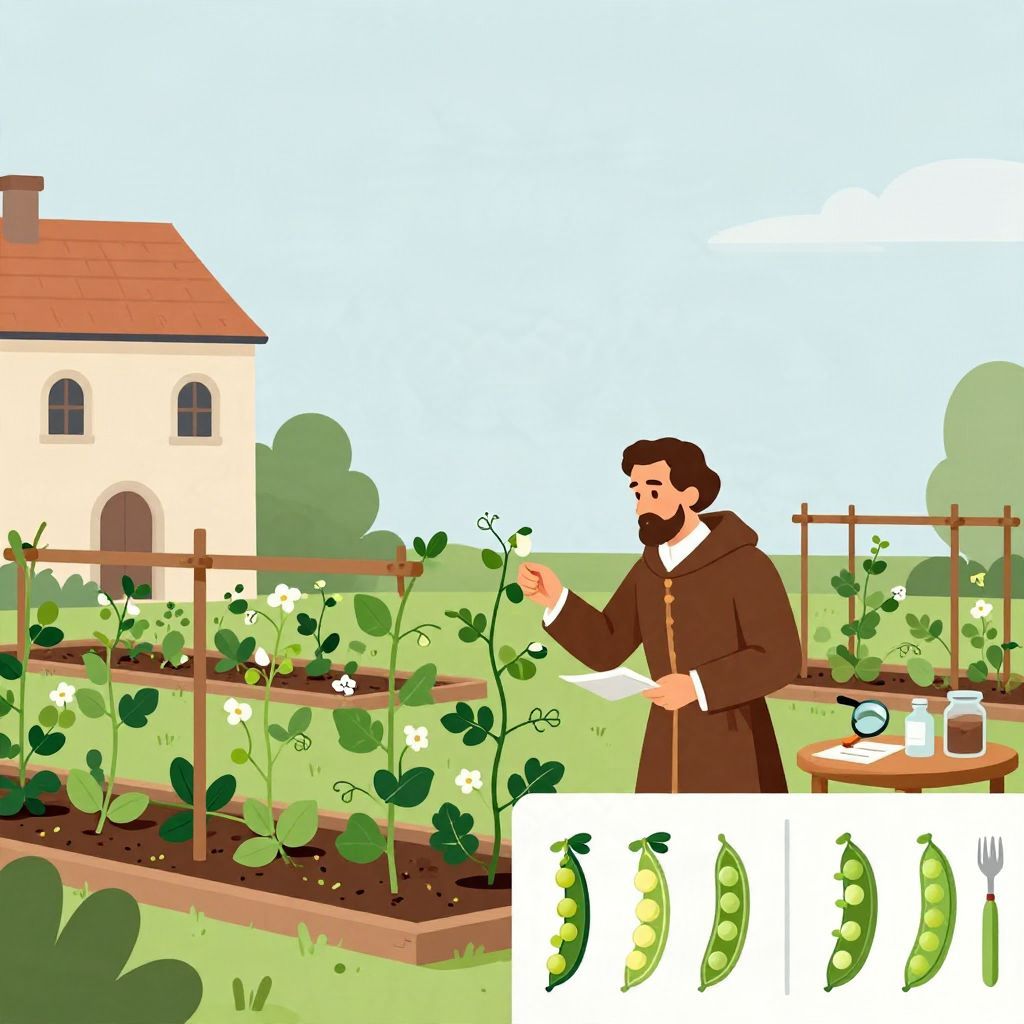
Why did Gregor Mendel study pea plants? The short answer is that peas were practical, easy to control, and ideal for testing how traits pass from one generation to the next. In the mid-19th century, Mendel needed a plant that could be bred in a careful, repeatable way, and garden peas fit that need better than most other organisms.
His choice was not random. It reflected the scientific goals of the time, the resources of an Augustinian monastery in Brno, and Mendel’s own training in mathematics and natural science. What he learned from peas eventually became the foundation of modern genetics.
Why Did Mendel Study Pea Plants?
Mendel studied pea plants because they were easy to cross-pollinate, had many clearly visible traits, and produced predictable offspring in relatively short generations. They also grew well in the monastery garden where he worked. These features let him count inheritance patterns carefully and test whether traits were passed on in fixed ratios.
Peas were practical for controlled experiments
Gregor Mendel conducted his famous experiments in the 1850s and early 1860s at the St. Thomas’s Abbey in Brno, then in the Austrian Empire, now in the Czech Republic. He needed a plant that could be managed under controlled conditions. Pea flowers naturally self-fertilize, which helps preserve pure lines, but they can also be cross-pollinated by hand, allowing an experimenter to choose the parents.
This combination was crucial. Mendel could start with plants that bred true for a trait, such as flower color or seed shape, then deliberately cross them and observe the results in the next generation. Few plants offered such a convenient balance of stability and control.
The traits were easy to see and count
Pea plants display several distinct, easily observed traits. Mendel focused on characteristics such as seed shape, seed color, flower color, pod shape, pod color, flower position, and plant height. These were useful because they came in clear, contrasting forms rather than blending continuously.
That mattered for his method. Mendel was not simply looking for interesting plants; he was trying to measure inheritance. The clearer the trait, the easier it was to count outcomes and compare them across large numbers of offspring. Peas made it possible to turn heredity into a numerical problem.
They produced enough offspring for statistical analysis
Another reason Mendel chose peas was that a single plant could produce many seeds. Large sample sizes allowed him to detect patterns that might be invisible in only a few offspring. This was one of the most important features of his work, because heredity does not always reveal itself in a single generation.
Mendel’s approach was unusual for his era. Many naturalists described living things by observation alone, but he used counting, ratios, and careful comparison. Pea plants gave him enough data to see recurring patterns such as the famous 3:1 ratio in the second generation of certain crosses.
Why Peas Fit Mendel’s Scientific Goals
Mendel wanted to understand whether inheritance followed orderly rules. Peas were ideal because they let him isolate one trait at a time, compare parent plants with offspring, and keep track of results across generations. Their biology made them especially suitable for a scientist who thought mathematically.
Mendel worked at a moment of scientific change
In the mid-19th century, biology was full of debate about how inheritance worked. The older idea of “blending” inheritance suggested that offspring were a mix of their parents in a way that diluted variation. Mendel’s experiments pointed in a different direction: traits could be transmitted as separate units, even if they were not yet understood as genes.
Pea plants helped him test this idea because their traits often appeared in distinct forms. If inheritance had been purely blending, the results would have looked more mixed and less predictable. Instead, Mendel saw consistent patterns that suggested discrete hereditary factors.
He could control pollination by hand
Peas were especially useful because Mendel could remove the anthers from a flower before self-fertilization and then apply pollen from another chosen plant. This allowed him to make deliberate crosses rather than rely on chance. In effect, he could design the experiment.
That level of control was rare in living organisms. It made peas a powerful tool for separating inherited traits from environmental influences. Mendel could ask whether the offspring’s characteristics came from the parents’ hereditary material rather than from soil, weather, or random variation alone.
The plants were manageable in size and season
Pea plants were also practical in a monastery garden. They were not too large, did not require elaborate equipment, and could be grown in rows and tracked carefully. Compared with animals or long-lived trees, they were relatively easy to cultivate and observe in a limited space.
They also had a short enough life cycle to allow Mendel to study multiple generations over several years. This was essential because inheritance becomes clearer when patterns repeat across generations, not just in one season.
The Historical Context of Mendel’s Choice
Mendel’s selection of pea plants was shaped by more than convenience. It reflected the broader world of 19th-century science, where scholars were increasingly interested in classification, variation, and the laws governing nature. Mendel’s work emerged from that intellectual climate, even though it was not fully appreciated at the time.
His monastery gave him time, space, and support
Mendel was an Augustinian friar, not a university professor. The monastery in Brno provided a setting where he could study, teach, and conduct experiments. Monastic life gave him access to land and a community that supported learning. That environment made long-term plant breeding possible.
He also studied in Vienna, where he encountered scientific and mathematical methods that influenced his thinking. His background helped him see that heredity might be analyzed through exact observation and numerical patterns. Pea plants were a good match for that approach.
He was not the first to breed plants, but he was different
Before Mendel, gardeners and naturalists had experimented with plant hybridization. What made Mendel distinctive was not simply that he crossed plants, but that he chose traits carefully, kept records, and analyzed results statistically. He treated biology as a problem of measurement.
Peas were central to that innovation. Their reliable traits and manageable reproduction let him move beyond anecdotal breeding and toward a systematic science of heredity. In that sense, the plant itself helped shape the discovery.
What Mendel Learned from Pea Plants
Mendel’s pea experiments led him to propose that inheritance works through discrete units that are passed from parents to offspring. He observed that some traits could disappear in one generation and reappear in the next, which suggested that heredity was not a simple blending process.
Dominant and recessive traits
One of Mendel’s major insights was that some traits masked others in hybrid offspring. He later described these as dominant and recessive, though the modern genetic meaning of those terms developed afterward. In his pea experiments, for example, one trait might appear in the first hybrid generation while another remained hidden but returned later.
This was a major break from older assumptions. It showed that a trait could be present without being visible, which helped explain why characteristics sometimes seemed to skip generations.
Predictable ratios
Mendel found that certain crosses produced offspring in regular numerical proportions. These ratios did not mean every individual plant behaved identically, but they did suggest an underlying order. His results became the basis for what later scientists called Mendel’s laws of inheritance.
Those laws were not immediately celebrated. Mendel published his findings in 1866, but his work was largely overlooked until around 1900, when other scientists rediscovered similar patterns. Even then, the importance of his pea experiments became clear only gradually.
Why Pea Plants Specifically, Not Something Else?
Mendel likely chose peas because they combined several advantages at once: easy cultivation, clear traits, controllable reproduction, and enough offspring for careful counting. A different organism might have offered one or two of these benefits, but peas offered all of them together.
- Self-fertilizing, which helped produce stable parent lines
- Cross-pollinatable by hand, which allowed controlled breeding
- Distinct traits, which were easy to classify
- Many seeds, which made statistical analysis possible
- Short generation time, which sped up the study of heredity
- Suitable for garden cultivation, which matched his setting
In other words, peas were not chosen because they were biologically unique in some mystical sense. They were chosen because they were experimentally useful. Mendel’s genius was partly in recognizing that usefulness and building a method around it.
The Lasting Importance of Mendel’s Pea Experiments
Mendel’s pea studies became foundational because they revealed patterns that later scientists could test in other organisms, including animals and humans. His work helped establish genetics as a scientific field, even though the word “gene” came later. The pea plant was the starting point for a much larger history of heredity research.
Why the experiments still matter
The pea experiments are still taught because they show how a carefully chosen organism can unlock a big scientific question. Mendel did not discover everything about inheritance, and modern genetics has shown that heredity can be more complicated than his original model. Still, his pea work remains one of the clearest examples of experimental biology.
It also reminds us that scientific breakthroughs often depend on practical choices. Mendel’s success was not only about insight; it was also about selecting the right plant for the question he wanted to answer.
Conclusion
Mendel studied pea plants because they were the best available tool for investigating heredity in a controlled, measurable way. Their traits were easy to observe, their breeding could be manipulated, and their offspring could be counted in large numbers. Those practical advantages allowed him to uncover patterns that transformed biology.
So the answer to why did Mendel study pea plants is both simple and historically significant: peas gave him the experimental conditions he needed, and in using them, he helped create the science of genetics. If you want to explore more about the history of biology, you might next look at the development of genetics or the scientific revolution in 19th-century Europe.