
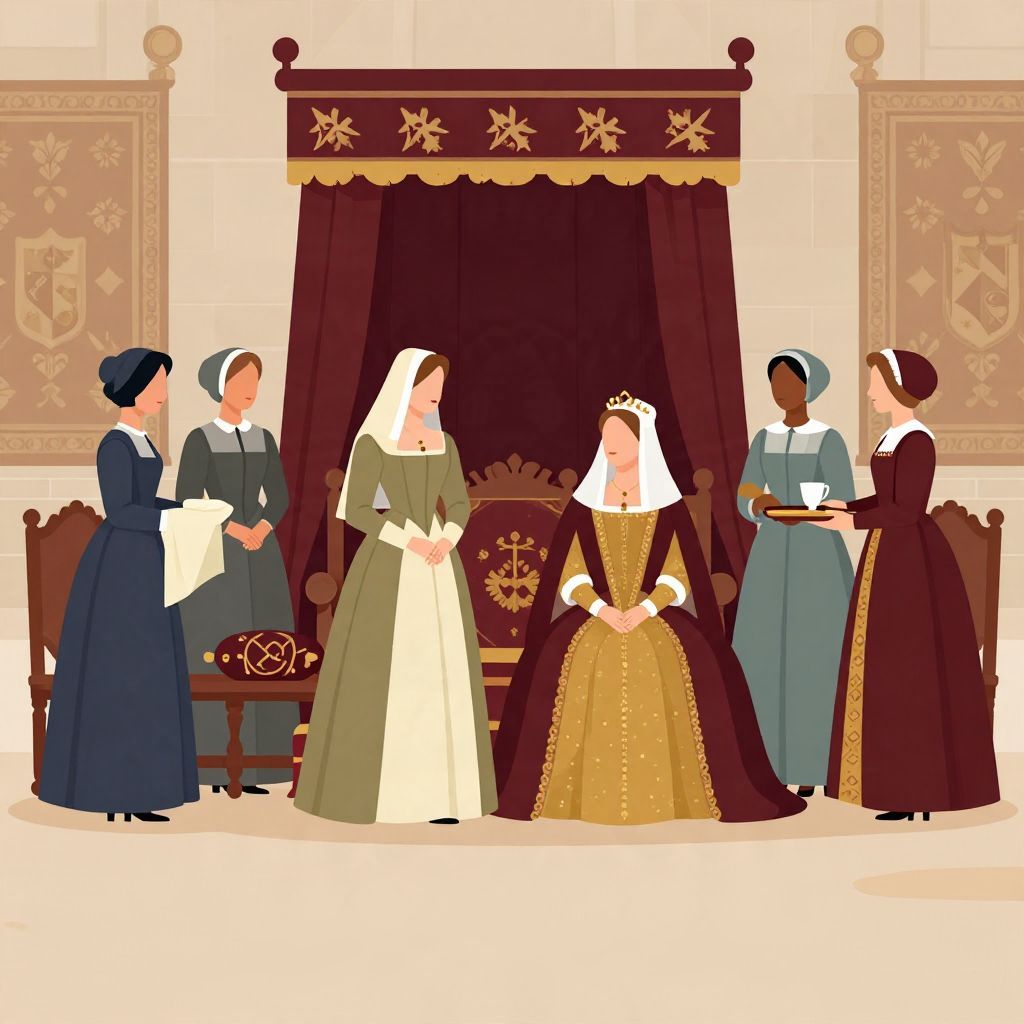
What does lady in waiting mean? The phrase refers to a woman who serves a queen, princess, or other high-ranking noblewoman in an aristocratic household. Historically, she was not a “waiting” servant in the modern sense of standing by tables, but a trusted companion, attendant, and court insider whose duties blended personal service, ceremony, and political access.
The role developed over centuries in European courts, especially from the Middle Ages onward, and it changed as monarchy, etiquette, and women’s courtly status changed. Its meaning is rooted in rank, proximity, and privilege as much as labor.
What does lady in waiting mean?
A lady in waiting was a woman of gentle birth who attended a queen or princess at court. She helped with dress, travel, ceremonies, and daily companionship, while also serving as a socially acceptable female presence in a royal household. The title signaled rank and access, not simply domestic work.
Origins of the term and the courtly role
The idea behind the lady in waiting emerged from medieval and early modern court culture, where rulers lived surrounded by households organized by hierarchy. Queens and noblewomen needed attendants for practical reasons, but also for status and propriety. In many courts, a queen was expected to appear in public with women of noble standing around her.
Why courts needed female attendants
Royal households were not private homes in the modern sense. They were political centers, ceremonial stages, and administrative hubs. A queen’s female attendants helped manage clothing, jewels, letters, audiences, and travel. They also protected her modesty and reputation in societies that placed strong limits on male-female interaction outside family or rank.
The phrase itself
The English phrase “lady in waiting” reflects the idea of a noblewoman who waited upon another woman of higher rank. Similar roles existed across Europe under different names. In French courts, for example, women served as dames d’honneur or other courtly attendants; in Spanish and other monarchies, comparable positions carried local titles and responsibilities. The exact wording varied, but the function was similar.
How the role worked in practice
Being a lady in waiting was often a prestigious appointment. It usually went to women from noble or gentry families, sometimes as a reward for family loyalty or political support. The work could be demanding, but it also offered education, influence, and visibility at court.
Typical duties
- Assisting with dressing, jewelry, and personal items
- Accompanying the queen or princess in public and private
- Helping manage correspondence and informal requests
- Attending ceremonies, meals, and religious observances
- Serving as a companion during travel or illness
Rank and hierarchy
Not every woman at court held the same position. Some served as senior attendants with close access to the queen; others had more limited duties. In some households, the highest-ranking women were married noblewomen who rotated attendance, while younger unmarried women might serve as companions or maids of honor. The structure depended on the court and period.
Historical timeline: how the role changed over time
The lady in waiting was not a single fixed office with one origin date. It evolved gradually as royal households became more formalized. A simple timeline helps show the development.
- Middle Ages: European courts begin organizing noble households around rulers and queens, with women attendants appearing as part of elite domestic and ceremonial life.
- Late medieval and Renaissance periods: Court etiquette becomes more elaborate, and female attendants gain clearer roles in ceremony, dress, and companionship.
- 16th to 18th centuries: The position becomes well established in many monarchies, especially in France, England, Spain, and the Habsburg courts.
- 19th century: Court life becomes more formalized and more restricted in some places, while constitutional monarchy reduces some political functions of court women.
- 20th century: In surviving monarchies, the role becomes increasingly ceremonial and symbolic, though still prestigious.
Medieval courts
In the medieval period, queens often maintained separate households. Female attendants helped create a courtly environment that reflected rank and dynastic dignity. Their presence also mattered because queens could be politically important in their own right, especially as mothers of heirs, patrons, and intermediaries.
Renaissance and early modern courts
By the 15th and 16th centuries, courts had become highly structured spaces of display and influence. Ladies in waiting could witness private conversations, help shape access to the queen, and sometimes influence petitions and appointments. Their closeness to power made them important, even when their formal authority was limited.
Later monarchy and modern ceremonial courts
As monarchies changed, especially after the rise of constitutional government, the role became less politically central. Yet the title survived in some royal households because it still served practical and ceremonial functions. In modern usage, the position is often associated with royal protocol, public events, and personal support rather than governance.
Historical significance of ladies in waiting
Although often overlooked, ladies in waiting were significant because they stood at the intersection of gender, class, and power. They helped maintain royal households, but they also occupied a space where informal influence could matter as much as official office.
Access to power
Because they were near the queen, ladies in waiting could hear news early, observe court politics, and sometimes carry messages. In a world where access to a ruler mattered enormously, proximity itself was a form of influence. This did not mean every lady in waiting wielded political power, but the position created opportunities unavailable to most women.
Women’s roles in elite society
The office also shows how aristocratic women participated in public life before modern political rights. They were not isolated from politics; instead, they often operated through household networks, patronage, kinship, and ceremony. The lady in waiting was one of the clearest examples of that system.
Education and social formation
For younger noblewomen, service at court could function as training. They learned etiquette, languages, dress, religion, and social behavior expected of elite women. For families, the appointment could raise status and strengthen connections. For the court, it ensured that the queen was surrounded by women who reflected the dignity of the monarchy.
Common misunderstandings about the phrase
Modern readers sometimes misunderstand “lady in waiting” because the phrase sounds like ordinary service. In historical context, however, the role was usually far more prestigious than that of a household servant. It combined companionship, ceremonial duty, and social standing.
Not the same as a maid
A lady in waiting was generally not a servant in the modern lower-status sense. She was commonly of noble or gentle birth and served within a hierarchy of rank. Some tasks may have been similar to domestic work, but the social meaning of the office was very different.
Not always a permanent job title
The phrase can also be misleading because court service varied widely. Some women served full time; others attended only during certain seasons, events, or periods of favor. In some courts, the title covered a range of related positions rather than one exact job description.
Examples from royal history
Ladies in waiting appear throughout the history of European monarchy, especially in the households of queens who needed trusted female attendants. Their names are often preserved in court records, letters, and memoirs, though not all are equally well documented. Some became famous because they influenced politics, while many others remained in the background.
Queens and their female households
English, French, Spanish, and other European courts all maintained female attendants for queens consort and royal princesses. These households helped manage public image and private life. In some cases, a queen’s ladies in waiting were selected carefully to balance family alliances, regional interests, and religious loyalties.
Influence behind the scenes
Historians often note that court women could shape access to the monarch, support petitions, and transmit information. Their influence was usually indirect, but in courts where personal relationships mattered, indirect influence could be powerful. This is one reason the role remains important in studies of political culture.
What the title reveals about history
The phrase “lady in waiting” reveals a great deal about the societies that used it. It reflects a world organized by rank, household service, and ceremonial life. It also shows how women’s labor at court could be both invisible and politically meaningful.
Gender and status
The office depended on the expectation that elite women should be accompanied by other women. This protected reputation, reinforced social hierarchy, and made the queen’s household look suitably noble. At the same time, it gave women a recognized place within the machinery of monarchy.
Power through proximity
In premodern courts, physical closeness to the ruler mattered. A lady in waiting was not simply nearby; she was part of the social fabric that made royal life function. Her position illustrates how power often operated through access, ceremony, and personal trust rather than through formal office alone.
So what does lady in waiting mean today?
Today, the phrase still means a female attendant to a queen or princess, though in modern royal households the role is usually ceremonial and administrative rather than politically influential. The historical meaning remains the most important one: a woman of rank who served close to a royal woman in a courtly setting.
In short, a lady in waiting was a noble or gentlewoman who attended a queen or princess, helping with daily life, ceremony, and courtly duties. The role mattered because it placed women close to power in monarchies where household service, etiquette, and politics were deeply connected. For related reading, see what is a lady in waiting and what is a lady in waiting to the queen.