
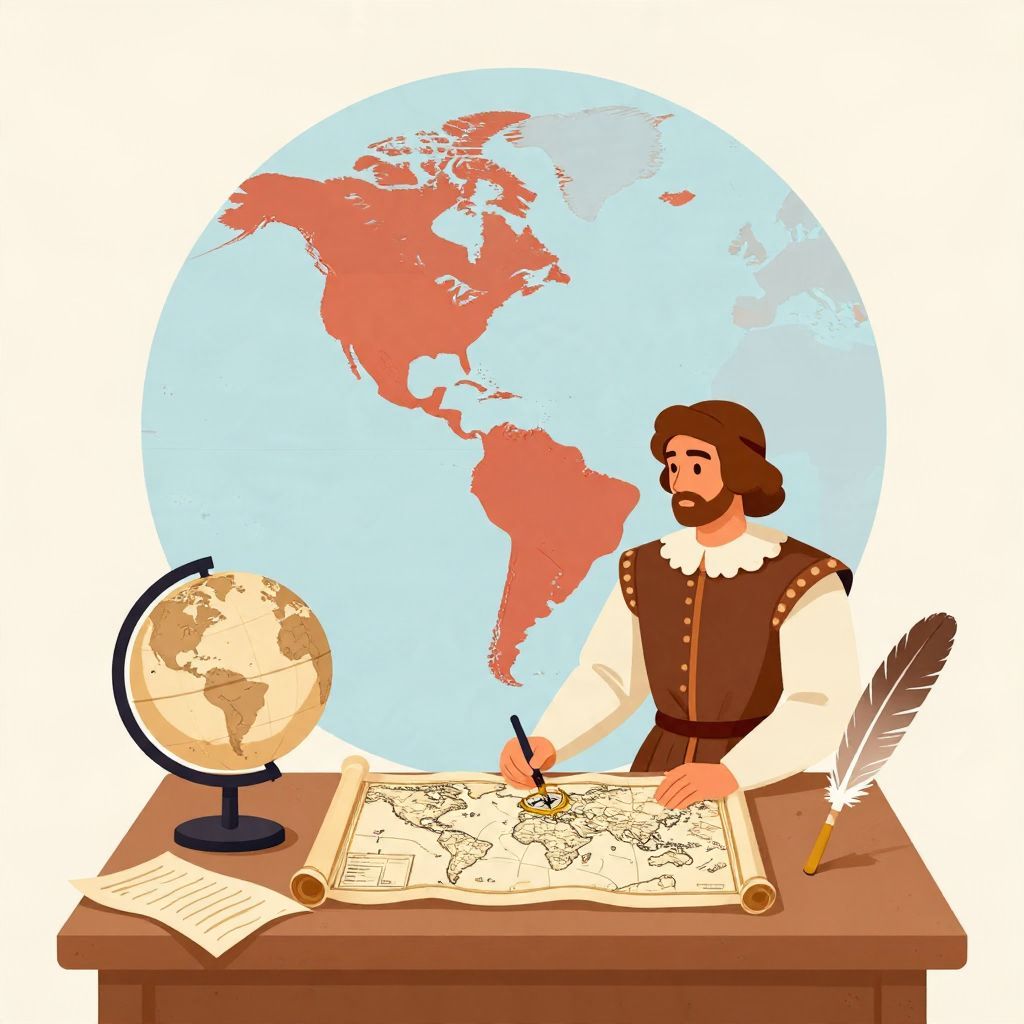
Why is America called America? The short answer is that the name came from the early 16th-century European mapmaking tradition, not from any Indigenous language or from Christopher Columbus. The label spread after cartographers began using the Latinized form of the explorer Amerigo Vespucci’s first name for the newly recognized lands across the Atlantic.
That simple explanation hides a more complicated story about exploration, printing, and the way Europeans understood the world in the age of discovery. The name “America” emerged gradually, and its meaning changed as Europeans came to see the Western Hemisphere as a separate set of continents rather than part of Asia.
Why Is America Called America?
America is called America because a German cartographer, Martin Waldseemüller, used the Latinized name “America” on a 1507 world map for the newly described lands in the Western Hemisphere. He based it on Amerigo Vespucci, whose writings suggested that these lands were not Asia but a separate “New World.” The name then spread through maps and books.
The Origin of the Name in Early 16th-Century Europe
The name “America” first appeared in print in 1507, on Waldseemüller’s large wall map and in a companion text. This was a period when European scholars, sailors, and princes were trying to make sense of voyages across the Atlantic. Columbus had reached the Caribbean in 1492, but many educated Europeans still thought those lands were part of Asia. Vespucci’s accounts helped change that view.
Why Vespucci mattered
Amerigo Vespucci, an Italian navigator and merchant, took part in voyages along the coasts of South America in the late 1490s and early 1500s, though the exact details of every voyage are sometimes debated. In letters attributed to him, he argued that the lands he had seen were not the edge of Asia but a previously unknown continent. Whether every letter was fully authentic is disputed, but his name became strongly associated with the idea of a “new world.”
Waldseemüller’s map and the naming decision
Waldseemüller and his colleagues in the Lorraine circle of scholars wanted a name for the new landmass. They used “America” as the feminine Latin form of “Americus,” the Latin version of Amerigo. Their logic was simple: Europe, Asia, and Africa already had names; the new land should have one too. In their view, Vespucci had helped reveal its separate identity, so the continent could be named after him.
How the Name Spread
Once printed, the name gained authority. In the early modern world, maps were powerful tools of knowledge. A name on an influential map could travel quickly through Europe, especially when copied by other cartographers and publishers. “America” appeared first on maps of South America, then on maps showing both North and South America, and eventually became the standard European term for the continents.
Printing made the name durable
Before printing, place-names could remain local or unstable. The printing press helped standardize geography. A map was not just a picture; it was an argument about how the world was organized. Once “America” entered printed geography, it became increasingly difficult to replace. Later mapmakers repeated the term, and schoolbooks and atlases reinforced it.
The term expanded beyond one continent
At first, “America” did not always mean the whole hemisphere. Some early uses referred mainly to South America. Over time, Europeans used it for the broader landmass, and later English usage often treated North and South America as separate continents within the larger Americas. Today, “America” can mean the United States in everyday speech, but historically the name originally referred to the continents, not the modern country alone.
Why Not Columbus?
Many people assume America was named after Christopher Columbus, but that is not how the historical naming worked. Columbus was the first European to make sustained contact with the Caribbean in 1492, yet he believed he had reached parts of Asia. Because of that, his name was not chosen for the new continent. Vespucci, by contrast, was linked to the idea that the lands were a distinct world.
A common myth, but not the historical origin
The Columbus explanation is understandable because he is the most famous early Atlantic explorer. Still, the documentary trail points elsewhere. The earliest known use of “America” is tied to Waldseemüller’s map, not to Columbus. That does not mean Columbus was unimportant; it means the naming followed a different chain of events than popular memory often suggests.
What “America” Meant in the Age of Discovery
To understand the name, it helps to remember that Europeans in the early 1500s did not yet have a settled picture of global geography. The idea of a separate Western Hemisphere developed slowly. “America” expressed a new understanding: the Atlantic lands were not simply extensions of Asia, but a distinct part of the world. The name therefore marked a major shift in geographic knowledge.
From discovery to classification
European exploration was not only about travel; it was also about naming, classifying, and claiming. Once a place was named on a map, it became easier for European powers to discuss possession, trade, and colonization. The word “America” thus belongs to a larger history of empire and cartography. It was part of how Europeans turned exploration into a mental map of the world.
Did the Indigenous Peoples Call It America?
No. The peoples living in the Americas before European arrival had their own names for their lands, communities, and regions. There was no single Indigenous name for the entire hemisphere because it contained many societies, languages, and political systems. The term “America” is a European label applied after contact, and it reflects European mapping practices rather than Indigenous self-identification.
Why this matters historically
Recognizing that “America” is a European name helps explain the colonial origins of the term. It also reminds us that the continents were not “empty” or unnamed before Europeans arrived. They were home to countless nations and civilizations, from the Maya and Mexica to the Inca and many others, each with their own geographic concepts and place-names.
Was Waldseemüller the Only Person Involved?
No. Although Waldseemüller is usually credited with popularizing the name, the story involved a broader network of scholars, printers, and mapmakers. The name emerged in a specific intellectual environment where humanists were reading travel accounts, debating geography, and revising inherited ideas from classical antiquity. Vespucci’s reputation, whether fully deserved or partly exaggerated, helped make the naming plausible.
How scholarly debate shaped the name
Early modern scholars often relied on letters, reports, and secondhand accounts. They did not have modern standards of verification, and some texts circulated in altered or embellished forms. Even so, the core historical development is clear: a new geographic name was needed, Vespucci was associated with recognizing a new continent, and “America” entered print as the chosen label.
Why the Name Survived
The name survived because it was useful, memorable, and already in circulation. Once European maps, atlases, and educational texts adopted it, the term became standard. Later political developments also reinforced it. As European colonies grew and eventually became independent states, “America” remained a powerful geographic and cultural label, especially in English-speaking contexts.
From continent to country
In the modern era, “America” often refers specifically to the United States of America. That usage developed because the country adopted the word in its official name after independence. But historically, the name predates the United States by nearly three centuries. The country inherited a continental term already in use, rather than creating it.
The Historical Significance of the Name
The naming of America is significant because it shows how knowledge is made. It was not simply a matter of one explorer “discovering” a place and naming it. Instead, the name arose from exploration, interpretation, printing, and European intellectual culture. It also reflects the unequal power dynamics of colonization, since European names often replaced or overshadowed Indigenous ones.
What the name reveals about history
“America” tells us that maps are historical documents, not neutral objects. They reveal what a society knows, what it values, and what it chooses to emphasize. The name also shows how quickly a scholarly suggestion can become a global standard when backed by print culture and empire. In that sense, the history of the word is also a history of modern world-making.
In Summary
America is called America because early 16th-century European mapmakers used the Latinized name of Amerigo Vespucci for the newly recognized lands of the Western Hemisphere. The term first appeared in print in 1507 and spread through maps and books. It was not named for Columbus, and it did not originate with Indigenous peoples. For a related look at the topic, see where the name America came from and what America was called before America.