
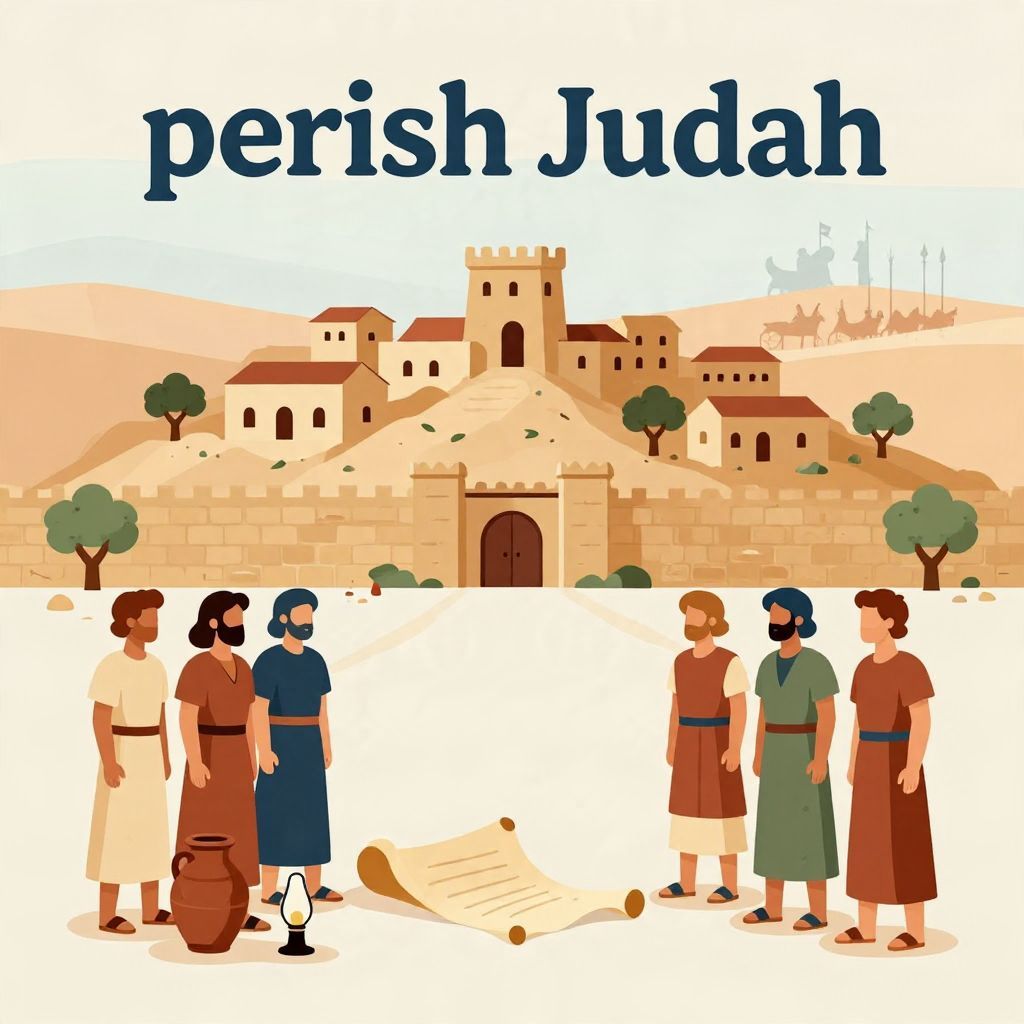
What does “perish Judah” mean? In most historical and biblical contexts, the phrase is not a standard ancient slogan or place-name. It is usually a modern misreading, mistranslation, or mishearing of language connected to Judas, Judah, or a hostile phrase about the people of Judah in the Bible. The exact meaning depends on where the words appear and which text is being discussed.
To understand it properly, we need to separate the biblical tribe and kingdom of Judah from later Christian traditions about Judas Iscariot, whose betrayal of Jesus became one of the most famous episodes in the New Testament.
What Does “Perish Judah” Mean?
“Perish Judah” is not a fixed historical term with one agreed meaning. It is most often read as an English phrase meaning “let Judah be destroyed” or “Judah will fall,” but in practice it usually reflects confusion between Judah and Judas, or a loose translation of a biblical passage about the kingdom of Judah. In historical terms, it points to ancient religious and political conflict, not a single event or slogan.
Judah and Judas: Why the Words Get Confused
Judah in the ancient world
Judah was one of the tribes of ancient Israel and later the name of a southern kingdom centered in Jerusalem. After the split of the united monarchy, Judah became the dominant southern state, surviving until the Babylonian conquest in the early 6th century BCE. In the Bible, “Judah” can mean the tribe, the kingdom, or the people descended from it.
Judas in the New Testament
Judas, especially Judas Iscariot, is the disciple traditionally remembered for betraying Jesus in the Passion narratives. Because “Judas” and “Judah” sound similar in English, people sometimes confuse the two. Historically, however, they refer to different things: one is an ancient Israelite polity and ethnic identity, the other a first-century figure in the Jesus movement.
Where the Phrase Likely Comes From
The phrase “perish Judah” is best understood as a paraphrase, not a standard quotation. It may arise from one of three sources: a Bible translation, a sermon-style interpretation, or a modern internet misunderstanding. In older religious language, “perish” often means “fall,” “be ruined,” or “come to destruction,” especially in prophetic speech about judgment.
Possible biblical background
Several biblical passages speak of Judah facing punishment, exile, or destruction because of covenant violation, idolatry, or political failure. Prophetic books such as Jeremiah, Isaiah, and Ezekiel repeatedly warn that Judah will suffer if it does not repent. These texts are not simple predictions of doom; they are part of a broader ancient Near Eastern tradition of moral warning and national lament.
Possible confusion with “Judas” traditions
In Christian tradition, Judas Iscariot became a symbol of betrayal and tragic ruin. Later literature, preaching, and popular culture often use harsh language about him. If someone hears “perish Judah” in a religious setting, it may actually be a distorted reference to Judas, not Judah. That distinction matters because one is a collective historical identity and the other an individual in the Gospel story.
Historical Timeline: Judah from Kingdom to Symbol
To see why the phrase can feel loaded, it helps to place Judah in historical sequence.
- c. 10th century BCE: Tradition places the rise of the united monarchy of Israel and Judah under David and Solomon, though historians debate the scale and form of this early state.
- c. 930 BCE: The kingdom splits into northern Israel and southern Judah.
- 8th–7th centuries BCE: Judah survives after the fall of the northern kingdom to Assyria in 722 BCE, becoming the main center of Israelite political and religious life.
- 586 BCE: Babylon destroys Jerusalem and the First Temple, ending the kingdom of Judah and sending many elites into exile.
- 539–515 BCE: Persian rule allows a return and rebuilding of the temple, but Judah no longer exists as an independent kingdom in the old sense.
- 1st century CE: “Judea,” derived from Judah, is a Roman province in the era of Jesus.
- Early Christian era: Judas Iscariot becomes a central figure in Gospel narratives of betrayal, which later readers sometimes mix up with Judah.
The Historical Meaning of “Perish” in Biblical Language
In older religious texts, “perish” does not always mean immediate annihilation. It can mean defeat, exile, loss of status, or divine judgment. Ancient writers often used strong language to describe national catastrophe. When Judah is said to “perish” in prophetic or poetic contexts, the text is usually expressing the danger of collapse under foreign pressure and internal corruption.
Judgment, exile, and restoration
The biblical story of Judah is not only about destruction. It also includes survival, exile, return, and reinterpretation. After the Babylonian conquest, the people of Judah preserved their identity through worship, law, memory, and scripture. That is one reason the term “Judah” remained historically important even after the kingdom itself disappeared.
Why the Phrase Has Historical Significance
The importance of “perish Judah” lies less in the phrase itself than in what it reveals about historical memory. It shows how biblical language can be compressed, misheard, or repurposed across centuries. It also reflects the long history of Judah as both a political kingdom and a religious symbol in Judaism and Christianity.
Judah as a political identity
Historically, Judah was a real kingdom with kings, fortifications, trade networks, and diplomatic struggles. Its destruction by Babylon was one of the defining events of ancient Israelite history. Any phrase implying Judah’s “perishing” evokes this collapse and the trauma of exile, which shaped later Jewish identity.
Judah as a religious and cultural symbol
After the exile, “Judah” and “Judea” remained central terms in Jewish and Roman-era history. The name persisted in geography, ethnicity, and scripture. In Christian interpretation, Judah also became part of salvation history, especially through the lineage traditions associated with David and Jesus. That is why language about Judah often carries layers of meaning beyond the literal.
Common Misreadings and How to Read the Phrase Carefully
1. It may not be a historical phrase at all
Sometimes “perish Judah” appears because of a translation error, a misheard lyric, or an online quote taken out of context. If the phrase is not attached to a specific source, it should be treated cautiously.
2. It may refer to biblical judgment on the kingdom of Judah
In that case, the phrase points to the fall of Judah in 586 BCE and the prophetic literature that interpreted that event as the result of covenant unfaithfulness and political instability.
3. It may be a confusion with Judas Iscariot
Because Judas is associated with betrayal and destruction in Christian tradition, some readers mistakenly substitute “Judah” for “Judas.” Historically, that changes the meaning entirely.
What Scholars Generally Agree On
There is broad agreement on several points. Judah was an ancient southern kingdom in the Levant. It was conquered by Babylon in 586 BCE. The name later survived in the forms “Judea” and “Jew.” Judas Iscariot is a separate first-century figure in Christian texts. Beyond that, the exact meaning of “perish Judah” depends on the source text and should not be treated as a fixed historical phrase.
- Judah = ancient kingdom, tribe, and later regional identity.
- Judas = New Testament disciple associated with betrayal.
- Perish = a term of destruction, ruin, or judgment in older English.
- Historical context = usually biblical prophecy, exile, or later religious interpretation.
Final Takeaway
So, what does “perish Judah” mean? Historically, it is best understood as a loose or mistaken phrase referring either to the destruction of the kingdom of Judah or to confusion with Judas Iscariot. The phrase is not a standard ancient term, but it opens a window onto the long and complex history of biblical Judah, its fall, and its lasting place in religious memory. For related context, see what happened to Judas after he betrayed Jesus and what Gethsemane means.