
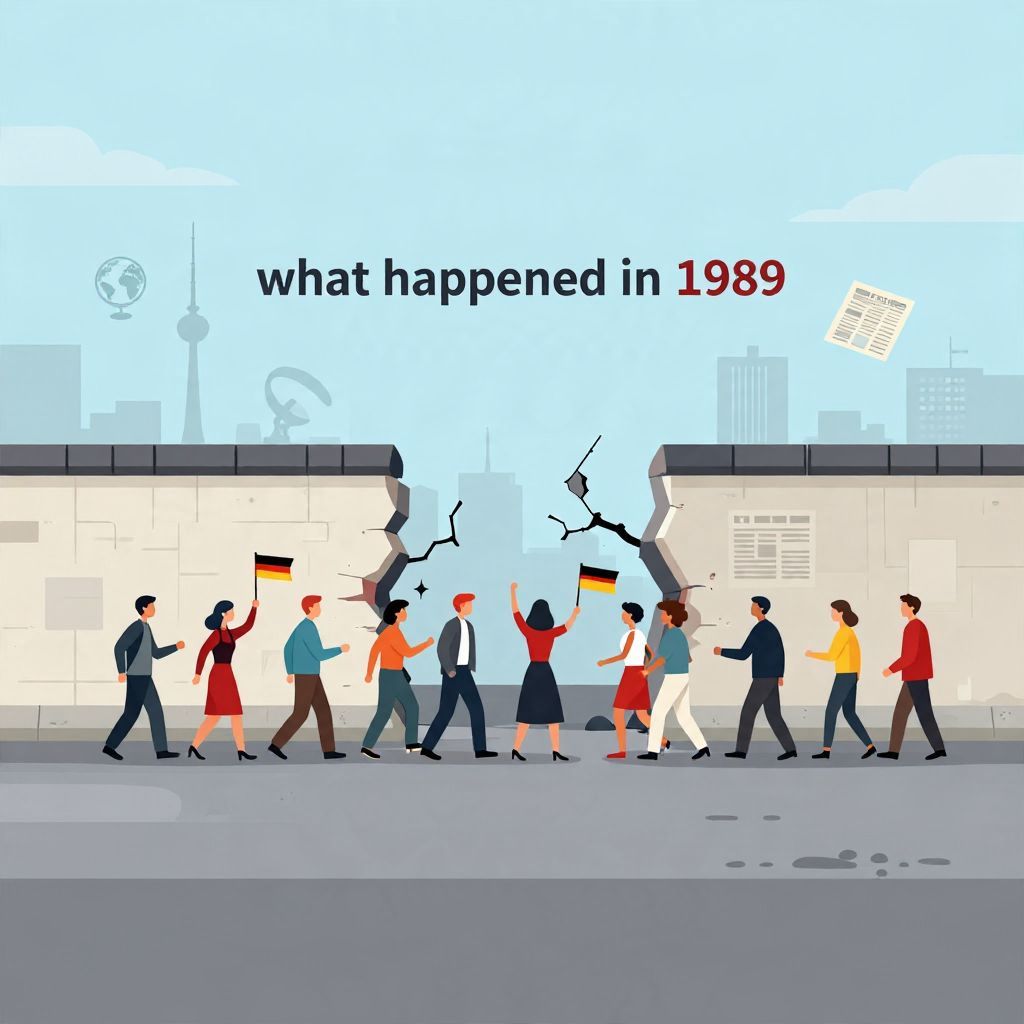
What happened in 1989? In short, it was one of the most consequential years of the 20th century. Across Europe, Asia, and the Americas, long-standing political systems began to crack, while protests, revolutions, and negotiated reforms reshaped the global order.
The year is best remembered for the collapse of communist rule in Eastern Europe, the Tiananmen Square crackdown in China, and the growing end of the Cold War. But 1989 also brought major changes in technology, culture, and international politics that still shape the world today.
What happened in 1989?
1989 was a turning point in modern history. The most dramatic developments were the fall of communist governments across Eastern Europe, the opening of the Berlin Wall, and the weakening of Soviet control over its bloc. At the same time, China’s government violently suppressed pro-democracy protests, showing that political change in 1989 did not follow a single path.
1989 timeline: the major events
The year unfolded quickly, with one event often triggering the next. Below is a simplified timeline of some of the most important developments.
- April–June: Pro-democracy demonstrations grew in China, culminating in the Tiananmen Square crackdown on 3–4 June.
- June: Poland held partially free elections after negotiations between the communist government and Solidarity.
- August: Hungary opened its border with Austria, helping East Germans flee to the West.
- September–October: Mass protests spread in East Germany, Czechoslovakia, and other Eastern European states.
- 9 November: The Berlin Wall opened after a confused announcement by East German authorities.
- December: Communist regimes fell in Czechoslovakia and Romania; the Romanian revolution ended with the execution of Nicolae and Elena Ceaușescu.
Why 1989 mattered so much
1989 mattered because it accelerated the collapse of the post-World War II division of Europe. For decades, the Soviet Union had dominated much of Eastern Europe through allied communist governments, military pressure, and political control. By 1989, economic stagnation, public dissatisfaction, reform movements, and shifting Soviet policy had made that system increasingly unstable.
The Soviet context: reform and restraint
Under Mikhail Gorbachev, the Soviet Union had introduced perestroika (restructuring) and glasnost (openness). These reforms were meant to strengthen socialism, not destroy it. But they loosened political control and signaled that Moscow was less willing to use force to preserve communist governments in Eastern Europe. That change was crucial.
Pressure from below
In many countries, ordinary people were already pushing for change. Workers, students, intellectuals, and religious groups demanded greater freedom, better living standards, and more political participation. In places such as Poland and East Germany, opposition movements had been building for years. In 1989, those pressures finally broke through.
Eastern Europe in 1989: the communist bloc unravels
The collapse of communist rule in Eastern Europe was not a single event but a chain reaction. Once one government began to loosen control, neighboring states faced renewed pressure from their own populations. The result was a rapid and often surprising transformation.
Poland and the rise of Solidarity
Poland was the first major breakthrough. After years of labor unrest and negotiation, the communist authorities agreed to partly free elections in June 1989. The opposition movement Solidarity won overwhelmingly in the seats it was allowed to contest. This did not instantly end communist rule, but it made clear that the old system had lost legitimacy.
Hungary opens the Iron Curtain
In Hungary, reform-minded leaders moved faster than many of their neighbors. In 1989, the government dismantled border barriers with Austria. This mattered far beyond Hungary because East Germans used the opening to travel west. The move weakened the East German state and helped turn a regional reform into a continental crisis.
East Germany and the fall of the Berlin Wall
East Germany became the symbol of 1989. As protests grew in cities such as Leipzig, the government struggled to respond. On 9 November, after a confusing press announcement about travel rules, crowds gathered at the Berlin Wall. Border guards eventually allowed people through, and the wall that had divided Berlin since 1961 effectively ceased to function. Its fall became the defining image of the year.
Czechoslovakia’s Velvet Revolution
In Czechoslovakia, mass demonstrations in November led to what became known as the Velvet Revolution, a largely peaceful transfer of power. By the end of the year, communist leaders had stepped down, and dissident playwright Václav Havel emerged as a key national figure. The peaceful nature of the transition made it especially notable in a year marked elsewhere by violence and uncertainty.
Romania’s violent revolution
Romania’s transition was the bloodiest in Eastern Europe. Public anger at Nicolae Ceaușescu’s authoritarian rule, economic hardship, and repression erupted in December. The regime collapsed after armed conflict, and Ceaușescu and his wife were executed on 25 December 1989. Romania’s revolution showed that the end of communist rule could be abrupt, chaotic, and deadly.
China in 1989: Tiananmen Square and its aftermath
While Eastern Europe moved toward democracy, China took a different path. In spring 1989, students and other citizens gathered in Beijing and elsewhere to demand political reform, anti-corruption measures, and greater freedom. The protests centered on Tiananmen Square, but they were part of a wider national movement.
The crackdown
On 3–4 June 1989, the Chinese government used military force to clear the protests. The exact number of deaths remains disputed, and estimates vary widely. What is certain is that the crackdown ended the movement and led to arrests, censorship, and political tightening. The event remains one of the most sensitive and controversial in modern Chinese history.
Why China’s path differed
China’s Communist Party chose repression rather than political liberalization. Unlike the Soviet bloc in Eastern Europe, the Chinese leadership did not permit the opposition to negotiate an orderly transition. The contrast between China and Eastern Europe in 1989 is one of the year’s most important historical lessons: reform movements can produce very different outcomes depending on how rulers respond.
The Cold War in 1989: the beginning of the end
1989 did not formally end the Cold War, but it made the old rivalry difficult to sustain. The division of Europe had been one of the central features of postwar international politics. Once communist governments began falling and Soviet control weakened, the geopolitical balance shifted rapidly.
What changed in international relations
Western governments watched the upheavals carefully, but much of the change came from within the Eastern bloc itself. The Soviet Union’s reluctance to intervene militarily marked a major departure from earlier decades, such as the invasions of Hungary in 1956 and Czechoslovakia in 1968. By late 1989, many observers understood that the Cold War era was entering its final phase.
What did not end immediately
Even after 1989, the Soviet Union still existed, and communist parties still governed several states. The Warsaw Pact and Soviet Union itself would survive until 1991. Still, the political momentum had shifted irreversibly. 1989 was the year the old order lost its confidence and much of its control.
Other important events in 1989
Although political upheaval dominated the year, 1989 also saw major developments in other areas.
Technology and everyday life
The late 1980s were a period of rapid change in personal computing, telecommunications, and media. The world was not yet fully digital, but new technologies were beginning to reshape work, entertainment, and communication. These shifts would become more visible in the 1990s, but 1989 belonged to the transition era.
Culture and global attention
1989 was also a year of intense global news coverage. Television brought images of demonstrations, border crossings, and collapsing regimes into homes around the world. That visibility mattered: public awareness of events in Eastern Europe helped turn local political struggles into a shared international story.
Environmental and social concerns
Across many countries, environmental issues, civil rights debates, and economic reforms were gaining prominence. The year did not revolve only around revolutions. It also reflected a broader world in motion, with societies reassessing power, identity, and the future.
Historical impact of 1989
The impact of 1989 was enormous. It reshaped Europe, altered the balance of power in world politics, and influenced how people thought about democracy and authoritarianism. The year is often treated as a hinge between the late Cold War and the post-Cold War world.
Germany reunifies
The fall of the Berlin Wall set the stage for German reunification in 1990. That process transformed Europe’s political geography and became one of the most visible consequences of 1989.
Communism loses its grip in Eastern Europe
By the end of the year, communist governments across much of Eastern Europe had either fallen or begun to collapse. This did not instantly create stable democracies, but it ended decades of one-party rule in much of the region.
New debates about freedom and reform
1989 also changed political language. Terms such as democracy, civil society, reform, and human rights gained renewed force in public debate. At the same time, the year reminded the world that political liberalization is not guaranteed to be peaceful or universal.
How historians view 1989
Historians generally agree that 1989 was a watershed year, but they differ on how to explain it. Some emphasize the role of grassroots protest and popular movements. Others focus on elite decisions, especially Gorbachev’s refusal to use force. Most modern scholarship sees the year as the result of both: pressure from below and restraint from above.
It is also important not to oversimplify 1989 as a universal triumph. The year brought liberation to many, but it also included violence, uncertainty, and unresolved problems. In China, reform was suppressed. In Eastern Europe, the transition to democracy and market economies created new hardships for some people even as it opened political freedoms.
So, what happened in 1989?
1989 was the year the Cold War order began to collapse in real time. Communist rule fell across much of Eastern Europe, the Berlin Wall opened, China crushed a pro-democracy movement, and the global political landscape changed dramatically. Few individual years have had such immediate and lasting historical consequences.
If you want to explore the broader context of the late 20th century, you may also find it useful to read about what happened in 2010 and what happened in 2013. But for modern history, 1989 remains one of the clearest examples of a year that changed the world.