
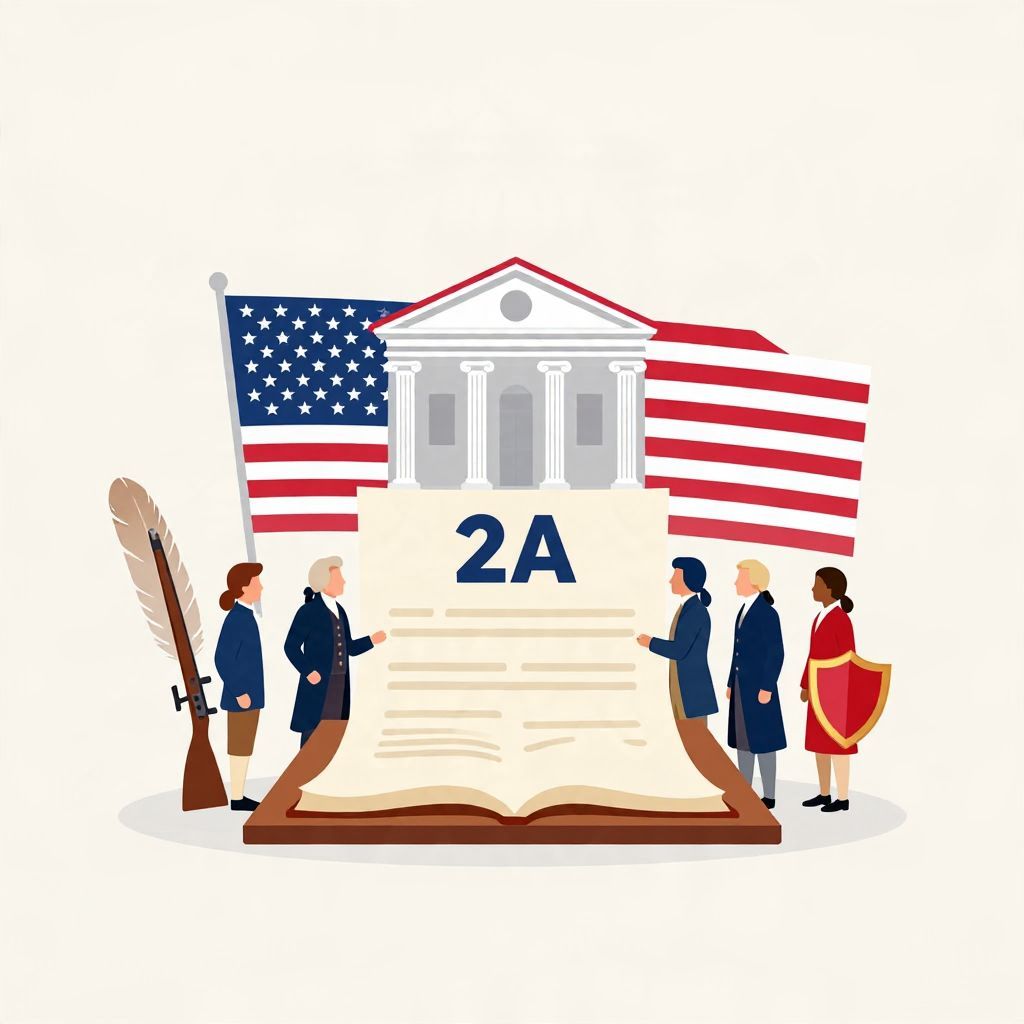
What is 2A? In U.S. political history, “2A” is shorthand for the Second Amendment to the United States Constitution. It is best known for protecting a right to “keep and bear Arms,” but its meaning has been debated for more than two centuries.
To understand 2A, you need both its historical origins and the changing ways Americans have interpreted it. The amendment grew out of the Revolutionary era, fears of standing armies, and the early republic’s concern with militia service, individual liberty, and federal power.
What Is 2A in the United States Constitution?
The Second Amendment, ratified in 1791 as part of the Bill of Rights, states that “the right of the people to keep and bear Arms, shall not be infringed.” Historically, it emerged from post-Revolution debates over militias, self-defense, and limits on federal authority. Its exact scope has been contested ever since.
The Origins of 2A in the Revolutionary Era
2A cannot be understood apart from the American Revolution and the political world that followed it. Many Americans in the late 1700s associated liberty with resistance to tyranny, local militia service, and suspicion of permanent standing armies. These ideas shaped the Constitution and the later Bill of Rights.
Colonial experience and fear of standing armies
In British North America, colonists had long relied on local militias for defense. At the same time, they associated standing armies with imperial control. British troops stationed in the colonies before and during the Revolution reinforced the belief that a large permanent army could threaten civil liberty.
The Revolutionary War and militia traditions
The war itself strengthened the importance of armed citizens in the political imagination of the new nation. Militias were not always effective, but they were central to colonial and revolutionary military life. That experience helped convince many founders that an armed populace could serve as both a defensive force and a safeguard against oppression.
Why Was the Second Amendment Added?
After independence, the new federal Constitution created a stronger national government. Supporters argued that this was necessary for stability; critics feared it might become too powerful. The Bill of Rights, including 2A, was added to reassure skeptics that the federal government would not swallow the liberties of the states or the people.
Anti-Federalist concerns
During ratification debates in 1787–1788, Anti-Federalists worried that the Constitution gave the national government too much military power. They feared Congress could disarm the people or neglect the state militias. A bill of rights was seen as a way to limit federal authority and preserve a balance between government and citizen power.
James Madison and the Bill of Rights
James Madison, who drafted the amendments that became the Bill of Rights, drew on state proposals and ratification demands. The final wording of the Second Amendment was concise, but that brevity has contributed to later debate. The amendment links a “well regulated Militia” with “the right of the people,” leaving room for different interpretations.
What Does the Text of 2A Say?
The full text of the amendment is short but historically dense: “A well regulated Militia, being necessary to the security of a free State, the right of the people to keep and bear Arms, shall not be infringed.” Scholars have long debated whether the prefatory clause about militia service limits the operative clause or simply explains its purpose.
Key phrases in historical context
- “Well regulated Militia” referred to an organized, trained militia, not regulation in the modern sense of government restriction alone.
- “The right of the people” echoes other constitutional rights language, such as in the First and Fourth Amendments.
- “Keep and bear Arms” was understood in the 18th century to involve possession and carrying of weapons, but the exact legal scope remains debated.
- “Free State” most likely referred to the security of a free political community, though some later readers have linked it specifically to state governments.
How 2A Was Understood in the Early Republic
In the early decades of the United States, the Second Amendment was not the center of national politics in the way it is today. Firearms were common tools of daily life, and state laws often assumed that white male citizens could possess arms while also serving in militias when called upon. The amendment’s practical meaning was shaped more by local custom than by repeated Supreme Court rulings.
Militia service and citizenship
In the 18th and early 19th centuries, militia duty was tied to citizenship and civic obligation. Men expected to furnish their own weapons when required. This historical reality is important: the amendment did not emerge from a world of modern police forces, mass-produced firearms, or contemporary gun politics.
Limits and exclusions
Like many rights in the early United States, access to arms was not equal. Enslaved people were disarmed, and many free Black Americans, Native Americans, women, and others were excluded from full civic participation. So while 2A is often discussed as a universal liberty, its historical application was shaped by the inequalities of the era.
How the Meaning of 2A Changed Over Time
The Second Amendment’s interpretation evolved as the United States changed. As the nation expanded westward, as military institutions professionalized, and as states adopted new gun laws, the amendment was increasingly read through modern legal and political disputes rather than through the original militia-centered world of 1791.
19th-century developments
In the 1800s, firearms became more widespread and more lethal, and states passed a variety of gun regulations. The federal government did not play a large role in gun policy for much of this period. Legal understandings of the Second Amendment remained relatively limited compared with the intense constitutional debate that would emerge later.
Reconstruction and the post-Civil War era
After the Civil War, weapons and self-defense took on new political meaning in the struggle over freedom, citizenship, and racial violence. The Fourteenth Amendment and federal civil rights legislation altered the constitutional landscape, but the Supreme Court did not fully settle how the Bill of Rights applied to the states. This left room for later reinterpretation.
Modern Debates Over 2A
In the 20th and 21st centuries, the Second Amendment became one of the most contested parts of the Constitution. The central dispute is whether it protects primarily a collective right tied to militia service or an individual right to possess firearms for lawful purposes such as self-defense.
Competing interpretations
One historical reading emphasizes the amendment’s militia origins and the founders’ concern with organized defense and federal power. Another stresses the phrase “the right of the people” and argues that the amendment protects individual gun ownership. Both interpretations draw on real historical evidence, but they emphasize different parts of the founding context.
Supreme Court milestones
Modern constitutional law has played a major role in shaping public understanding of 2A. In District of Columbia v. Heller (2008), the Supreme Court held that the Second Amendment protects an individual right to possess a firearm unconnected with militia service, at least for lawful purposes such as self-defense in the home. In McDonald v. City of Chicago (2010), the Court applied that protection against state and local governments through the Fourteenth Amendment.
These decisions did not end debate. They clarified one legal approach, but historians and legal scholars still disagree about how closely that approach matches the amendment’s original context.
Why 2A Remains Historically Important
The significance of 2A goes beyond gun policy. It reflects foundational questions about the American republic: Who should hold power? How should liberty be protected? What role should armed citizens play in a democracy? Because the amendment sits at the intersection of rights, violence, citizenship, and state authority, it remains central to American political history.
Broader historical themes behind the amendment
- Federalism: the balance between national and state power.
- Republican ideology: the belief that citizens should guard against tyranny.
- Militia tradition: the older civic model of defense before a modern standing military became dominant.
- Rights discourse: the broader constitutional idea that certain liberties should be protected from government interference.
Common Misunderstandings About 2A
Because the Second Amendment is often discussed in modern political arguments, it is easy to simplify it in ways that flatten history. A careful historical reading shows that the amendment was not written in a vacuum and does not map neatly onto every present-day dispute.
It was not written for today’s gun culture
The founders did not know modern assault-style weapons, concealed-carry licensing systems, or contemporary policing. The amendment was created in a world of muskets, militias, and a fragile new republic. That does not make it irrelevant, but it does mean that historical context matters.
It was not only about hunting or self-defense
Although Americans later connected firearms to hunting and personal protection, those were not the only historical concerns behind 2A. The amendment grew out of a political crisis about power, security, and the structure of the republic.
It was not originally a simple slogan
“2A” is a modern shorthand, but the amendment’s history is layered. Its meaning has shifted as the United States itself changed, and that is why historians, judges, and citizens continue to debate it.
Conclusion: What 2A Means in Historical Perspective
What is 2A? Historically, it is the Second Amendment, born from the Founding Era’s concerns about militias, liberty, and federal power, and later transformed by changing legal and political debates. Its enduring importance lies in how it captures a central American tension: the relationship between individual rights and collective security. For more context, see related discussions of political rights and political ideology.