
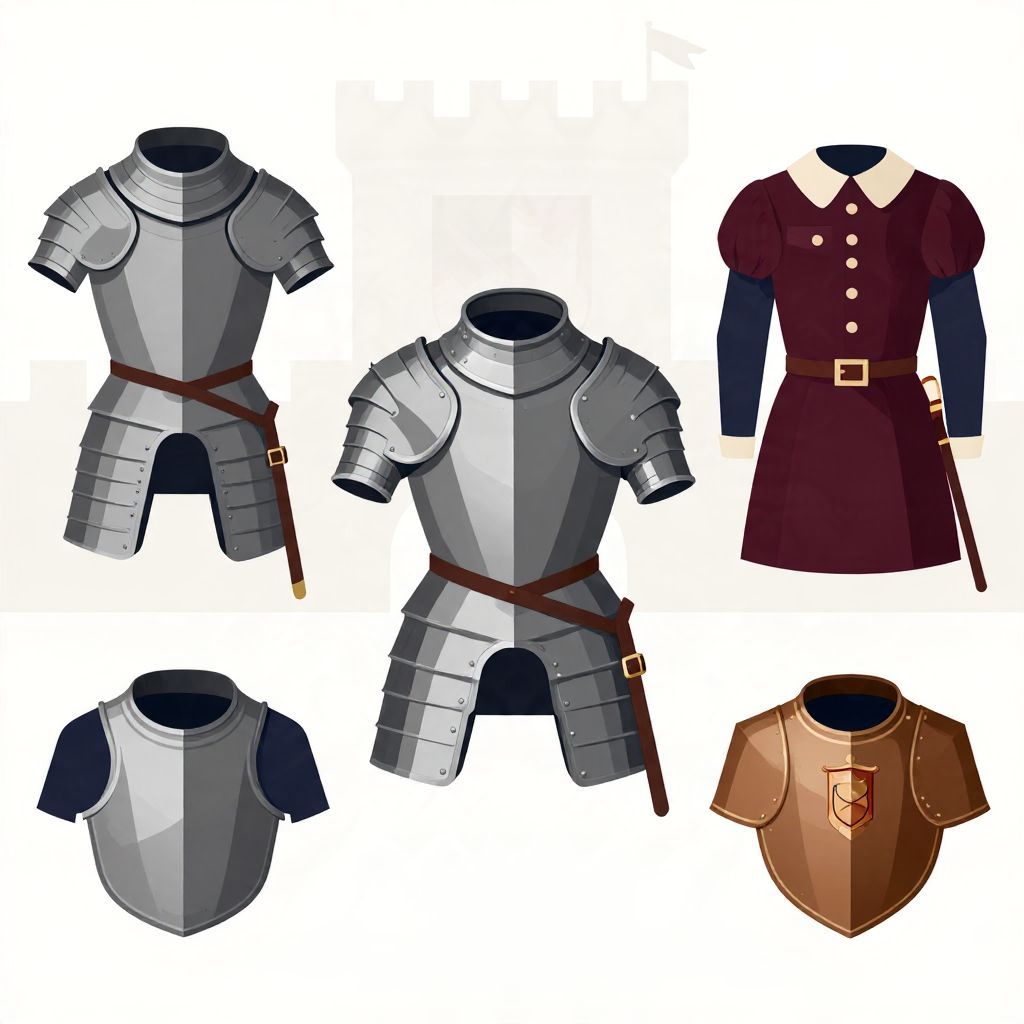
A gorget is a piece of protective wear or insignia worn around the throat and neck. In military history, the word most often refers to a metal collar or throat plate that was part of armor in the Middle Ages and later became a decorative mark of rank for officers. The term has also been used in civilian fashion and, more broadly, for the neck area itself in older English.
Because the gorget changed meaning over time, it is a useful example of how practical equipment can become symbolic. Its history runs from battlefield protection to status emblem, and then largely into ceremonial use.
What Is a Gorget?
A gorget is a neck covering or neck plate, originally designed to protect the throat in armor. In medieval and early modern Europe, it was worn as part of a suit of armor; by the 17th and 18th centuries, it often survived as a smaller metal badge or collar worn by officers as a sign of authority rather than defense.
Where Did the Word “Gorget” Come From?
The word gorget comes from the French gorgerin, from gorge, meaning throat. That linguistic origin reflects the object’s original purpose: to guard the throat and upper chest. In English, the term entered use in the late medieval period and gradually broadened from a practical armor component to a ceremonial item.
The Gorget in Medieval Armor
In the Middle Ages, the throat was one of the most vulnerable parts of the body in combat. Armor makers responded by developing pieces that protected the neck and upper chest. Early gorgets could be simple metal plates, leather reinforcements, or integrated parts of a helmet-and-breastplate system. Their design varied by region, century, and the needs of the wearer.
Protection in a dangerous fighting environment
As armor improved, so did the effort to close gaps between helmet, breastplate, and shoulder defenses. The gorget helped shield a place where a sword, spear, arrow, or later firearms-related fragments could cause severe injury. It was not always a separate object: in many suits of armor, the throat defense was built into the larger ensemble.
From functional armor to specialized plate
By the late medieval and early modern periods, armor became more tailored and standardized. A gorget might consist of overlapping steel plates that sat around the base of the neck, sometimes attached to the helmet or worn beneath other armor. As battlefield technology changed, especially with the spread of firearms, full armor became less common, but the gorget remained in some military contexts.
How the Gorget Became a Symbol of Rank
As heavy armor declined in everyday warfare, the gorget took on a new role. In the 17th and 18th centuries, officers in several European armies wore small ornamental gorgets, often crescent-shaped and sometimes engraved with a coat of arms or royal insignia. These were no longer mainly for protection; they signaled command, identity, and prestige.
Why officers wore gorgets
Officers needed a visible way to distinguish themselves on the battlefield and in camp. A gorget served as a practical marker of authority in an era before standardized modern uniforms fully developed. It was especially useful in armies where rank recognition mattered for issuing orders and maintaining discipline.
Design and meaning
These later gorgets were often made of polished metal, suspended by ribbons or cords. Their shape and decoration varied by country and period, but the basic idea was similar: a small, conspicuous object placed at the throat, where it could be seen easily. In this form, the gorget became less about armor and more about military identity.
Gorgets in Different Historical Periods
The gorget did not have one fixed form. Its appearance and function changed over centuries, which is why historians and collectors must pay attention to context. A gorget from the age of plate armor is not the same thing as an officer’s gorget from the age of powdered wigs and line infantry.
Medieval and Renaissance use
In the later Middle Ages and Renaissance, gorgets were part of the broader development of plate armor. They were shaped to fit the neck and upper chest and were often paired with helmets, breastplates, and pauldrons. Armorers refined them as part of the ongoing effort to balance mobility with protection.
Early modern military use
By the 1600s and 1700s, many European armies retained gorgets as insignia for officers. In some armies they were still worn in the field; in others, they became more ceremonial or were reserved for certain ranks. Their presence on uniforms reflected the continuing importance of visible hierarchy in military culture.
19th-century survival in ceremonial form
As military uniforms became more standardized and epaulettes, sashes, and badges took on clearer roles, the gorget largely faded from active use. It survived in some ceremonial traditions and in certain military services, but it was no longer a common practical item of dress or armor.
Was the Gorget Only Military?
No. Although the military gorget is the best-known form, the word has also been used more generally for neck ornaments and protective collars in fashion and ceremonial dress. In some historical contexts, especially in older European usage, “gorget” could refer to a woman’s ornamental neck covering or neckline decoration. The meaning depended heavily on period and setting.
Fashion and ornament
In elite dress, neck ornaments often carried social meaning similar to jewelry or embroidery elsewhere on the body. A gorget in this sense was not armor but adornment, showing that the throat and neckline were considered important visual spaces in dress culture.
Broader language use
Older English sometimes used related terms for the throat itself or for garments that covered it. This is one reason the word can seem confusing today: it belongs to a historical vocabulary in which the same body part could inspire both protective gear and decorative fashion.
How the Gorget Fits Into the History of Armor
The gorget is best understood as part of the long evolution of armor. It represents a recurring problem in military history: how to protect a vulnerable area without making movement impossible. As weapons changed, armor makers adapted. The gorget is one of the clearest examples of that adaptation because the neck was both essential and exposed.
Armor as technology
Armor was never static. It changed with metallurgy, warfare, and social expectations. The gorget shows how armor could be modular, practical, and symbolic at the same time. It also reminds us that military equipment was often designed not only to save lives but to communicate rank and discipline.
The decline of full armor
With the rise of firearms and the changing nature of armies, full body armor became less practical for most soldiers. Yet certain pieces, including the gorget, lingered because they had acquired symbolic value. This is a common pattern in military history: once an object loses one function, it may survive by gaining another.
Gorget vs. Torc: Are They the Same?
No. A gorget and a torc are different objects, though both are worn around the neck and both can carry status meanings. A torc is usually a rigid neck ring associated especially with ancient Celtic and other Iron Age cultures, while a gorget is typically a throat plate, collar, or neck defense from medieval and early modern contexts.
Why people confuse them
The confusion comes from their shared placement on the body and their ceremonial associations. Both can appear in art, archaeology, and costume history as symbols of rank or identity. But they belong to different historical traditions and should not be treated as interchangeable.
Why the Gorget Matters Historically
The gorget matters because it shows how a single object can move between utility and symbolism. It began as armor, became an officer’s emblem, and then mostly disappeared from ordinary use. That shift reflects larger changes in warfare, social hierarchy, and dress. Studying the gorget helps explain how material culture preserves traces of older military worlds.
A small object with a long history
Though modest in size, the gorget connects to major historical themes: the development of armor, the rise of professional armies, the visual language of authority, and the transformation of military dress. It is a reminder that history is often carried not only in grand events, but also in the design of everyday objects.
So, what is a gorget? It is a throat or neck piece that began as protective armor and later became a badge of military rank and ceremony. If you want to explore related objects and meanings, you may also enjoy reading about the gorget in more detail and the history of the torc.