
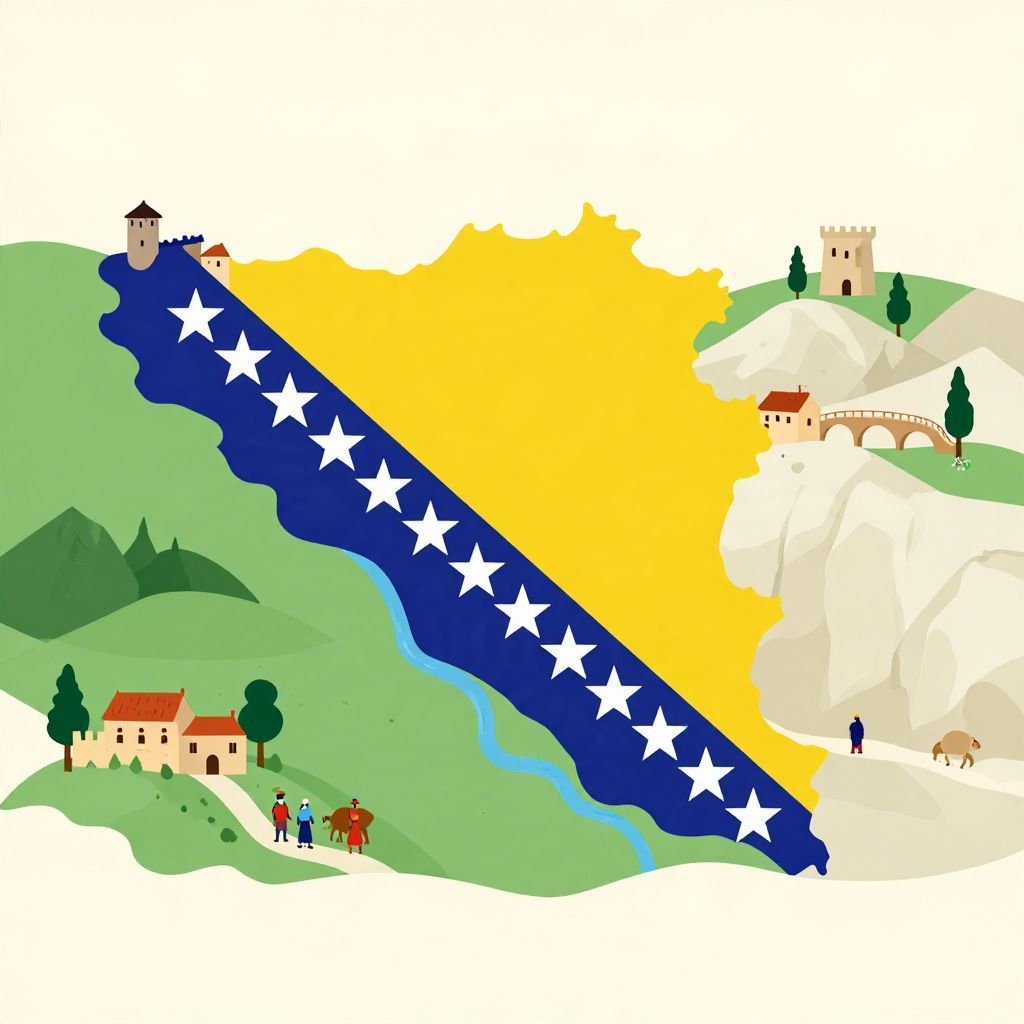
Why is Bosnia and Herzegovina called that? The short answer is that the country’s name combines two historical regions: Bosnia, a long-established medieval and geographical name, and Herzegovina, a later name that came from a 15th-century noble title. Together, they reflect the layered political history of the western Balkans rather than a single founding moment or one unified ethnic origin.
The name is best understood as a record of how lands, rulers, and identities changed over centuries. Bosnia and Herzegovina became one state much later than each name first appeared, and the combined form preserves that older regional history.
Why is Bosnia and Herzegovina called that?
It is called Bosnia and Herzegovina because the modern country unites two historically distinct regions. Bosnia is the older name, probably connected to the Bosna River and used in medieval sources, while Herzegovina comes from the title of a 15th-century ruler, herceg meaning “duke.” The state’s full name reflects the joining of these regions under later political arrangements.
The origin of the name Bosnia
A name older than the modern state
Bosnia is the older of the two names and appears in medieval written sources. Scholars generally connect it to the Bosna River, which runs through the region. The exact linguistic origin is debated, but the river-name explanation is the most widely accepted. In other words, the country was not named after a modern political idea; the political unit later took its name from an existing geographic term.
By the early Middle Ages, Bosnia was already recognized as a distinct territory in the western Balkans. It developed as a medieval banate and later kingdom, especially in the 12th to 15th centuries, before Ottoman conquest changed the region’s political structure. The persistence of the name shows how geography often outlasts dynasties and borders.
What the name probably meant
There is no single universally agreed etymology for “Bosna.” Some theories connect it to older Indo-European or Illyrian roots, while others suggest pre-Slavic or Roman-era influences. Because the evidence is fragmentary, historians usually avoid overly confident claims. What matters historically is that the name was already in use long before the modern nation-state appeared.
Where Herzegovina comes from
A title became a regional name
Herzegovina is not an ancient tribal or river name. It comes from the title herceg, a South Slavic form of the Germanic word Herzog, meaning “duke.” In the 15th century, the powerful noble Stjepan Vukčić Kosača styled himself herceg of Saint Sava. The lands associated with him gradually became known as the “herceg’s land,” or Herzegovina.
This is a classic example of a political title turning into a geographic label. Similar naming patterns appear elsewhere in history when a ruler’s title or estate becomes so closely associated with a territory that outsiders and locals begin using it as a place-name.
How the name spread
The name Herzegovina became more common in the late medieval and early Ottoman periods. It referred broadly to the southern and southwestern parts of the old Bosnian political sphere. As Ottoman administration reorganized the region, the term remained useful for distinguishing this area from Bosnia proper. Over time, the name stuck.
How Bosnia and Herzegovina became one country
From medieval lands to imperial provinces
For much of history, Bosnia and Herzegovina were not a single unified country in the modern sense. Under Ottoman rule, the region was divided into administrative units that did not always match older regional boundaries. Still, the names Bosnia and Herzegovina remained meaningful because they described real historical and geographic areas with different local traditions and administrative experiences.
In the 19th century, as empires weakened and nationalism grew across the Balkans, regional names became politically important. Bosnia and Herzegovina were brought under Austro-Hungarian occupation in 1878 and formally annexed in 1908. The combined imperial administrative unit helped закрепить the paired name in international usage.
The modern state and its inherited name
The modern country’s name reflects the twentieth-century continuation of that paired identity. After the breakup of Yugoslavia in the 1990s, the internationally recognized state retained the historical compound name Bosnia and Herzegovina. That choice acknowledged both major regional components and avoided privileging one over the other.
The name therefore does not mean the country has two separate nations in a simple sense. Rather, it records the historical fact that the territory developed from two named regions that were later joined within one political framework.
Why the name is written with “and”
A compound of two historical regions
The “and” in Bosnia and Herzegovina matters. It signals that the country is made up of two named historical regions rather than one place with a double name. Bosnia is the larger and older core region, while Herzegovina is the southern historical region whose name emerged later from noble and administrative history. The conjunction preserves that distinction.
This is why the country’s name can feel unusual to English speakers. Many country names are single inherited terms, but this one is a union of two regional names that remained meaningful over centuries of changing rule.
Not a modern invention, but a historical layer cake
The full name is not the product of a single founding event. Instead, it reflects several layers of history:
- an older regional name, Bosnia, tied to medieval geography and politics;
- a later regional name, Herzegovina, derived from a noble title;
- imperial and administrative usage that made the pairing official and familiar;
- modern statehood that preserved both names in one country.
Historical timeline of the name
Key stages in the naming of the country
- Early medieval period: Bosnia appears as a regional name in written sources.
- 12th–15th centuries: Bosnia develops as a political entity; the name becomes firmly established.
- 15th century: Stjepan Vukčić Kosača adopts the title herceg; the term Herzegovina emerges.
- Ottoman era: Bosnia and Herzegovina remain recognizable regional designations, though under new administration.
- 1878–1908: Austro-Hungarian rule helps standardize the combined name in official usage.
- 20th century to present: the modern state retains the historical compound name.
Common misunderstandings about the name
It is not named after one founder
Unlike some countries that are named after a dynasty, a saint, or a single ruler, Bosnia and Herzegovina does not come from one founding person. Bosnia is much older than Herzegovina as a name, and Herzegovina itself comes from a title rather than a family name. The country’s name is therefore historical and regional, not personal in the usual sense.
It does not mean there are only two peoples
The name can sometimes be misunderstood as if it refers to two ethnic groups or two equal historical states. In reality, it refers to two regions whose names survived political change. The country’s population has long included multiple communities, including Bosniaks, Croats, and Serbs, along with others. The name is about territory and history, not a simple ethnic formula.
Why the name still matters today
A reminder of layered history
Names often preserve older political realities long after borders change. Bosnia and Herzegovina is a good example: the country’s name still carries the memory of medieval Bosnia, the rise of Herzegovina as a regional label, Ottoman and Austro-Hungarian administration, and the modern state that eventually emerged. The name is a compact summary of centuries of change.
That is why the answer to “Why is Bosnia and Herzegovina called that?” is not just linguistic. It is historical. The name reflects how regions were formed, ruled, renamed, and eventually joined into one country.
For readers interested in how place-names preserve history, it can also be useful to compare this case with why Latin America is called Latin America or why Iceland is called Iceland. Bosnia and Herzegovina’s name, like those examples, shows how geography, politics, and language can leave a lasting mark on the map.
In short: Bosnia and Herzegovina is called that because the modern state combines the older region of Bosnia with Herzegovina, a name that grew out of a 15th-century noble title. The full name preserves centuries of regional history in a single phrase.