
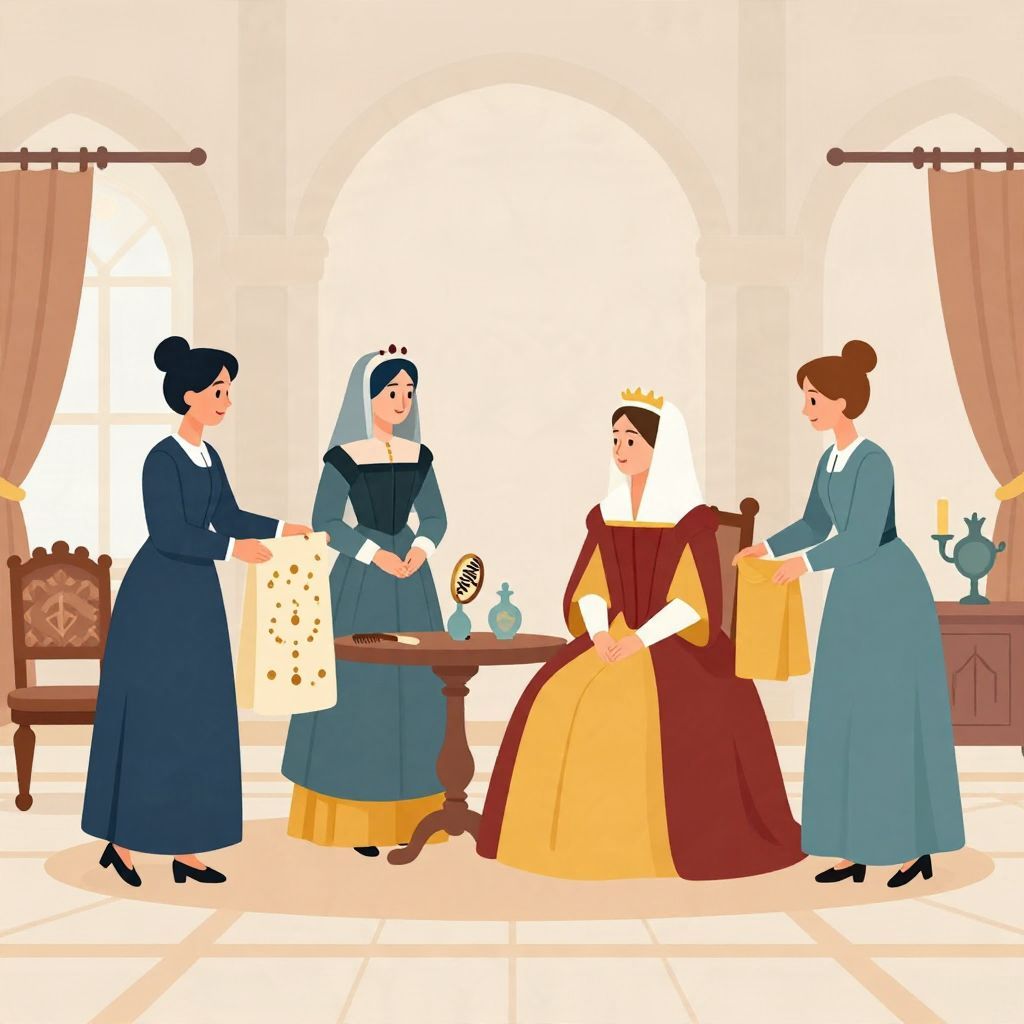
What is a lady-in-waiting? The short answer is that a lady-in-waiting was a woman of rank or respectable social standing who attended a queen, princess, or other noblewoman in a royal or aristocratic household. Her role could include companionship, ceremonial duties, personal assistance, and, in some courts, influence at court.
The title sounds simple, but the office changed over time. In some periods a lady-in-waiting was a trusted companion; in others she was part of a carefully ordered court system shaped by politics, etiquette, and patronage. Understanding the role means looking at how royal households worked and why access to a ruler mattered so much.
What is a lady-in-waiting?
A lady-in-waiting was a female court attendant who served a queen, princess, or noblewoman. She was usually not a servant in the modern sense, but a woman from the gentry or nobility who performed personal, ceremonial, and social duties. In many monarchies, the position carried status as well as responsibility.
Where did the role come from?
The office developed gradually in medieval and early modern European courts, where royal households were organized around rank, access, and ceremony. Women of elite background attended queens and princesses because elite women were expected to keep company with their social equals. The exact title and structure varied by country, but the basic idea was long-lived.
By the later Middle Ages, courts had become more formalized. Monarchs needed households that could manage daily life, display prestige, and reinforce hierarchy. Women attached to the queen’s household helped create that environment while also serving practical needs. Similar roles existed in many cultures, though the English phrase “lady-in-waiting” is specifically associated with European courts.
What did a lady-in-waiting actually do?
Her duties depended on the period and the rank of the woman she served. A lady-in-waiting might help dress the queen, accompany her in public, keep her company in private, assist with correspondence, and take part in court ceremonies. She also acted as a social companion, which was often as important as any practical task.
Typical responsibilities
- Attending the queen or princess during daily routines
- Accompanying her at meals, ceremonies, and public appearances
- Helping manage access to the royal woman
- Serving as a companion in conversation, travel, or leisure
- Sometimes carrying messages or helping with household organization
Not every lady-in-waiting did all of these things. Court households were highly structured, and duties could be divided among women with different ranks. Some attendants were close personal companions; others were more ceremonial. In larger courts, the title covered a range of positions rather than one fixed job description.
Was a lady-in-waiting a servant or a noblewoman?
Usually, she was both dependent on the court and socially above ordinary servants. Many ladies-in-waiting came from noble or gentry families, and the position could be a mark of family prestige. At the same time, she worked within the queen’s household and was expected to obey court rules and the authority of her mistress.
This combination is important. The role was not simply domestic labor. It was also a form of court service that reflected the social order of the time. Because elite women were often restricted in public life, service in a royal household could be one of the few respected ways to participate in politics, culture, and patronage.
Why were ladies-in-waiting important in history?
Ladies-in-waiting mattered because courts were centers of power. A woman who spent time near a queen could witness decisions, shape conversations, and help control who had access to the ruler. In monarchies where personal relationships influenced government, proximity to the royal household could be politically significant.
They also helped sustain the ceremonial life of the court. Monarchies used ritual to express legitimacy, rank, and continuity. Ladies-in-waiting were part of that visual and social order, appearing in processions, receptions, religious observances, and formal audiences. Their presence reinforced the dignity of the queen’s household.
Political and social influence
- They could act as intermediaries between petitioners and the royal household
- They sometimes influenced patronage, appointments, and favor
- They provided information and social intelligence within the court
- They could advance family interests through proximity to power
That said, the extent of influence varied widely. Some ladies-in-waiting were politically active; others were mainly ceremonial figures. Historians are careful not to exaggerate their power, because access did not always translate into control. Still, in court societies, access itself was valuable.
How did the role differ across time?
The meaning of “lady-in-waiting” changed from the medieval period to the modern era. In earlier courts, the household of a queen could be relatively small and personal. By the early modern period, especially in kingdoms such as England, France, Spain, and the Habsburg realms, court households became more elaborate and hierarchical.
In the 16th and 17th centuries, queens consort and queens regnant often had carefully ranked female attendants. Some served for life, while others held office for a period or as part of family strategy. By the 18th and 19th centuries, the role remained important in monarchies, but it became more formalized and often more ceremonial, especially as court life became more public and rule-bound.
Broad historical development
- Medieval period: royal households grew more organized, and elite women attended queens as companions and attendants.
- Early modern period: the role became more formal, with clearer ranks and court etiquette.
- 18th–19th centuries: ladies-in-waiting remained part of royal courts, though duties often became increasingly ceremonial.
- Modern monarchies: the office survives in some royal households, but usually in a reduced and symbolic form.
Did every country use the same term?
No. The English phrase “lady-in-waiting” is one version of a broader court tradition. Other languages and courts used different titles for women serving queens or princesses. Some positions were more administrative, some more intimate, and some more ceremonial. The exact structure depended on local customs, dynastic politics, and court culture.
For example, in many European monarchies there were multiple categories of female attendants, each with its own rank. The queen might have a chief lady, chamber women, maids of honor, and other attendants. These distinctions mattered because court rank was a language of status. Being near the queen did not mean being equal to her in authority.
How did women become ladies-in-waiting?
Appointments were often shaped by family connections, noble status, and political loyalty. A family might seek a place for a daughter at court because it offered prestige, marriage prospects, and access to influence. In some cases, the queen herself chose attendants she trusted. In others, the appointment reflected broader court politics.
The position could be a stepping stone into marriage, patronage networks, or a lifelong court career. For unmarried women of elite background, it offered a socially acceptable public role. For widows or older women, it could provide continued status and income. The office therefore served both the court and the families connected to it.
What was life like for a lady-in-waiting?
Life at court could be privileged but demanding. A lady-in-waiting lived under strict etiquette, long hours, and constant observation. She had to dress appropriately, behave with discretion, and understand the complex rules of precedence. Court life could be glamorous in public and tedious or politically tense in private.
Her experience depended on the household, the monarch, and her own rank. Some ladies enjoyed close friendship with the queen and relative comfort. Others found court life competitive and exhausting. Because court households were full of alliances and rivalries, a lady-in-waiting needed tact as well as loyalty.
Advantages and limitations
- Advantages: status, access, education in court culture, and possible influence
- Limitations: dependence on favor, strict etiquette, and limited personal freedom
Did ladies-in-waiting have real power?
Sometimes, but not always. Their power was usually indirect. They could recommend people, pass on information, or shape the atmosphere around a queen. In some courts, a trusted lady-in-waiting could become an important political figure. In others, she remained largely symbolic. The office’s influence came from proximity, not formal authority.
It is also important not to confuse admiration with office. Popular culture often imagines ladies-in-waiting as secret power brokers or glamorous companions. While some certainly influenced events, most were part of a structured household system. Their importance lay in how court society worked, not in any universal ability to control policy.
What happened to the role in modern times?
In many monarchies, the role survived into the 19th and 20th centuries, though it became more ceremonial and less politically central. Modern royal households often retained ladies-in-waiting as companions and aides to queens and princesses, especially for public events, travel, and formal engagements. In some countries, the office has been reduced or replaced by different forms of staff support.
The decline of court-centered politics changed the role. As governments became more institutional and less dependent on personal household access, the political significance of a lady-in-waiting diminished. Yet the title remains a reminder of a time when royal households were not just private spaces, but engines of status, ceremony, and influence.
Why the term still matters today
“Lady-in-waiting” survives in history books, biographies, films, and discussions of monarchy because it captures something larger than a job title. It reflects the social world of courts, where rank shaped daily life and women of elite background could participate in politics through service, companionship, and proximity to power.
For historians, the role is useful because it reveals how monarchy worked behind the scenes. It shows that power was not exercised only by kings and queens, but also by the households around them. Ladies-in-waiting were part of that system: visible, constrained, and sometimes influential.
So, what is a lady-in-waiting? Historically, she was a noble or gentlewoman who attended a queen or princess, combining companionship, ceremony, and service in a court setting. The role evolved over centuries, but its meaning remained tied to status, access, and the politics of royal life. If you want to explore the subject further, see what a lady-in-waiting to the queen did and this broader guide on the history of ladies-in-waiting.