
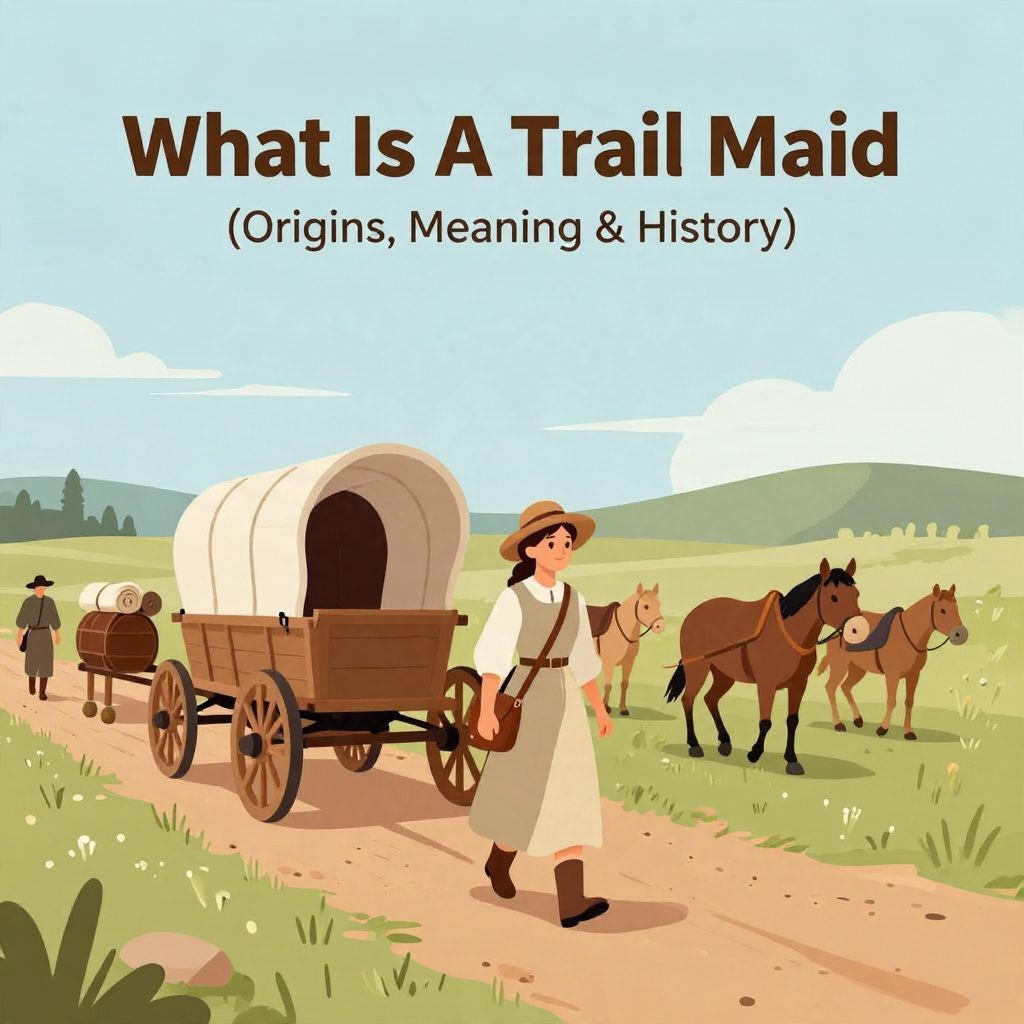
What is a trail maid? The phrase can be confusing because it does not refer to a single, universally recognized historical office or institution. In most historical contexts, it is best understood as a descriptive term for a woman associated with a trail, route, or journey—especially in frontier, travel, or outdoor settings.
Because the expression is used inconsistently, its meaning depends on region, period, and source. In some cases it may appear in folklore, local history, tourism, or modern storytelling rather than in formal historical records. That makes it important to separate documented usage from romanticized or invented tradition.
What Is a Trail Maid?
A trail maid is generally a woman connected with travel along a trail, road, or migration route, but the term is not a standard historical title with one fixed meaning. It may describe a guide, companion, settler, camp follower, or symbolic female figure in local tradition, depending on the source and era.
Where Does the Term Come From?
The words themselves are straightforward: trail refers to a path or route, and maid is an older English word for a young woman or unmarried woman. Put together, the phrase sounds old-fashioned, but that does not mean it came from a single historical institution. More often, it is a literary or local descriptive phrase than a formal job title.
“Maid” in historical English
In earlier English, “maid” could simply mean a young woman, a servant, or a female attendant. Over time, the word acquired poetic and archaic overtones. That is one reason “trail maid” can sound medieval or pioneer-like even when its actual use is much later.
“Trail” as a historical word
“Trail” became especially common in English-language writing about migration, hunting, exploration, and frontier movement. In North American history, the word is strongly associated with overland routes such as the Oregon Trail, Santa Fe Trail, and other paths used by travelers, traders, and migrants in the 18th and 19th centuries.
How Has “Trail Maid” Been Used Historically?
The term has no single, well-documented origin like a royal title or military rank. Instead, it appears to have developed as a flexible phrase used in storytelling, pageantry, local heritage events, and sometimes in romanticized accounts of frontier life. In those settings, a “trail maid” might symbolize endurance, hospitality, or the feminine presence in a harsh travel landscape.
Frontier and pioneer imagery
In the 19th-century American West, women traveled long distances with families, wagons, and emigrant parties. They cooked, cared for children, repaired clothing, fetched water, and helped maintain morale. A phrase like “trail maid” could be used loosely to evoke such women, though historical records more often call them pioneers, emigrants, settlers, or travelers rather than by that exact title.
Folklore and pageantry
In some communities, “trail maid” may have been adopted for festivals, historical reenactments, or local beauty contests tied to frontier heritage. In those cases, the term reflects modern commemoration more than older historical practice. This is common in place-based traditions, where communities create symbolic figures to celebrate regional identity.
Was a Trail Maid a Real Historical Role?
Not in the formal sense. There is no widely recognized historical profession, office, or rank called “trail maid” in the way there were blacksmiths, nurses, scouts, or wagon masters. The phrase is better understood as a cultural label or symbolic description than as a standardized role in historical records.
Why the distinction matters
History often preserves popular terms that sound ancient but were actually created later for storytelling or commemoration. A term like “trail maid” may seem to describe a specific past reality, but historians would want evidence from diaries, newspapers, census records, or official documents before treating it as a true historical category.
Documented women on trails
Women absolutely played major roles in trail history. They crossed mountain passes, endured disease and hunger, managed households on the move, and sometimes traveled alone or worked as guides, traders, or entrepreneurs. The historical significance lies not in the phrase itself, but in the real experiences it may point toward.
Women and Trail Travel in History
To understand what a trail maid might represent, it helps to look at the broader history of women on trails and migration routes. From ancient caravans to early modern trade roads and 19th-century wagon trails, women were present in nearly every form of long-distance movement, even when records overlooked them.
Migration and survival
Trail travel was physically demanding. Travelers faced weather, rough terrain, illness, limited supplies, and the constant need to make camp. Women contributed to survival in practical ways that were often invisible in official narratives. They preserved food, nursed the sick, organized domestic labor, and helped sustain family groups during long journeys.
Indigenous and frontier contexts
In many regions, trails existed long before European expansion. Indigenous peoples created and maintained travel networks for trade, seasonal movement, diplomacy, and subsistence. Women in Indigenous societies also played important roles in mobility, agriculture, and knowledge-sharing. Any history of a “trail maid” should avoid assuming a single frontier-only meaning and should recognize these deeper Indigenous geographies.
Why the Phrase Sounds Romantic
“Trail maid” has a romantic, almost ballad-like quality. That is partly because later generations often turned frontier history into legend. Nineteenth- and twentieth-century storytelling frequently softened the hardships of overland travel and highlighted courage, purity, and domestic virtue. A phrase like this fits that style of memory-making.
Romanticism and the frontier
As frontier life became part of national mythology, writers, local historians, and event organizers often used elevated language to create emotional appeal. Words such as “maid,” “pioneer maiden,” or “trail maiden” could make a woman seem emblematic of sacrifice and resilience, even when the historical reality was more complicated and less idealized.
Modern heritage culture
Today, the phrase may appear in pageants, museum labels, local festivals, or tourism materials. In those settings, it can function as a heritage symbol rather than a strictly historical term. That does not make it meaningless, but it does mean readers should treat it as a cultural expression rather than a proven ancient title.
How Historians Would Approach the Term
Historians would ask where the phrase appears, who used it, and in what context. If it shows up in a newspaper from the late 1800s, it may reflect the language of that period. If it appears mainly in a much later festival or local legend, it may be a modern invention inspired by older frontier imagery.
Questions historians ask
- Is the phrase found in primary sources, or only in later retellings?
- Does it describe a real occupation, or a symbolic figure?
- Is it tied to one region, one event, or one community tradition?
- Does the source use the term literally, poetically, or ceremonially?
Why evidence matters
Without documentation, it is easy to mistake a decorative phrase for a historical fact. That is especially true for frontier history, where later memory often blends truth, legend, and nostalgia. Careful historical reading distinguishes between what people actually did and the names later generations gave them.
Possible Meanings of “Trail Maid” Today
In modern usage, the phrase may carry several overlapping meanings. It can refer to a woman associated with trail culture, a symbolic figure in local heritage, or simply a poetic way of describing a female traveler or pioneer. In some cases, it may be used as a title in community events or storytelling traditions.
Common modern interpretations
- A symbolic woman of the frontier or trail.
- A participant in a heritage pageant or local celebration.
- A literary or decorative phrase for a young woman on a journey.
- A romanticized label for women in migration history.
Why the meaning varies
Regional language changes over time. A phrase that is obvious in one town or tradition may be unfamiliar elsewhere. Because “trail maid” is not standardized, its meaning must be inferred from context rather than assumed from the words alone.
What Is the Historical Importance of the Idea?
Even if “trail maid” is not a formal historical category, the idea behind it points to an important truth: women were central to trail history. They were not merely passengers in male-led adventures. They were workers, decision-makers, caregivers, and survivors whose labor made overland movement possible.
Recovering overlooked lives
Many historical narratives once focused on explorers, soldiers, and wagon leaders while minimizing women’s contributions. Looking at a phrase like “trail maid” can be a useful entry point into broader questions about gender, migration, labor, and memory. It reminds us that history is often preserved unevenly.
From lived experience to cultural symbol
Over time, real experiences can become symbols. The hardships of women on trails were transformed into stories of courage, sacrifice, and settlement. That symbolic layer is historically important in its own right, because it shows how later societies chose to remember the past.
So, What Is a Trail Maid?
A trail maid is best understood as a descriptive or symbolic term for a woman associated with a trail, journey, or frontier setting, rather than a fixed historical office. The phrase reflects later romantic, local, or literary uses more than a single documented role in history.
In historical terms, the more important story is the one the phrase points toward: the real women who traveled, worked, endured, and helped shape migration routes and frontier communities. If you want to explore related historical themes, you may also enjoy how humans survived the Ice Age and how long the Roman Empire lasted.