
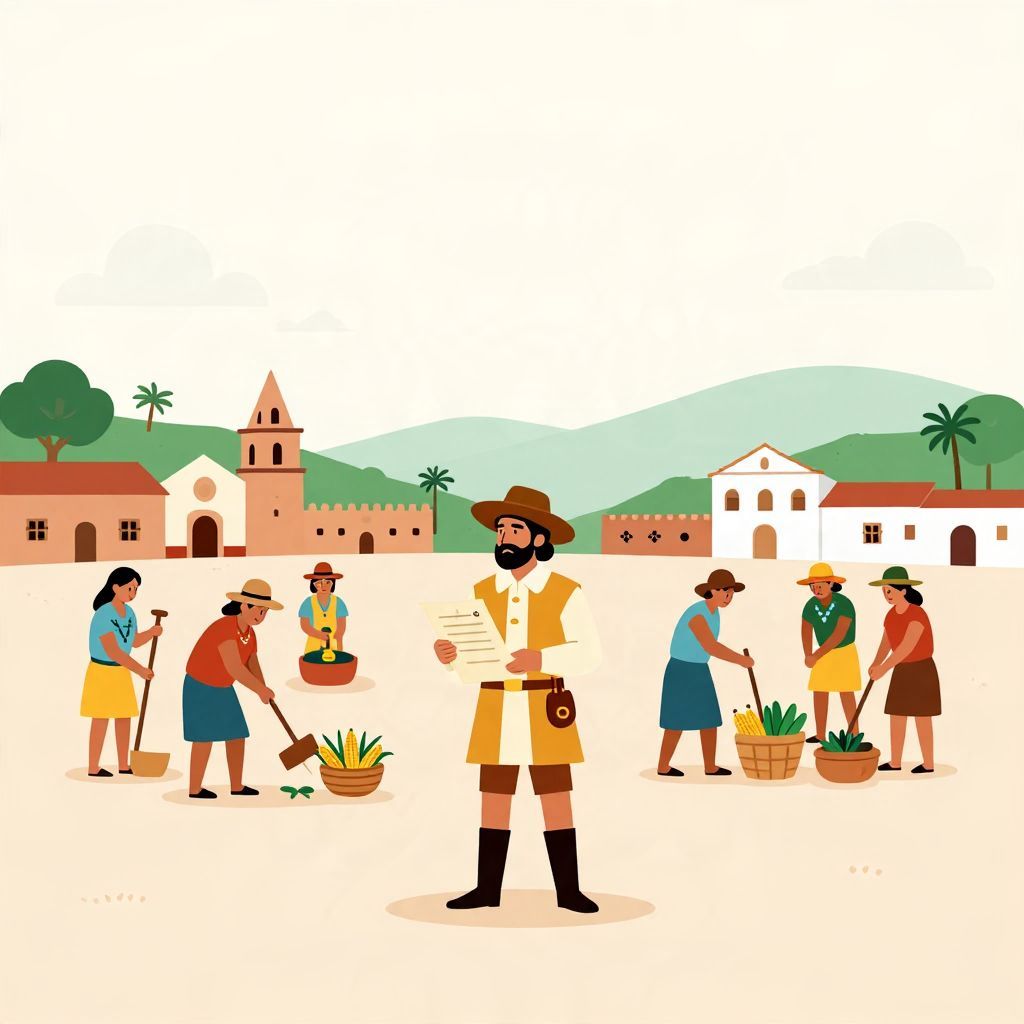
What is encomienda? In Spanish colonial history, it was a system in which the Crown granted a colonist the right to receive labor, tribute, or services from a designated Indigenous community. In theory, the encomendero was supposed to protect, Christianize, and oversee those people; in practice, it often became a form of coercive exploitation.
The encomienda shaped Spanish rule in the Americas from the early 1500s onward, especially in the Caribbean, Mexico, and Peru. Understanding it helps explain how conquest, forced labor, evangelization, and colonial wealth were connected in the early modern Spanish Empire.
What Is Encomienda?
Encomienda was a Spanish colonial labor and tribute system that emerged after conquest in the Americas. The Crown entrusted a Spaniard, the encomendero, with the right to collect tribute and labor from Indigenous people in a specific area, while officially requiring him to provide protection and religious instruction. It was not outright ownership of land or people, but it often functioned like forced labor.
Origins of the Encomienda System
The encomienda did not begin in the Americas from nothing. It drew on medieval Iberian practices developed during the Christian reconquest of Muslim-ruled territories on the Iberian Peninsula. In those earlier settings, rulers sometimes granted settlers rights over land, tribute, or local populations in frontier zones. Spanish conquerors adapted these ideas after 1492 for overseas empire.
Why Spain Created It
When Spain conquered large parts of the Caribbean and later mainland American empires, it faced a practical problem: how to reward conquerors, organize control, and extract wealth without building a huge royal bureaucracy immediately. The encomienda offered a quick solution. It helped Spanish settlers profit from conquest while the Crown tried to keep authority centralized.
Early Expansion in the Caribbean
The system first took shape in the early 1500s on islands such as Hispaniola, Cuba, and Puerto Rico. There, Indigenous populations were devastated by disease, warfare, displacement, and overwork. As labor shortages grew, Spanish colonists increasingly relied on coerced Indigenous labor for mining, agriculture, and transport.
How the Encomienda Worked in Practice
In theory, the encomienda was a reciprocal arrangement. The encomendero received tribute or labor, but he was supposed to defend the community, maintain order, and support Christian conversion. In reality, the balance usually favored the colonist. Indigenous people often had little choice but to provide labor, goods, or food under pressure from colonial authorities.
Tribute and Labor
Tribute could take many forms: gold, cotton, maize, textiles, or labor services. The exact demands varied by region and period. In mining zones, labor was especially harsh. In agricultural areas, Indigenous communities might be compelled to work fields, carry supplies, or support Spanish households and settlements.
Not the Same as Land Ownership
A common misunderstanding is that encomienda meant the encomendero owned the land or the Indigenous people themselves. Legally, it did not. The Crown retained sovereignty, and Indigenous communities were not supposed to be sold like slaves. Yet the distinction mattered less in daily life than in law, because coercion, abuse, and dependency were widespread.
Encomienda, Conquest, and Indigenous Exploitation
The encomienda became one of the most important institutions of early Spanish colonial rule because it linked conquest to profit. It helped Spaniards reward soldiers and settlers, but it also intensified the suffering of Indigenous communities. Combined with epidemic disease and military violence, it contributed to dramatic population decline in many regions.
Differences from Slavery
Encomienda was not identical to chattel slavery, but the difference could be thin in practice. Enslaved people were legally owned as property, while Indigenous communities under encomienda were theoretically subjects of the Crown. Still, both systems involved forced extraction of labor and severe loss of autonomy. In some places, Indigenous enslavement and encomienda overlapped.
Connection to Religious Conversion
Spanish officials and churchmen often justified encomienda by saying it would aid Christian evangelization. This claim reflected the empire’s religious mission, but it also masked exploitation. Missionary work and labor extraction were frequently intertwined, and Indigenous people were expected to accept Spanish rule as part of conversion.
Key Historical Debates and Reforms
From the beginning, the encomienda provoked criticism. Some clergy and reformers argued that the system was morally wrong and incompatible with Christian teaching. Others defended it as necessary for colonization and order. These debates became central to Spanish imperial policy in the 16th century.
Las Casas and the Critique of Colonial Violence
One of the most famous critics was Bartolomé de las Casas, a Dominican friar who condemned the abuse of Indigenous peoples and argued for their protection. He helped bring wider attention to the destructive effects of conquest and forced labor, though his own views and proposals also changed over time.
The New Laws of 1542
The Spanish Crown attempted reform through the New Laws of 1542, which aimed to limit hereditary encomiendas and reduce abuses. These laws reflected royal concern that powerful encomenderos might become too independent and that Indigenous populations were being destroyed. Enforcement, however, was uneven and often resisted by colonists.
Why Reform Was So Difficult
Reform was difficult because encomienda was tied to the economic structure of empire. Colonists depended on Indigenous labor, and local elites resisted losing privileges. The Crown also needed colonial revenues and stability. As a result, the system was gradually weakened in some regions but never eliminated overnight.
Encomienda in Different Parts of Spanish America
The encomienda did not look exactly the same everywhere. Local geography, Indigenous political structures, population density, and economic priorities shaped how it operated. In central Mexico and the Andes, where large Indigenous populations and existing tribute systems already existed, Spanish rulers adapted preconquest structures to colonial demands.
New Spain
In Mexico, the Spanish often built on tribute networks that had existed under the Aztec Empire. Indigenous communities were reorganized under colonial supervision, and tribute demands were redirected toward Spanish interests. Over time, other labor systems, especially repartimiento, became more prominent, though encomienda remained important in the early colonial period.
The Andes
In Peru, the Spanish encountered the Inca state and its labor obligations, including systems of rotational labor. The encomienda initially became a way to channel Indigenous tribute and labor to Spanish conquerors. Later, the colonial state increasingly relied on other mechanisms, especially the mita, a draft labor system adapted from Andean precedent and used heavily in mining.
How Encomienda Changed Over Time
By the later 1500s and 1600s, encomienda was no longer as central as it had been at the start of conquest. The Crown sought to limit the power of encomenderos and strengthen direct royal administration. In many places, the system declined as Indigenous populations fell, tribute arrangements changed, and colonial institutions became more bureaucratic.
Decline but Not Immediate Disappearance
Encomienda did not vanish at once. In some regions, it persisted in modified form for generations. But its political importance faded as Spain built a more centralized colonial state with royal officials, courts, bishops, and viceroys. The empire increasingly preferred systems that gave the Crown more direct control.
Long-Term Legacy
Even after encomienda weakened, its legacy remained powerful. It helped establish patterns of racial hierarchy, coerced labor, and unequal wealth distribution that lasted throughout colonial rule and beyond. It also shaped later debates about human rights, empire, and the moral limits of conquest.
Why Encomienda Matters in History
Encomienda matters because it shows how empires often combine legal language with coercive realities. It was presented as protection and Christian duty, yet it became a tool for extracting labor from conquered peoples. The system reveals the tension between imperial ideals and colonial violence in Spanish America.
It also helps explain why Spanish colonization was not just a military event but a social and economic transformation. Conquest was followed by institutions that reorganized daily life, labor, religion, and authority. Encomienda was one of the clearest examples of that process.
Quick Summary
- Encomienda was a Spanish colonial system of tribute and labor extraction.
- It developed in the early 1500s after conquest in the Americas.
- Encomenderos were supposed to protect and Christianize Indigenous people, but abuse was common.
- The system was criticized by reformers and limited by the Spanish Crown, especially after 1542.
- It declined over time, but its effects on colonial society were long-lasting.
So, what is encomienda? It was a foundational institution of Spanish colonial rule: a system that linked conquest, labor, tribute, and evangelization, while leaving a deep legacy of exploitation. For more on how governments structured power in history, you may also be interested in the Northwest Ordinance and the Gestapo.