
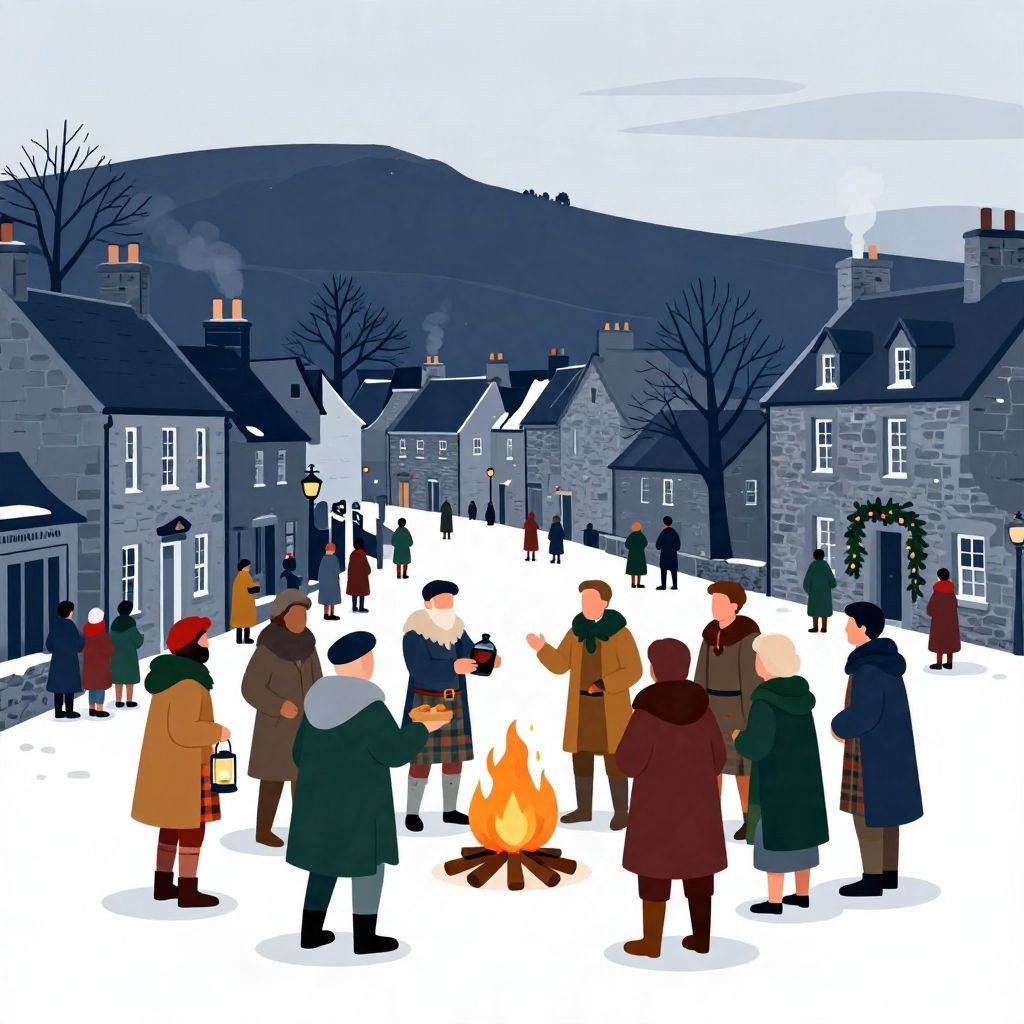
What is Hogmanay? It is the Scottish name for New Year’s Eve and, by extension, the New Year celebrations that follow into 1 January. Today it is one of Scotland’s best-known festive traditions, marked by street parties, fireworks, singing, and customs such as first-footing.
Its history is older and more complicated than a simple “Scottish New Year” story. Hogmanay combines medieval winter customs, religious change, local folklore, and modern public celebration, making it a vivid example of how traditions evolve over time.
What Is Hogmanay?
Hogmanay is the traditional Scottish term for the New Year period, especially New Year’s Eve on 31 December. It refers both to the night itself and to the customs associated with welcoming the new year. While now widely celebrated as a public festival, its roots lie in older seasonal practices and in Scotland’s distinctive religious and cultural history.
Where Did the Word “Hogmanay” Come From?
The origin of the word Hogmanay is uncertain, and historians and linguists have proposed several explanations. No single origin has been proved beyond doubt, which is important to keep in mind because the word’s history is often wrapped in folklore. Its earliest surviving written appearances are from the 17th century, but the term may be older in speech.
Possible language origins
- French influence: Some scholars connect it to northern French or Norman words used in medieval Scotland, possibly brought through trade or cultural contact.
- Gaelic or Scots development: Others suggest it grew within Scottish speech, shaped by local dialects and seasonal custom.
- Folk explanations: Popular stories sometimes link it to phrases meaning “new moon,” “gift,” or even to medieval street cries, but these are not securely established.
Because the evidence is incomplete, the safest historical answer is that Hogmanay is a Scottish term of uncertain origin that became attached to New Year celebrations. The word itself is part of the tradition’s mystery.
How Did Hogmanay Develop Historically?
Hogmanay developed over centuries rather than being invented at one moment. Its customs reflect the meeting of pre-Christian seasonal observance, medieval winter festivity, and later Protestant religious culture. Scotland’s New Year came to carry special importance partly because the country’s Christmas traditions were suppressed for long periods, shifting festive energy to the end of December and the start of January.
Medieval and early modern winter customs
Across Europe, winter was a time of communal celebration, gift-giving, food, drink, and symbolic acts meant to secure good fortune. Scotland shared many of these customs. People marked the turning of the year with hospitality, visits, songs, and the exchange of food or drink. These habits were not uniquely Scottish, but in Scotland they gradually took on a distinct identity under the name Hogmanay.
The impact of the Reformation
One major reason Hogmanay became so important in Scotland was the country’s religious history. After the Protestant Reformation in the 16th century, Christmas was often discouraged or even banned in parts of Scotland for long periods. That did not eliminate winter celebration, but it reduced the public role of Christmas and left New Year’s observance more prominent. In effect, Hogmanay became Scotland’s major winter holiday.
From local custom to national celebration
By the 18th and 19th centuries, Hogmanay customs were well established in many parts of Scotland. Industrialization and urbanization did not erase them; instead, they helped spread and reshape them. As people moved into towns and cities, local customs were performed in new settings, and the New Year became a public as well as a household event.
What Are the Main Hogmanay Traditions?
Hogmanay is associated with several customs, some very old and some more recent. Not every Scottish community has practiced all of them, and the details vary by region. Still, a few traditions have become especially well known and continue to define the festival today.
First-footing
Perhaps the best-known custom is first-footing, the first person to cross the threshold after midnight. Traditionally, the ideal first-footer was a dark-haired man, thought to bring luck. He might carry symbolic gifts such as coal, shortbread, salt, whisky, or a black bun. These items represented warmth, food, prosperity, and hospitality.
The custom reflects older beliefs about luck and protection at the turning of the year. A first visitor could shape the household’s fortune, so the choice of guest mattered. In modern practice, first-footing is often more playful than superstitious, but the symbolism remains strong.
Song, drink, and social visiting
Hogmanay has long been a social festival. Families, neighbors, and friends gather to eat, drink, sing, and exchange good wishes. One of the most famous songs associated with the night is Auld Lang Syne, written in the late 18th century by Robert Burns, though the poem draws on older Scots language and earlier ideas of friendship and memory. It is now sung around the world at New Year.
Fire and light
In some Scottish communities, fire has played a striking role in New Year customs. Fire symbolized purification, protection, and renewal. Modern Hogmanay events sometimes include fire festivals, torchlight processions, or fireworks, continuing the older idea that light at midwinter marks hope and renewal.
Cleaning and clearing out the old year
Another recurring theme is the symbolic clearing away of the old year. In some places, people cleaned homes thoroughly before New Year or performed acts meant to sweep away bad luck. This idea appears in many cultures, but it fits Hogmanay especially well because the holiday is about crossing a threshold into a fresh beginning.
Why Is Hogmanay So Important in Scotland?
Hogmanay matters because it became more than a date on the calendar. It developed into a shared cultural marker that expresses Scottish identity, hospitality, memory, and renewal. For centuries, it was one of the most important times of year for family visits and community rituals, especially in a country where Christmas had a reduced public role.
A holiday shaped by religion and law
Scotland’s Protestant culture helped make New Year more prominent than Christmas in public life for much of the early modern period. This does not mean Scots ignored Christmas entirely, but the balance of celebration was different from that in many neighboring countries. As a result, Hogmanay became the season when people most openly gathered, feasted, and celebrated.
A holiday shaped by community life
Hogmanay also fit older patterns of social exchange. Visiting neighbors, bringing gifts, and sharing food all reinforced ties within communities. At a time when winter could be harsh and isolation common, the festival offered warmth, connection, and a sense of continuity. That social function helped the tradition survive even as society changed.
How Did Hogmanay Become a Modern Public Festival?
In the 20th century, Hogmanay moved increasingly from private custom to public spectacle. Cities such as Edinburgh turned New Year into a major event with concerts, fireworks, and large crowds. This did not replace older traditions so much as layer new forms of celebration on top of them. The result is a holiday that feels both ancient and contemporary.
Urban celebrations and tourism
Modern Hogmanay events have been shaped by tourism, media, and civic branding. Edinburgh’s New Year celebrations, for example, are now internationally recognized. Public entertainment has made Hogmanay visible far beyond Scotland, helping it become a symbol of Scottish culture worldwide.
Continuity and change
Even as the scale of celebration has grown, many older elements remain recognizable. People still exchange good wishes, gather with friends and family, and sing Auld Lang Syne. The festival has adapted to modern life, but its core meaning—welcoming the new year together—has stayed remarkably stable.
Hogmanay in the Wider History of New Year Celebrations
Hogmanay belongs to a much larger human history of marking the turn of the year. Different societies have chosen different calendar dates and different rituals, but the underlying themes are similar: renewal, reflection, luck, and community. In that sense, Hogmanay is both distinctly Scottish and broadly human.
Its history also shows how traditions are made. A holiday does not need a single founder or a single origin. It can grow from many layers: language, religion, local custom, and later reinvention. Hogmanay is a good example of a tradition that survived because it could change.
What Is Hogmanay Today?
Today, Hogmanay is celebrated across Scotland and by Scottish communities around the world. For many people it means parties, fireworks, music, and midnight toasts. For others it still includes first-footing, family visits, and quieter household rituals. The holiday remains both festive and meaningful because it connects modern celebration with older ideas of luck, hospitality, and new beginnings.
In historical terms, Hogmanay is not just “Scottish New Year” but a long-evolving cultural tradition shaped by language, religion, and community life. Its endurance shows how a seasonal custom can become a national symbol without losing its local roots. For more on the way customs develop, see what a tradition is and what culture is.