
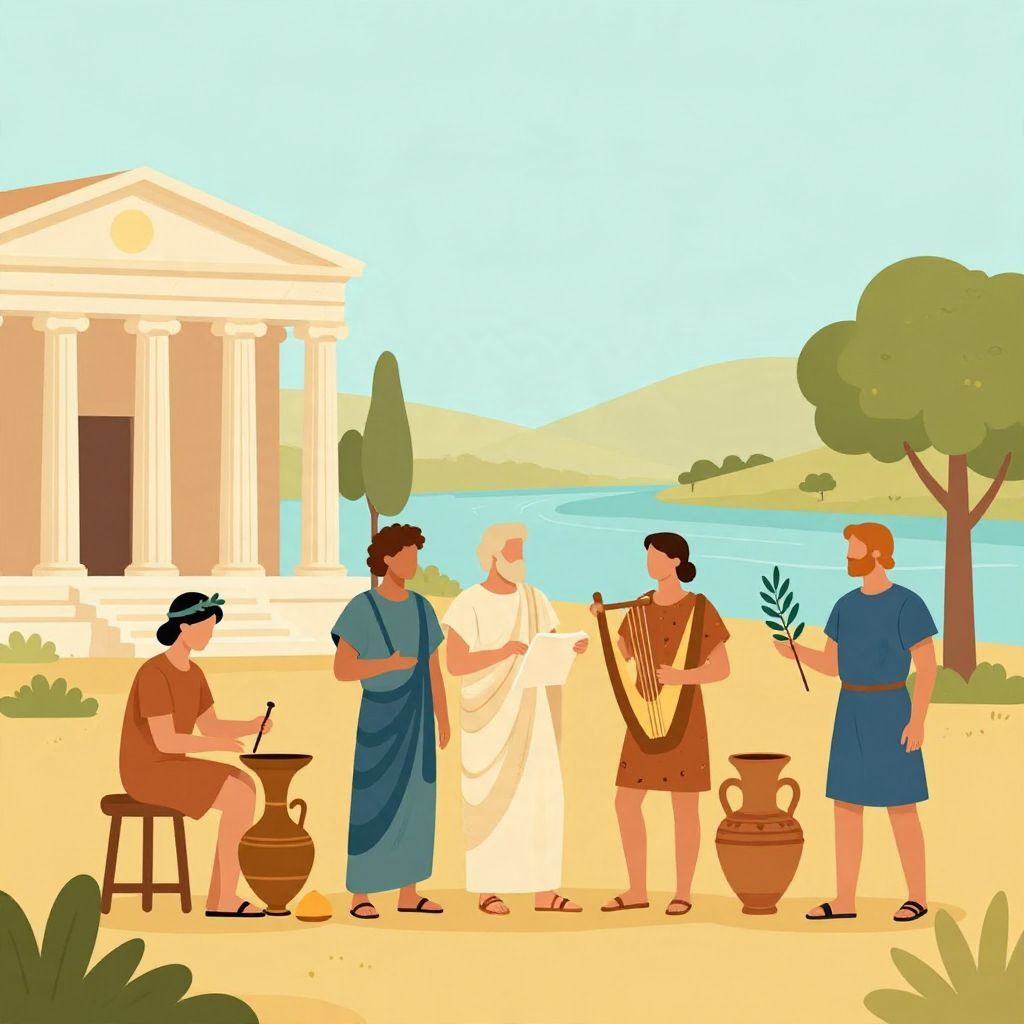
What was the Golden Age? In history, the phrase usually means a period remembered as especially prosperous, creative, or powerful. It is not a single fixed era, but a label applied by later generations to times that seemed unusually successful in politics, art, learning, trade, or culture.
Because different societies use the term in different ways, the “Golden Age” can refer to ancient myth, a real historical flourishing, or a nostalgic memory of a past era. Understanding the phrase means separating legend from evidence and asking why people later chose to describe a period as “golden.”
What Was the Golden Age?
The Golden Age was a term used to describe an idealized period of peace, abundance, cultural achievement, or moral purity. In mythology, it often meant a lost age of perfection. In history, it usually refers to a real era of exceptional growth, such as a civilization’s artistic or intellectual peak.
Where Did the Idea of a Golden Age Come From?
The idea comes from ancient myth and literature, especially Greek and Roman writers. They imagined history as a decline from an original perfect age. Later historians and societies reused the phrase to describe periods they admired, even when those periods were not truly peaceful or equal for everyone.
Golden Age in Myth
One of the earliest famous versions appears in Greek tradition, especially in the poet Hesiod’s Works and Days (usually dated to around the 8th or 7th century BCE). He described a “Golden Race” of people who lived without toil, suffering, or old age. This was not history in the modern sense, but a moral story about human decline.
The Roman poet Ovid later expanded the idea in Metamorphoses, presenting the Golden Age as a time when the earth gave food freely and people lived without laws because they did not need them. These accounts shaped later European thinking about a lost age of innocence.
Golden Age as Historical Label
In actual history, “Golden Age” became a retrospective label. People often used it after the fact, when a civilization had already changed or declined. That means the term tells us as much about memory and identity as it does about the period itself.
Which Historical Periods Are Called Golden Ages?
Many different eras have been called Golden Ages. The term is not limited to one civilization. Historians and later writers have applied it to periods of strong political power, artistic innovation, scientific progress, or economic expansion, though the exact meaning varies by place and context.
Examples from World History
- Classical Athens in the 5th century BCE, especially under Pericles, for drama, philosophy, architecture, and political influence.
- The Islamic Golden Age, often dated roughly from the 8th to the 13th centuries, for scholarship, medicine, mathematics, astronomy, and translation work.
- The Spanish Golden Age (Siglo de Oro), broadly from the late 15th to the 17th centuries, for literature, painting, and imperial power.
- The Dutch Golden Age in the 17th century, known for trade, finance, art, and maritime influence.
- The Elizabethan age in England, often associated with theater, exploration, and state consolidation.
These labels are useful, but they can oversimplify. A period celebrated for art or wealth may also have had war, inequality, slavery, religious conflict, or political repression. The “golden” label usually reflects the achievements of a society’s elites more than the lives of ordinary people.
Why Do Historians Use the Term?
Historians use “Golden Age” cautiously because it helps identify periods of notable achievement, but it can also distort the past. The phrase is most useful when it points to measurable cultural or economic flourishing. It becomes misleading when it suggests a society was universally happy, just, or stable.
What Makes an Age Seem Golden?
A period may later be called golden for several reasons:
- Cultural output: major works of literature, art, music, or architecture.
- Scientific or intellectual growth: new discoveries, schools of thought, or translations of knowledge.
- Political strength: expansion, stability, or successful leadership.
- Economic prosperity: trade, urban growth, and wealth creation.
- Later nostalgia: people remembering a past era as better than the present.
In many cases, the label appears after a later crisis. When a society experiences decline, invasion, or internal conflict, earlier decades may begin to look like a golden age in comparison.
The Islamic Golden Age: A Major Example
One of the best-known historical uses of the term is the Islamic Golden Age, though scholars debate its exact dates and whether a single “age” can capture such a long and diverse history. It is usually associated with the Abbasid era, beginning in the 8th century CE and lasting in different forms for several centuries.
This period saw major advances in mathematics, medicine, philosophy, astronomy, geography, and literature. Cities such as Baghdad became centers of learning and exchange. Scholars translated and studied Greek, Persian, Indian, and other texts, building on earlier knowledge rather than simply preserving it.
Why It Flourished
Several factors helped this intellectual growth:
- Support from rulers and elites for scholarship and translation.
- Trade networks linking the Mediterranean, the Middle East, Central Asia, India, and beyond.
- Urban centers where scholars, merchants, and officials interacted.
- A shared scholarly language, especially Arabic, which helped knowledge circulate widely.
Even here, the term “golden” should be used carefully. Political fragmentation, religious debate, and social inequalities were also part of the period. The label highlights real achievements, but it does not mean the era was perfect.
The Golden Age in Europe and the Arts
In European history, “Golden Age” often refers to cultural high points rather than a single political era. The phrase is especially common in discussions of literature, painting, theater, and music. It often marks a time when patronage, urban wealth, and intellectual life supported extraordinary creativity.
The Spanish Golden Age
The Spanish Golden Age is usually placed from the late 1400s into the 1600s. It included writers such as Miguel de Cervantes and dramatists like Lope de Vega and Calderón de la Barca, along with painters such as El Greco and Diego Velázquez. Spain was also a major imperial power during much of this period.
Yet Spain’s “golden” label can be misleading if taken too literally. Imperial expansion brought wealth, but also warfare, inflation, and heavy burdens on the population. Cultural brilliance and political strain existed side by side.
The Dutch Golden Age
The Dutch Golden Age, mainly the 17th century, is another famous example. The Dutch Republic became a center of global trade, shipbuilding, finance, and art. Painters such as Rembrandt and Vermeer became emblematic of the era. Amsterdam grew into a major commercial hub.
At the same time, Dutch prosperity depended partly on colonial expansion and global commerce, including systems of exploitation. The term “golden” captures wealth and artistic achievement, but not the full moral or social picture.
How the Meaning of Golden Age Changed Over Time
Originally, the Golden Age was a mythic idea of a lost perfect world. Over time, it became a historical metaphor for greatness. Modern historians often avoid using it uncritically because the phrase can hide conflict, inequality, and complexity. Still, it remains useful when carefully defined.
From Myth to Memory
The shift from myth to history matters. In myth, the Golden Age describes a world that never existed in the historical record. In memory, it describes a real period that later generations idealized. That is why the same phrase can mean both a legend and a scholarly shorthand.
Why the Term Persists
People continue to use “Golden Age” because it is powerful and easy to understand. It suggests a peak, a high point, or a moment of exceptional brilliance. But the best historical writing treats it as an interpretive label, not a neutral fact.
Was There Ever a Truly Golden Age?
From a historian’s point of view, no society has had a truly perfect Golden Age. Every era had winners and losers. A period may be exceptional in art, learning, or power, but it still contained poverty, conflict, exclusion, and hardship. The label is best understood as a judgment about achievement, not universal well-being.
That does not make the term meaningless. It helps historians and readers identify times when a civilization produced remarkable works or reached unusual influence. The key is to ask: golden for whom, and in what sense?
Why the Golden Age Still Matters Today
The idea of the Golden Age matters because it shapes how people remember the past. Nations, religions, and cultures often look back to a “golden” period when they want to explain identity, pride, or decline. These memories can inspire learning and creativity, but they can also encourage nostalgia and selective history.
Studying the Golden Age concept teaches an important historical lesson: the past is often remembered less for what it was than for what later generations need it to mean. That is why historians look beyond the label to the evidence, context, and contradictions beneath it.
So, what was the Golden Age? It was either a mythic age of perfection in ancient thought or, more commonly, a later name for a period of exceptional achievement. To understand it well, compare the idea with specific historical examples such as the Islamic Golden Age or the Dutch Golden Age, and explore how memory turns history into legend.