
When readers ask, “Where is Babylon in the Bible?” they are usually looking for both a map location and the city’s role in biblical history. Babylon was a real ancient city in Mesopotamia, later a symbol of imperial power, exile, and human pride in the Bible.
Its ruins lie in modern Iraq, and its story stretches from the earliest Mesopotamian kingdoms to the Babylonian captivity of Judah and beyond. In Scripture, Babylon is both a place and an idea: a historical capital and a powerful biblical symbol.
Where Is Babylon In The Bible?
Babylon in the Bible refers to the ancient city of Babylon in Mesopotamia, near the Euphrates River in present-day Iraq, about 85 kilometers (50 miles) south of modern Baghdad. It was the capital of the Babylonian Empire and one of the most important cities of the ancient Near East.
The city’s historical location
Archaeological remains identify Babylon with the site near the modern Iraqi town of Hillah, in Babil Province. The ancient city sat on the Euphrates, which made it a strategic center for trade, agriculture, and military control. Its location helped make Babylon a major power in the first millennium BCE.
Why the Bible mentions Babylon so often
Babylon appears in the Bible because it became a dominant imperial power that conquered Judah, destroyed Jerusalem in 586 BCE, and deported many Judeans into exile. It also appears as a symbol of arrogance, oppression, and idolatry, especially in prophetic and apocalyptic texts.
Babylon’s Geography and Ancient Setting
Babylon stood in southern Mesopotamia, the land between the Tigris and Euphrates rivers. This region, often called the “cradle of civilization,” supported early urban life through irrigation and fertile farmland. Babylon’s position on the Euphrates gave it access to river transport, trade routes, and defensive advantages.
Mesopotamia in biblical terms
The Bible often uses broad geographic terms rather than modern national borders. Mesopotamia appears in biblical tradition as a land connected with the ancestors of Israel, including Abraham’s background in the region of Ur and Haran. Babylon later became the best-known city in that wider cultural world.
Modern location
Today, Babylon’s ruins are in Iraq, southeast of Baghdad. The site has been studied by archaeologists for more than a century, though parts of the ancient city remain buried or damaged. The modern landscape is very different from the ancient metropolis, but the location is well established.
Babylon in the Old Testament
In the Hebrew Bible, Babylon is both a historical empire and a recurring theological image. It appears in narratives, prophecies, and poetry, often associated with conquest, exile, and the consequences of disobedience. The biblical portrayal reflects real political events, but it also carries religious meaning.
Early biblical references
Babylon is mentioned in traditions about the ancient world, including the story of Babel in Genesis 11. The “Tower of Babel” is not a straightforward historical report about the city of Babylon itself; rather, it is a theological story explaining human pride, confusion, and the scattering of peoples. Scholars generally distinguish this narrative from the later historical city of Babylon.
The Babylonian Empire and Judah
Babylon became especially important in the late 7th and early 6th centuries BCE under the Neo-Babylonian Empire. King Nebuchadnezzar II ruled from about 605 to 562 BCE and expanded Babylonian power across the Levant. Under his reign, Judah was defeated, Jerusalem was besieged, and the temple was destroyed in 586 BCE.
The Babylonian exile
The exile of Judeans to Babylon was one of the most significant events in biblical history. It shaped later Jewish identity, worship, and literature. Psalms and prophetic books reflect grief, displacement, and hope for restoration. Babylon thus became not only a place of captivity but also a setting for religious reflection and adaptation.
What Babylon Looked Like in Its Peak
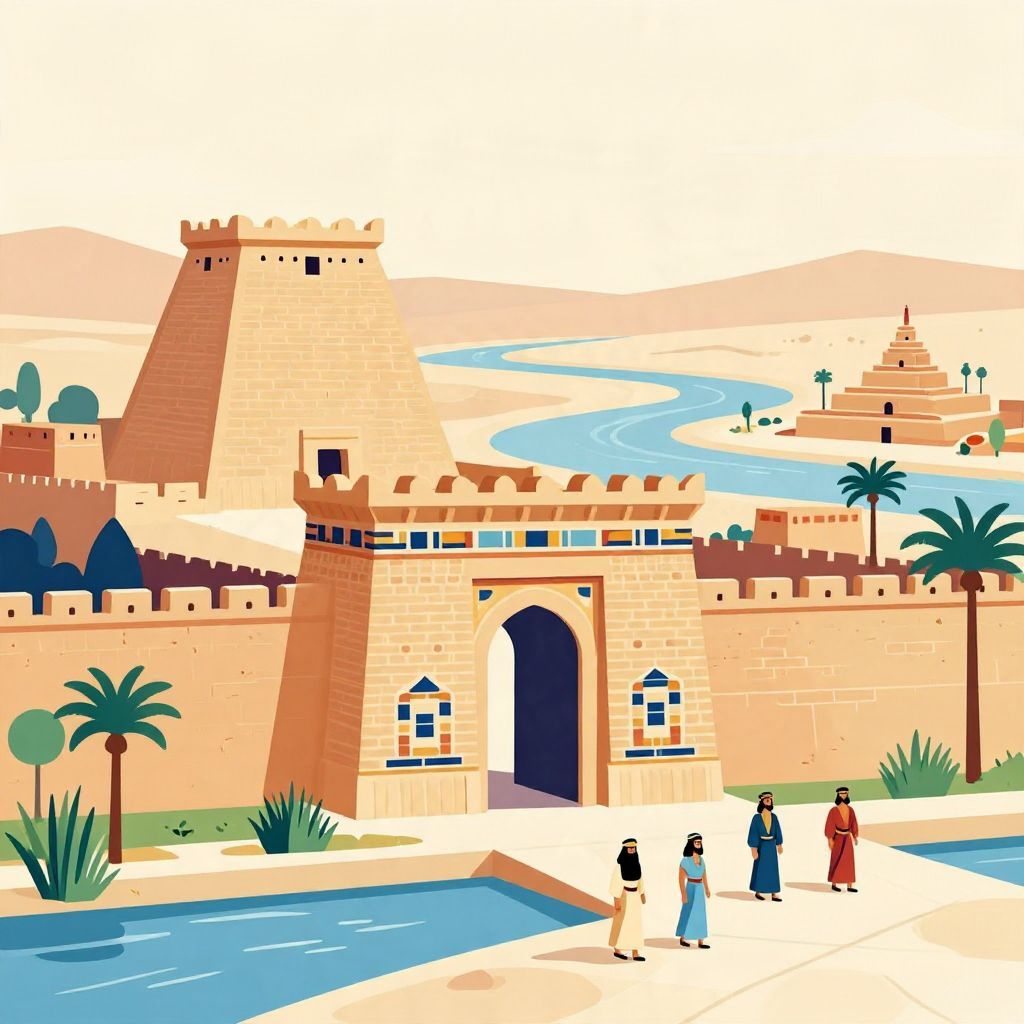
At its height, Babylon was famous for monumental walls, processional streets, temples, and royal palaces. Ancient writers described it as a magnificent city, though some later accounts were exaggerated. Archaeology confirms that Babylon was indeed a large and impressive urban center, especially in the Neo-Babylonian period.
Famous features associated with Babylon
- Ishtar Gate — a grand ceremonial entrance decorated with glazed bricks and animal reliefs.
- Processional Way — the route used in religious festivals and state ceremonies.
- Temples and ziggurats — religious structures dedicated to major deities, especially Marduk.
- Royal palaces — centers of administration and royal display.
The Hanging Gardens question
Babylon is also linked to the famous Hanging Gardens, one of the Seven Wonders of the Ancient World. However, their exact existence and location remain uncertain. Some ancient descriptions may refer to Babylon, but others may be confused, symbolic, or based on secondhand reports. Historians treat the Hanging Gardens as a debated tradition rather than a fully confirmed feature of the city.
Babylon as a Symbol in the Bible
Beyond its historical reality, Babylon becomes a powerful symbol in biblical literature. It represents imperial domination, moral corruption, and the danger of placing human power above God. This symbolic use is especially strong in prophetic writings and later Christian interpretation.
Babylon in the prophets
Prophets such as Jeremiah and Isaiah speak of Babylon as an instrument of judgment and later as an object of judgment itself. These texts reflect both historical events and theological interpretation. Babylon is portrayed as mighty, but not ultimate; its power is temporary and subject to divine justice.
Babylon in the Book of Revelation
In the New Testament, “Babylon” appears as a coded or symbolic name in Revelation. Many scholars understand this as a reference to Rome, or more broadly to oppressive world power. The use of Babylon here draws on the older biblical memory of exile and empire, turning the ancient city into a lasting symbol of resistance to tyranny.
Timeline of Babylon’s Biblical Importance
Babylon’s biblical significance developed over many centuries. The city’s history is best understood as a sequence of rise, conquest, exile, and symbolic reuse.
- Early Mesopotamian period — Babylon emerges as a city in southern Mesopotamia.
- 2nd millennium BCE — Babylon becomes an important regional center under earlier dynasties.
- 7th–6th centuries BCE — The Neo-Babylonian Empire reaches its height.
- 586 BCE — Jerusalem is destroyed and Judeans are exiled to Babylon.
- 539 BCE — Babylon falls to the Persian king Cyrus the Great.
- Later biblical writings — Babylon becomes a symbol in prophecy and apocalyptic literature.
The Fall of Babylon and Its Aftermath
Babylon’s political power ended when Cyrus the Great of Persia captured the city in 539 BCE. The conquest was relatively swift compared with Babylon’s earlier prominence. Under Persian rule, many exiled peoples, including Judeans, were allowed to return to their homelands or continue their religious life under a new imperial order.
Why the fall mattered biblically
The fall of Babylon was interpreted by biblical writers as evidence that even the greatest empires are temporary. For the exiles, it opened the way for return and rebuilding. For later readers, it reinforced a central biblical theme: human kingdoms rise and fall, but divine purpose endures.
Babylon after the empire
Although Babylon remained an important site for some time, it gradually declined. Over centuries, the city lost its political and economic significance. By the time of the classical and medieval periods, Babylon was no longer a living imperial capital but a remembered and partially ruined ancient city.
How Historians Read Babylon Today
Modern historians and archaeologists separate three things when studying Babylon: the actual ancient city, the biblical memories of exile and empire, and the symbolic use of Babylon in later religious texts. This distinction matters because the Bible uses Babylon in both literal and figurative ways.
Historical Babylon versus literary Babylon
The historical Babylon was a real city with rulers, walls, temples, and administrative records. The literary Babylon of the Bible sometimes reflects that reality directly, but at other times it serves as a theological symbol. Readers should not assume every biblical mention refers to the same exact historical moment or meaning.
Archaeology and the biblical record
Excavations at Babylon have confirmed much about the city’s grandeur, layout, and imperial importance. At the same time, archaeology does not resolve every biblical question. Some details in biblical texts are shaped by memory, theology, or later interpretation rather than by modern historical writing standards.
Why Babylon Still Matters
Babylon remains important because it sits at the intersection of geography, empire, and faith. It was a real city in ancient Iraq, a major power in the biblical world, and a lasting symbol in Jewish and Christian tradition. Its story helps explain the historical background of exile, restoration, and resistance to imperial domination.
So, if you are asking where Babylon is in the Bible, the direct answer is this: Babylon was in ancient Mesopotamia, in present-day Iraq, and in the Bible it stands for both a historical city and a powerful symbol. If you want to go further, see what happened to Babylon and what Babylon is called today.