
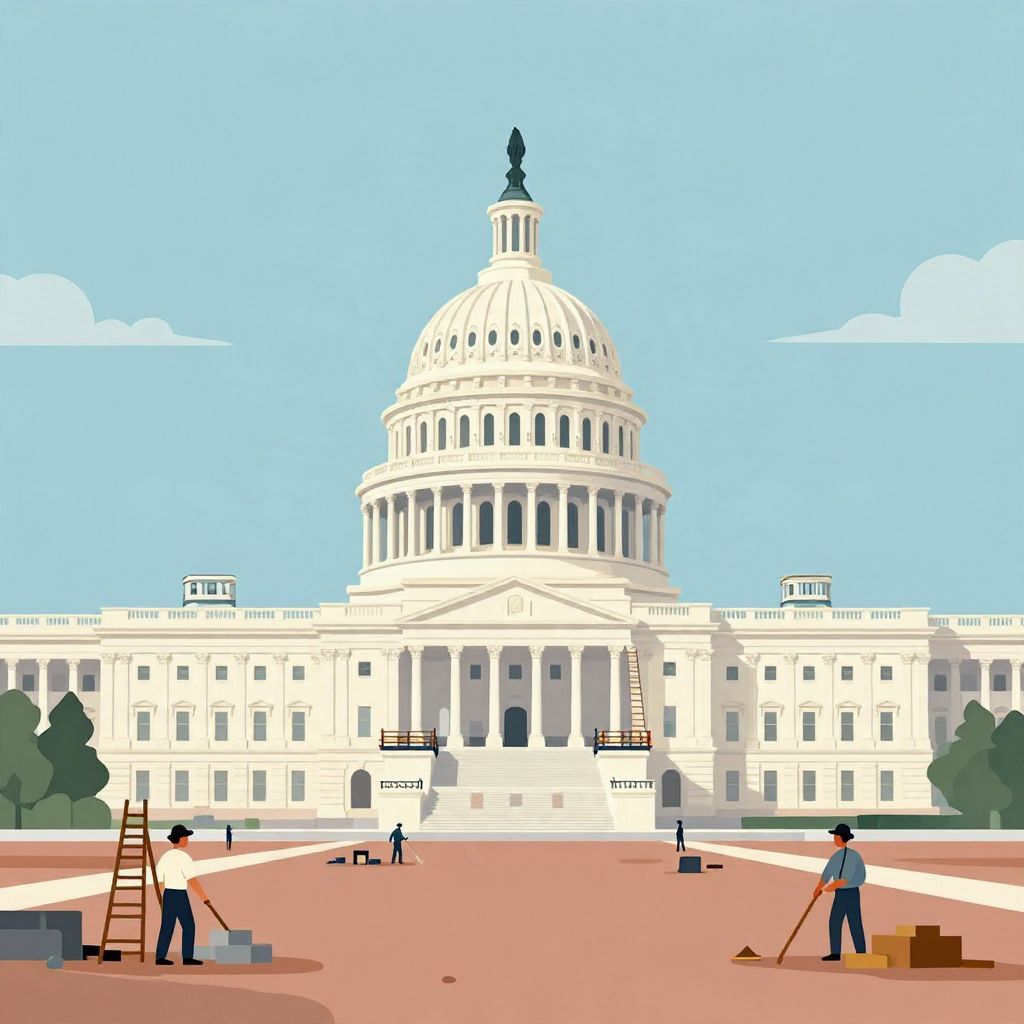
When was the Capitol Building built? The short answer is that the U.S. Capitol in Washington, D.C., was first begun in 1793, but it was built in stages over many decades. The original structure was usable by the early 1800s, then expanded, damaged, rebuilt, and enlarged as the United States grew.
Because the Capitol has been repeatedly altered, there is no single “finished” date in the simple sense. Its history is really a timeline of construction, destruction, rebuilding, and expansion that mirrors the development of the American republic itself.
When Was the Capitol Building Built?
The U.S. Capitol was first constructed starting in 1793. The original building was sufficiently complete for Congress to meet there by 1800, though work continued after that. Major additions in the 19th century, including the dome and new wings, transformed it into the familiar Capitol seen today.
Why the Capitol Was Built in the First Place
The Capitol was created as part of the new federal city planned after the American Revolution. When the United States chose a permanent national capital on the Potomac River, lawmakers needed a building to house Congress and symbolize the authority of the federal government. The Capitol was meant to be both practical and symbolic: a working legislative chamber and a civic monument.
Its placement on Jenkins Hill, later called Capitol Hill, was deliberate. The site gave the building prominence in the landscape, emphasizing that the legislature would stand at the center of the new capital. In this sense, the Capitol was not just a government office building; it was part of a broader experiment in republican nation-building.
The Early Construction Timeline
The Capitol’s construction began in the 1790s, but the process was slow and uneven. The federal government was young, money was limited, and skilled labor had to be gathered from various places. Several architects and builders contributed to the early work, and plans evolved as the project moved forward.
Key early dates
- 1793 — Construction begins on the Capitol.
- 1800 — Congress first meets in the building.
- 1814 — The building is burned by British forces during the War of 1812.
- 1815 onward — Reconstruction begins.
- 1850s–1860s — Major expansion and the current dome are added.
These dates help explain why the Capitol cannot be dated like a single house or courthouse. It was built, damaged, repaired, and enlarged in phases, with each generation leaving its mark on the structure.
The Original Capitol: 1793 to 1800
President George Washington laid the cornerstone of the Capitol on September 18, 1793. That event is often treated as the building’s true starting point. The original design came from a competition, and the early structure was intended to be elegant but restrained, reflecting the ideals of the new republic rather than the grandeur of European monarchies.
By 1800, the north wing was ready enough for Congress to move in. The building was still incomplete, but it could serve its basic purpose. The unfinished state of the Capitol at that moment is important historically: the United States was still a developing nation, and its capital city was very much under construction.
Who designed the early Capitol?
The Capitol’s early design is commonly associated with William Thornton, who won the design competition in 1793. Other important figures, including Benjamin Henry Latrobe, later shaped major parts of the building. The Capitol’s appearance today is therefore the result of several architects and successive redesigns, not a single original plan preserved unchanged.
Destruction and Rebuilding During the War of 1812
One of the most dramatic chapters in the Capitol’s history came in 1814, when British troops burned much of Washington, including the Capitol, during the War of 1812. The fire severely damaged the building and destroyed large portions of the interior. This was a national humiliation, but it also became a turning point in the Capitol’s architectural history.
Reconstruction began soon after the war. Rather than simply restoring the building exactly as it had been, American leaders used the opportunity to improve and enlarge it. The rebuilding reflected both practical needs and a desire to project resilience after wartime destruction.
The 19th-Century Expansion of the Capitol
As the nation expanded westward and the number of states increased, Congress outgrew the original Capitol. New states meant more representatives and senators, which in turn required larger chambers and more office space. The building had to evolve with the political system it housed.
Major expansion work accelerated in the mid-19th century. New wings were added for the House and Senate, and the old structure was no longer enough on its own. This was not simply a matter of convenience; it was a physical expression of the Union’s growth.
The dome and the Civil War era
The most recognizable feature of the Capitol, its great cast-iron dome, was added during the 1850s and 1860s. The existing building had become too small and visually modest for a nation that now saw itself as a continental power. The dome helped transform the Capitol into a more imposing national symbol.
Construction of the dome continued through the Civil War period, a striking fact in itself. Even as the country was divided, the federal government kept building. The unfinished dome during wartime became a powerful image of continuity and national endurance.
Why There Is No Single “Built” Date
People often ask when the Capitol was built as if there were one completion year. In reality, the answer depends on what part of the building you mean. If you mean the first structure on the site, the answer is 1793. If you mean the first time Congress could use it, the answer is 1800. If you mean the present-day Capitol with its dome and major wings, the answer stretches into the mid-19th century.
This is common with historic government buildings. They often change as political institutions grow. The Capitol is especially complex because it was not only expanded but also rebuilt after destruction. It is therefore better understood as a living monument than as a single completed project.
Historical Facts About the Capitol Building
The Capitol is one of the most important buildings in the United States, both politically and symbolically. Its history reflects the country’s early uncertainty, its wartime vulnerability, and its later confidence as a growing republic.
Important facts to know
- The Capitol is the home of the U.S. Congress, including the House of Representatives and the Senate.
- Construction began in 1793 on Capitol Hill in Washington, D.C.
- The building was first occupied by Congress in 1800.
- It was burned by British forces in 1814 during the War of 1812.
- Its current appearance results from major 19th-century expansions and the addition of the dome.
These facts show that the Capitol’s story is tied closely to the growth of American political institutions. As the country expanded, the building expanded with it.
The Capitol as a Symbol of the United States
Beyond its practical function, the Capitol became a national symbol of democratic government. Its architecture was meant to communicate permanence, order, and civic authority. Over time, the building came to represent the legislative branch itself and, more broadly, the idea of constitutional government in the United States.
That symbolism has only grown stronger because the building has survived fire, war, expansion, and political conflict. The Capitol is not frozen in one historical moment; it is a structure shaped by the nation’s changing needs and ideals.
Conclusion
The U.S. Capitol was built beginning in 1793, first occupied by Congress in 1800, damaged in 1814, and expanded substantially in the decades that followed. So the best answer is that the Capitol Building was not built all at once—it was created over time, and its long construction history reflects the history of the United States itself. For related reading, see when the Washington Monument was built and how long it took to build the Colosseum.