
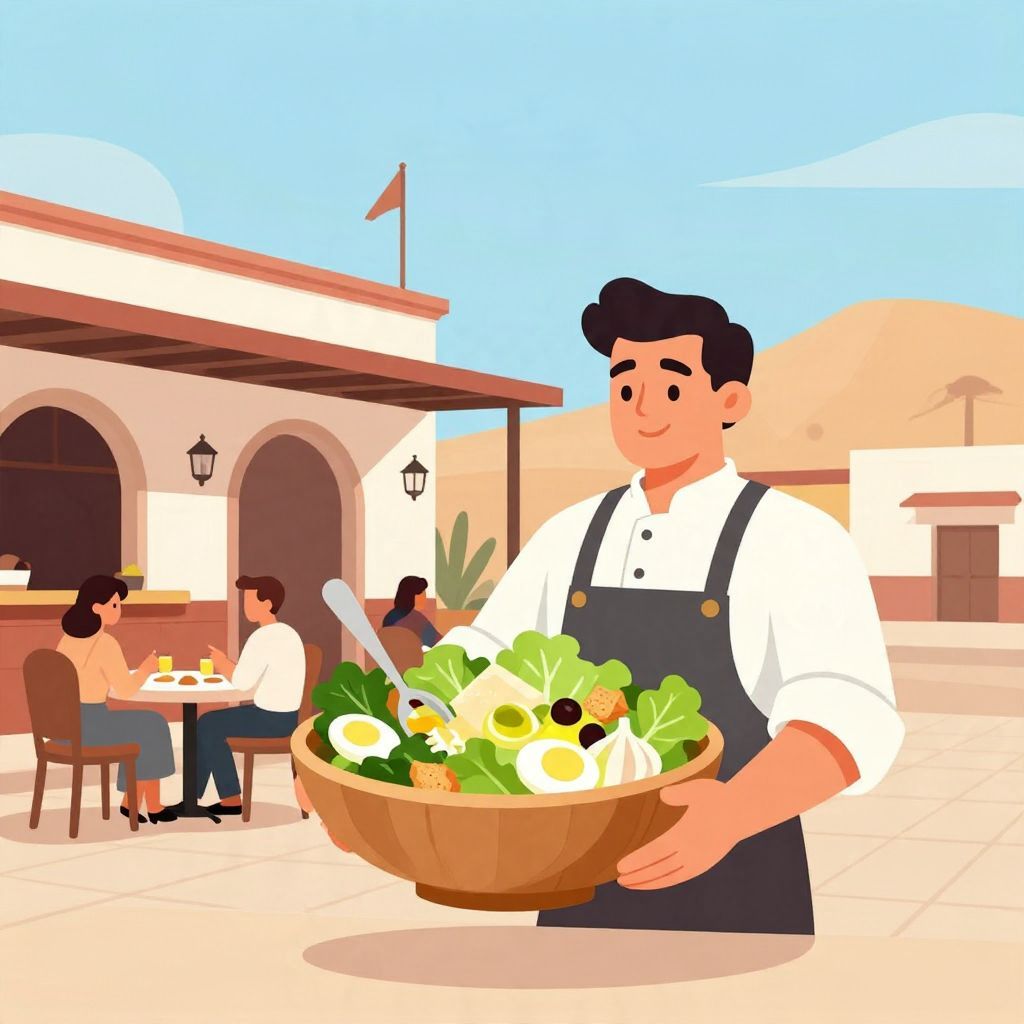
Where did Caesar salad originate? The short answer is that it was created in Tijuana, Mexico, most likely in the early 1920s, by restaurateur Caesar Cardini. Despite its Roman-sounding name, the salad is a modern North American dish with a borderland history shaped by tourism, Prohibition-era travel, and improvisation in a busy restaurant kitchen.
Its exact origin story is not perfectly documented, and several family members and witnesses offered slightly different versions. But historians and food writers generally agree on the central point: Caesar salad was not an ancient Roman recipe. It emerged in the cosmopolitan dining culture of the U.S.-Mexico border, where Cardini’s restaurant became famous for serving a dramatic salad prepared tableside.
Where Did Caesar Salad Originate?
Caesar salad originated in Tijuana, Baja California, Mexico, in the early 1920s, usually dated to 1924. It is widely associated with Caesar Cardini, an Italian-born restaurateur who ran a restaurant there. The dish spread quickly through North America and later became one of the best-known salads in the world.
The Borderland Setting That Made Caesar Salad Possible
To understand the salad’s origin, it helps to understand Tijuana in the 1920s. The city sat just across the border from California and attracted American visitors looking for dining, entertainment, and legal loopholes during Prohibition. Restaurants in Tijuana catered to tourists who wanted alcohol, nightlife, and a glamorous escape close to home.
That environment encouraged theatrical food service. A dish prepared at the table, with fresh ingredients and a sense of spectacle, fit perfectly into the era’s hospitality culture. Caesar salad was not born in a quiet domestic kitchen; it was created in a lively commercial setting where presentation mattered as much as flavor.
Why Tijuana mattered
- It drew American tourists from Southern California.
- It benefited from cross-border business during Prohibition.
- Its restaurants competed by offering novelty and flair.
- Fresh ingredients and quick improvisation were part of the appeal.
Who Created Caesar Salad?
The salad is most commonly credited to Caesar Cardini, an Italian immigrant and restaurateur. Cardini operated restaurants in Mexico and the United States, and his Tijuana establishment became the setting for the salad’s invention. His name became attached to the dish, though the precise moment of creation is debated.
Cardini’s story fits the broader pattern of immigrant entrepreneurship in early 20th-century North America. He brought European culinary experience into a border city shaped by international travel. The salad that emerged from his restaurant combined simple ingredients into something elegant enough to become a signature dish.
A family story with variations
Several versions of the origin story exist. One popular account says Cardini improvised the salad when the kitchen was running low on supplies during a busy holiday weekend. Another version credits a kitchen assistant or family member with helping shape the recipe. These differences do not change the basic historical consensus, but they do show how restaurant legends often grow around famous dishes.
The most responsible conclusion is that Caesar Cardini and his restaurant were central to the salad’s creation, even if the exact sequence of events cannot be proven in every detail.
What Was the Original Caesar Salad Like?
The original Caesar salad was simpler than many modern versions. It was built from romaine lettuce, olive oil, lemon juice, egg, Parmesan cheese, Worcestershire sauce, garlic, and croutons. Anchovies are often associated with Caesar salad today, but early versions did not always include them directly; instead, Worcestershire sauce supplied a savory depth that may have contributed a subtle anchovy flavor.
One reason the dish stood out was its method of preparation. The salad was assembled and tossed at the table, sometimes with flair. That performance turned a basic salad into an event. In an era when restaurant dining was becoming more theatrical, this mattered almost as much as the ingredients themselves.
Key features of the early dish
- Fresh romaine lettuce as the base.
- A garlicky, lemony dressing.
- Parmesan cheese for richness.
- Croutons for texture.
- Tableside preparation for spectacle.
Why the Name “Caesar”?
The name comes from Caesar Cardini, not from Julius Caesar or ancient Rome. That misunderstanding has helped the salad’s mystique, but it is historically inaccurate. The Roman association is a later layer of branding and popular imagination, not evidence of ancient origin.
In fact, the name reflects a common pattern in food history: a dish can become famous through the reputation of the person or place that popularized it. Over time, the name may invite myths that make the food seem older or more exotic than it really is.
How the Salad Spread Beyond Tijuana
Caesar salad gained popularity after travelers experienced it in Tijuana and brought the idea back to the United States. As the dish moved north, it was adapted by restaurants and home cooks. Recipes appeared in cookbooks and newspapers, and the salad gradually became a standard menu item in upscale dining rooms and eventually in everyday restaurants.
Its spread was helped by several factors. It was visually appealing, easy to adapt, and associated with sophistication. The salad also fit changing American tastes in the mid-20th century, when salads became more common as a first course and as a lighter alternative to heavier meals.
From signature dish to global staple
By the mid-20th century, Caesar salad had moved far beyond its original border setting. Bottled dressings, restaurant chains, and home recipe culture all helped standardize it. As that happened, the dish became less tied to its Tijuana origins in the public mind, even though those origins remained central to its history.
What Is Historically Certain, and What Is Debated?
There is strong historical agreement on the broad outline: Caesar salad originated in Tijuana in the 1920s and is linked to Caesar Cardini. The uncertainty lies in the details. Exact dates, the identity of the first person to assemble it, and the precise recipe at the moment of invention are harder to verify because the story developed through memory, family testimony, and restaurant lore rather than a single definitive document.
That uncertainty is common in culinary history. Many famous dishes were not invented in a single, fully recorded moment. Instead, they emerged through improvisation, repetition, and later storytelling. Caesar salad is a good example of how a recipe can be both historically real and partly legendary.
What historians can say with confidence
- The salad is a 20th-century creation, not an ancient one.
- Its origin is linked to Tijuana, Mexico.
- Caesar Cardini is the key figure associated with it.
- The dish spread from a restaurant specialty to an international favorite.
Why Caesar Salad Became So Famous
The salad’s success came from more than taste. It had a memorable name, a dramatic presentation, and a story people liked to repeat. It also fit a larger dining trend: the appeal of dishes that felt both fresh and refined. Caesar salad offered a balance of simplicity and richness that made it adaptable across different restaurants and eras.
Its fame also reflects the power of border culture. Tijuana was not a culinary backwater; it was a place where Mexican, American, and international influences met. Caesar salad emerged from that exchange, which helps explain why it traveled so easily across borders and class boundaries.
Caesar Salad in Historical Perspective
Looking at Caesar salad as history rather than just a recipe reveals several larger themes. It shows how migration shaped modern food, how border cities could become centers of innovation, and how restaurant culture helped create new culinary traditions. It also reminds us that many “classic” dishes are surprisingly recent.
In that sense, the question “Where did Caesar salad originate?” is really a question about modern food culture: how a dish can be invented in one place, mythologized in another, and eventually claimed by the world.
So the best historical answer is clear: Caesar salad originated in Tijuana, Mexico, in the early 1920s, most likely at Caesar Cardini’s restaurant. Its exact origin story has some uncertainty, but its borderland birthplace is well established. For more food-history origin stories, you might also enjoy where sushi originated and where French fries originated.