
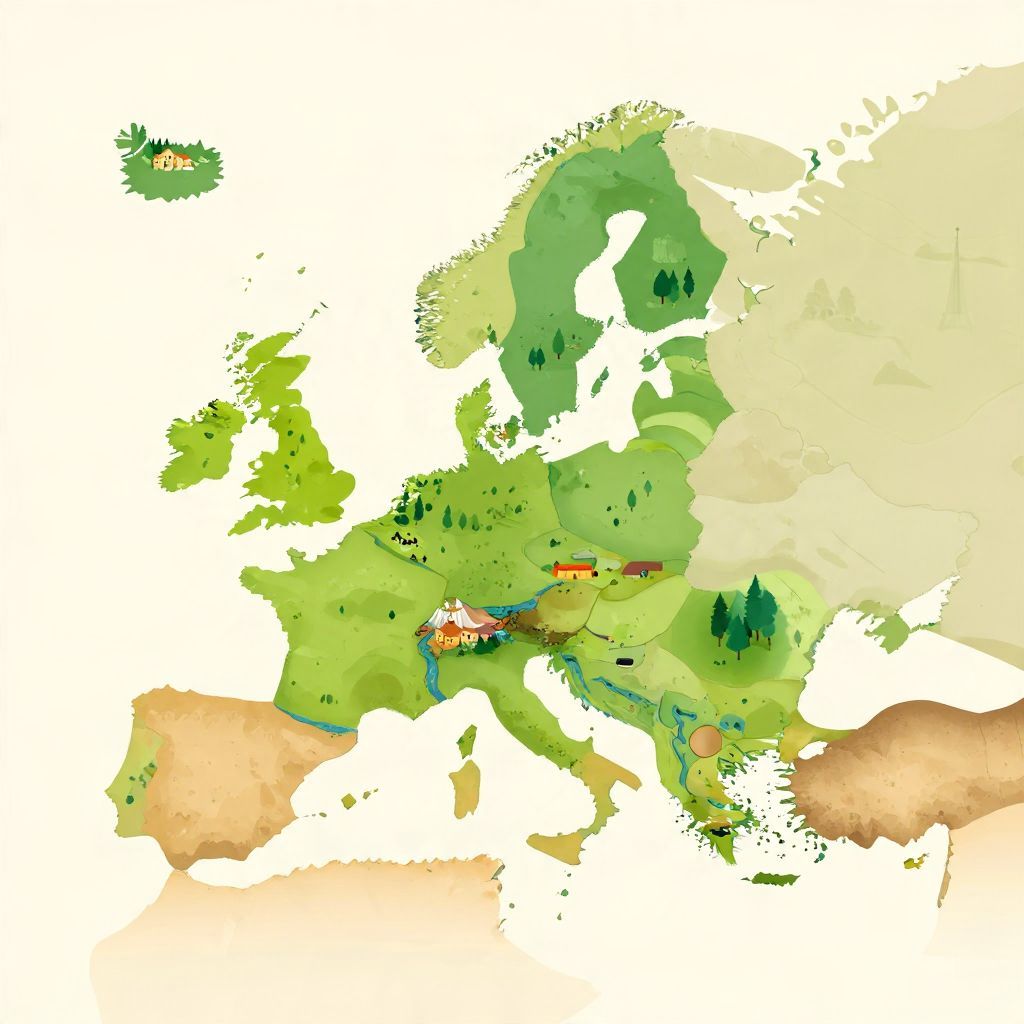
Gaul was the ancient Roman name for a broad region of western Europe, best known as the land that became most of modern-day France. It also included parts of present-day Belgium, Luxembourg, western Switzerland, northern Italy, and small areas of the Netherlands and Germany.
Because the boundaries changed over time, “Gaul” does not refer to one fixed map. It was a cultural and political label used by Greeks and Romans for Celtic-speaking peoples and the territories they inhabited before and during Roman rule.
Where Was Gaul?
Gaul was located in western Europe, centered on the territory of modern France and extending into neighboring regions. In Roman usage, it usually meant the lands north of the Alps and west of the Rhine, though the exact limits varied by period. The region was divided by the Romans into several provinces, including Gallia Narbonensis in the south and Gallia Comata in the north and west.
The core of Gaul: modern France
The heart of Gaul lay in what is now France. This was the largest and most important part of the region in Roman eyes, especially after Julius Caesar’s conquest in the 1st century BCE. Major rivers such as the Seine, Loire, Rhône, and Garonne helped shape settlement, trade, and military movement.
Neighboring areas included in Gaul
Depending on the source and the era, Gaul could also include:
- present-day Belgium and Luxembourg
- western Switzerland
- parts of the Netherlands south of the Rhine
- small areas of western Germany along the Rhine frontier
- northern Italy in earlier or broader Greek and Roman geographic usage
What Did “Gaul” Mean in Antiquity?
“Gaul” was not a name used by all the people who lived there. It was mainly a Greek and Roman term for lands inhabited by groups the Romans called Gauls, many of whom were Celtic-speaking communities. The label was geographic and cultural as much as political, and its meaning shifted as Roman power expanded.
Greek and Roman perspectives
Greek writers used names such as Keltoi and later Romans used Galli or Gallia. These terms reflected outside observation rather than a single unified identity. The peoples of Gaul were not one nation; they were many tribes and communities with different rulers, alliances, and local customs.
Not a single country
Before Roman conquest, Gaul was a patchwork of tribal territories. Some groups were powerful and urbanized by ancient standards, while others lived in smaller rural settlements. There was no centralized “Gaulish state.” That is one reason the region was easier for Rome to conquer than a unified kingdom might have been.
Gaul Before the Romans
Long before Roman rule, the region had a long prehistoric and Iron Age history. By the first millennium BCE, Celtic cultures were widespread across much of the area. Archaeology shows fortified settlements, trade networks, metalworking, and contact with Mediterranean powers such as the Greeks and Etruscans.
Trade and contact with the Mediterranean
Southern Gaul had especially strong links to the ancient Mediterranean world. Greek colonists founded Massalia, modern Marseille, around 600 BCE, creating a major trading center. Through such contacts, wine, pottery, and luxury goods moved into Gaul, while metals, slaves, and agricultural products moved outward.
Tribal diversity
Many tribal names appear in Roman sources, including the Arverni, Aedui, Sequani, Belgae, and Helvetii. These were not “nations” in the modern sense, but political communities with leaders, client relationships, and shifting rivalries. Roman authors often emphasized their divisions, which later helped justify conquest.
How Rome Conquered Gaul
Gaul became central to Roman history during the Gallic Wars, fought mainly between 58 and 50 BCE. Julius Caesar led Roman armies against a series of Gallic coalitions, using diplomacy, military force, and political strategy. His conquest transformed the region and also helped propel Caesar into the Roman civil wars.
Why Rome intervened
Roman involvement began partly through frontier politics in southern Gaul and the Alps. Rome had already established influence in the Mediterranean coastal zone, especially around Massalia and the province later called Narbonensis. Caesar then used border conflicts and tribal movements as a pretext for deeper intervention.
The conquest and its consequences
Caesar’s campaigns culminated in the defeat of Vercingetorix at Alesia in 52 BCE, one of the best-known episodes in Roman-Gaulish history. After resistance collapsed, Rome reorganized the region under imperial administration. Over time, Gaul became more deeply integrated into the Roman world through roads, towns, taxation, and military service.
Roman Gaul: Provinces and Frontiers
Under Rome, Gaul was no longer a loose cultural region but a set of provinces. The Romans divided it for easier administration and defense. The Rhine became one of the empire’s most important frontiers, separating Roman Gaul from Germanic territories to the east.
Major Roman divisions
By the early imperial period, Roman Gaul commonly included provinces such as:
- Gallia Narbonensis in the south, centered on the Mediterranean corridor
- Aquitania in the southwest
- Gallia Lugdunensis in central and western areas
- Gallia Belgica in the northeast
- the Germaniae provinces along the Rhine frontier, often associated with Gaul in broader regional discussions
Lugdunum and Roman administration
Lugdunum, modern Lyon, became one of the most important Roman cities in Gaul. It served as a political and commercial hub and symbolized the region’s integration into the empire. Roman roads connected towns, military bases, and river routes, making Gaul a vital part of imperial logistics.
What Happened to Gaul After Rome?
Gaul did not disappear when Roman power declined; it changed. In the late Roman and early medieval periods, the region became a battleground for new powers, including Frankish, Burgundian, and Visigothic rulers. Latin language and Roman institutions survived in altered form and helped shape medieval France.
From Roman province to medieval kingdoms
By the 5th century CE, Roman authority weakened in western Europe. Local elites, bishops, and military leaders increasingly filled the gap. The Franks eventually came to dominate much of Gaul, and their kingdom became the foundation of later French political history.
Language and identity
Latin gradually replaced many local Celtic languages in much of the region, though not everywhere at once. Over centuries, this produced the Romance languages of western Europe, especially French. The old name “Gaul” survived in historical writing, but the region’s identity evolved into new medieval and early modern forms.
Why Gaul Matters in History
Gaul matters because it was a major crossroads of ancient Europe. It connected the Atlantic world, the Mediterranean, and the Rhine frontier. Its conquest helped transform the Roman Republic into an empire, and its later transformation helped shape medieval Europe, especially France and neighboring lands.
Lasting historical significance
Studying Gaul helps explain several larger historical processes: Roman expansion, cultural exchange, frontier warfare, urbanization, and the transition from ancient to medieval Europe. It also shows how historical names can outlive the political entities they once described.
So, where was Gaul? It was the ancient Roman name for a large region of western Europe, centered on modern France and extending into nearby lands. Its borders shifted with time, but its historical importance remained: Gaul was one of the key regions through which ancient Europe was conquered, Romanized, and later reshaped into medieval kingdoms. For related regional history, you may also find where Prussia was located and what the Holy Roman Empire was useful comparisons.