
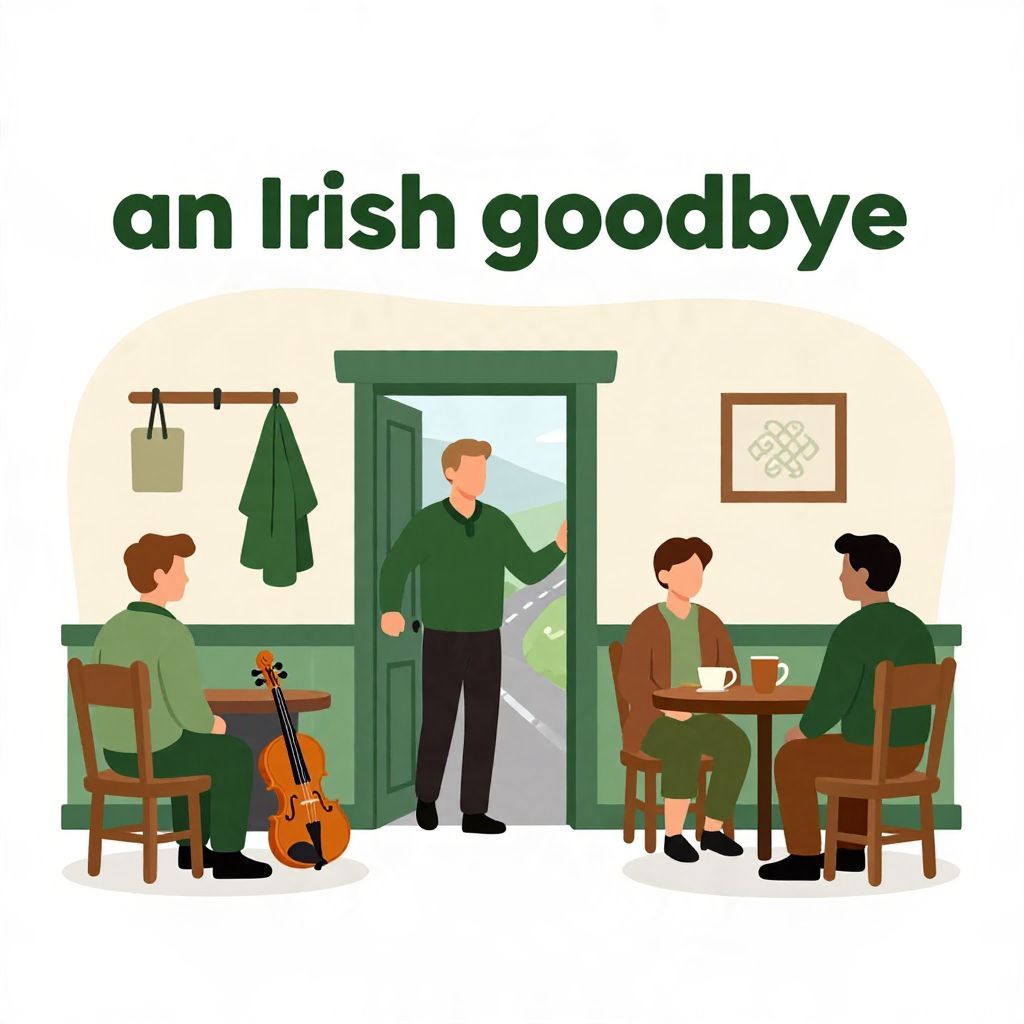
Why is it called an Irish goodbye? The short answer is that the phrase is not a neutral historical label but a cultural expression that emerged from older stereotypes about the Irish and their social habits. In modern usage, it means leaving a gathering without saying goodbye to everyone. The name reflects how ethnic jokes and national nicknames often developed in English-speaking societies.
The phrase’s history is less about Ireland itself than about how language turned social behavior into a national stereotype. Understanding that background helps explain why the term exists, why many people now find it insensitive, and why its origin is more complicated than the expression suggests.
Why Is It Called an Irish Goodbye?
An “Irish goodbye” is called that because English-speaking people attached the act of leaving quietly and without formal farewells to an ethnic stereotype about the Irish. The phrase likely grew out of 19th- and early 20th-century humor and prejudice, not from any uniquely Irish custom. In other words, the name reflects social bias more than historical fact.
The Meaning of the Phrase Today
Today, an Irish goodbye usually means slipping out of a party, pub, wedding, or other social event without announcing your departure. People use it casually to describe avoiding the awkwardness of long farewells. In modern speech, it can sound playful, but it also carries a history of ethnic labeling that is worth understanding.
Common modern uses
- Leaving a party quietly so as not to interrupt the flow of the evening
- Departing early from a crowded event without a scene
- Avoiding lengthy goodbyes, hugs, or repeated “just one more minute” exchanges
The phrase is especially common in the United States, where many ethnic labels entered everyday slang through immigration-era humor, social tension, and stereotype-driven jokes.
Where Did the Expression Come From?
The exact first use of “Irish goodbye” is difficult to pin down with certainty. Like many idioms, it likely developed gradually in spoken language before appearing in print. What historians can say is that the phrase fits a broader pattern from the 19th century and early 20th century, when immigrant groups were frequently turned into targets of jokes, insults, and shorthand cultural descriptions.
Irish immigrants in Britain and the United States faced discrimination for decades, especially during the large waves of migration after the Great Famine of the 1840s. In that setting, “Irish” was often used in slang not as a neutral ethnic descriptor, but as a way to stereotype behavior, temperament, or manners.
Why ethnic labels became common in slang
During the 19th century, newspapers, vaudeville humor, popular songs, and casual speech often attached national identities to habits people wanted to mock or exaggerate. Similar expressions were built around other groups as well. These phrases did not describe actual national customs so much as they reflected the prejudices of the societies that coined them.
That is why the phrase “Irish goodbye” should not be read as evidence that Irish people historically favored abrupt departures. Rather, it is a product of the social climate in which Irish people were often caricatured by outsiders.
Did the Irish Actually Do This More Than Anyone Else?
There is no solid historical evidence that leaving without saying goodbye was a distinctively Irish practice. People in every culture sometimes slip away from gatherings for practical or personal reasons. The association with Ireland appears to be a stereotype, not a documented tradition. The phrase tells us more about the people who coined it than about the Irish themselves.
Why the stereotype stuck
Several factors helped such expressions spread:
- Immigration and urban life: Large, diverse cities created more social mixing and more opportunities for ethnic joking.
- Humor and performance culture: Music halls, newspapers, and comic sketches normalized broad ethnic caricatures.
- Social prejudice: Anti-Irish bias made negative or mocking labels easier to popularize.
Because the phrase is tied to stereotype rather than fact, many speakers today avoid it or use it only with awareness of its history.
Historical Background: Irish Stereotypes in the 19th Century
To understand the phrase, it helps to look at the wider history of anti-Irish sentiment. In the 1800s, especially in Britain and the United States, Irish migrants were often portrayed as unruly, overly emotional, drunk, lazy, or socially inept. These caricatures were common in political cartoons and popular entertainment.
The Great Famine of 1845–1852 accelerated Irish migration to North America and Britain. Many newcomers arrived poor and were forced into low-paid labor in cities that were already tense and competitive. Hostility toward immigrants often became encoded in jokes and slang. Expressions like “Irish goodbye” belong to that world of ethnic labeling.
How prejudice shaped language
Language often preserves old social attitudes long after those attitudes have become unacceptable. A phrase can remain in circulation even when the original prejudice behind it is no longer obvious to speakers. That is one reason historians pay attention to idioms: they can reveal how ordinary language carried assumptions about class, race, religion, and nationality.
In this case, “Irish goodbye” likely emerged from a culture where Irishness was frequently treated as comic shorthand. The phrase survived because it was memorable and easy to use, not because it was historically accurate.
Is It Offensive?
Whether the phrase is offensive depends on context, audience, and intent, but it does have a discriminatory origin. For some people, it is a harmless idiom. For others, especially those aware of its history, it can sound dismissive or insulting. That tension is common with ethnic expressions that began as jokes or slurs and later became everyday speech.
Why some people avoid it
- It reduces a national identity to a stereotype
- It comes from a period of anti-Irish prejudice
- It can be heard as casual ethnic mockery even when not meant that way
Because of that history, many speakers now prefer more neutral alternatives such as “slipping out quietly,” “making a quiet exit,” or simply “leaving early.”
How the Phrase Fits into the History of Idioms
“Irish goodbye” is part of a larger pattern in English where national names were attached to behaviors, often in ways that reflected rivalry or prejudice. These expressions are historically revealing because they show how language can encode social hierarchies. Some terms were playful, some insulting, and many were both at once.
Over time, idioms can lose their original force. People repeat them without knowing where they came from. But historical context matters. A phrase that sounds lighthearted today may have been born in a period when ethnic groups were mocked as outsiders.
Why historians care about phrases like this
Idioms are small pieces of cultural history. They preserve assumptions about who belonged, who was mocked, and how everyday life was narrated in the past. Studying them helps explain not only language change, but also social attitudes toward immigrants and minorities.
What the Phrase Does Not Mean
It is important not to mistake the idiom for a factual claim about Irish culture. The phrase does not mean that Irish people traditionally avoided politeness or that Irish social life was somehow less formal than others. Nor does it point to a specific Irish custom with a traceable origin. It is best understood as an outsider’s label, shaped by prejudice and repeated over time.
That distinction matters because historical language can easily blur stereotype and reality. When a phrase becomes familiar, its origins may disappear from view even though the assumptions behind it remain embedded in the wording.
Why the Name Has Lasting Power
The phrase has lasted because it is vivid, short, and easy to understand. It captures a familiar social experience: the awkwardness of saying goodbye at length. But its staying power also comes from the way ethnic humor often becomes normalized in everyday speech. Many people use the phrase without thinking about its history, which is why it continues to appear in conversation, media, and casual writing.
At the same time, awareness of its background has grown. As people become more sensitive to the history of ethnic stereotyping, they are more likely to question phrases that once passed unexamined. That broader shift is part of how language changes in response to historical memory.
Conclusion: The Real History Behind the Phrase
It is called an Irish goodbye because English speakers attached the idea of a quiet, unannounced exit to an old stereotype about the Irish. The phrase is not evidence of a uniquely Irish custom; it is a reminder of how prejudice can shape everyday language. Its history reflects immigration, social tension, and the long life of ethnic humor in modern English. For related language history, you may also enjoy what an Irish goodbye means and the story behind why New Orleans is called the Big Easy.