
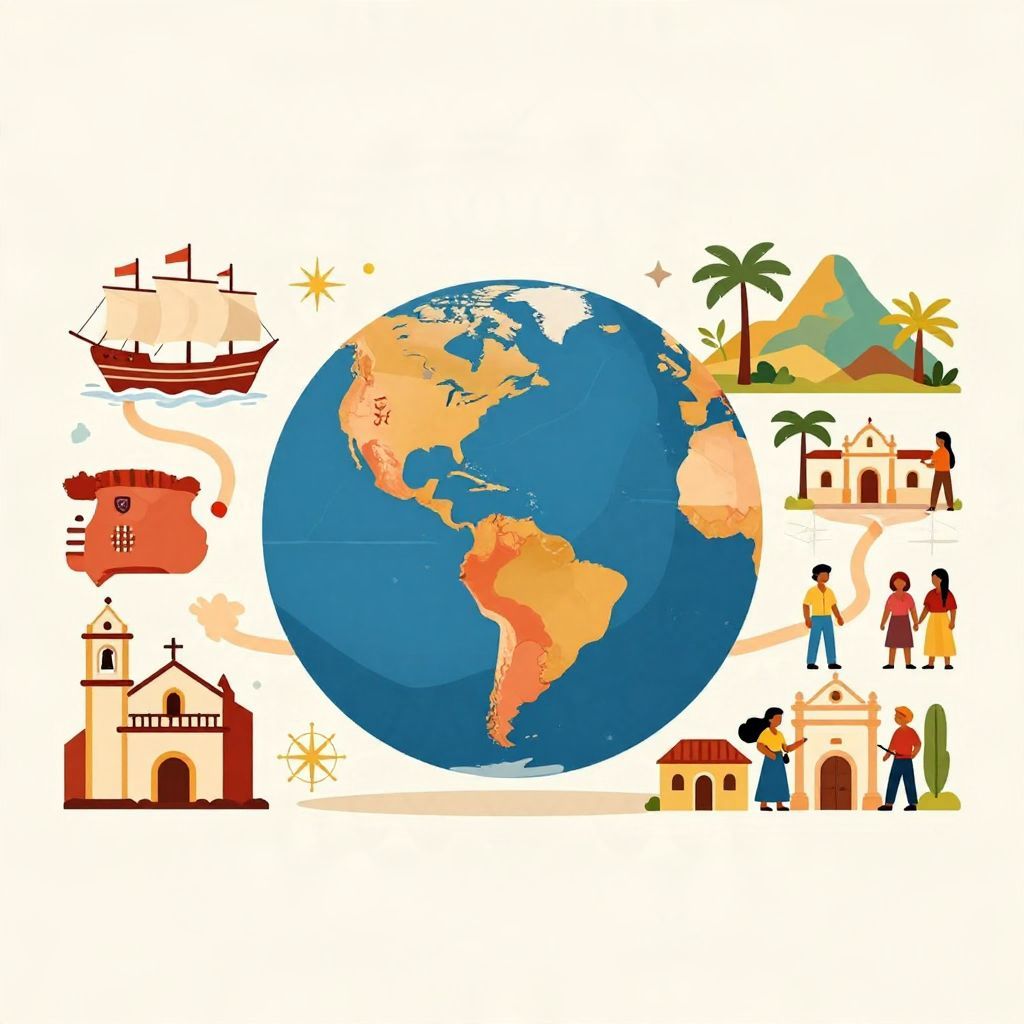
Why is Latin America called Latin America? The short answer is that the name refers to the region’s Romance-language heritage—especially Spanish and Portuguese, and in a broader sense French—languages that developed from Latin after the fall of the Roman Empire. The label is not ancient; it emerged in the 19th century, when intellectuals and politicians were trying to describe the cultural and political identity of the Americas under European influence.
That makes the term both linguistic and historical. It points to colonial conquest, language spread, and later efforts to define a shared regional identity distinct from the English-speaking “Anglo” world.
Why Is Latin America Called Latin America?
Latin America is called “Latin” because most of the region’s dominant languages—Spanish, Portuguese, and sometimes French—come from Latin, the language of ancient Rome. The term became common in the 1800s as a way to group together countries in the Americas shaped by Iberian and French colonial rule, especially in contrast to English-speaking North America.
Where the Name Came From
The phrase Latin America did not exist during the Spanish conquest or the early colonial period. It was a later invention, appearing in the 19th century. Scholars generally trace its rise to French intellectual and political circles, where the idea of a “Latin” world helped justify France’s cultural influence in the Americas and distinguish it from Anglo-Saxon power.
In other words, the name was created after the independence movements in Spanish America and Brazil. It was part of a larger effort to classify nations by language, culture, and imperial history rather than by geography alone.
The role of Romance languages
Spanish and Portuguese are called Romance languages because they evolved from spoken Latin, not because they are “romantic” in the modern sense. French is also a Romance language, though French-speaking countries are not always included in every definition of Latin America. The “Latin” in the name therefore refers to linguistic ancestry, not to the Roman Empire directly.
Why not just call it “Spanish America”?
That would leave out Brazil, which was colonized by Portugal and became the largest country in the region. It would also ignore French-speaking areas and the broader cultural similarities many 19th-century writers wanted to emphasize. “Latin America” offered a larger umbrella term for territories shaped by Iberian and, in some cases, French colonial traditions.
The Historical Background: Roman Latin to New World Languages
The story begins with the Roman Empire. As Rome expanded, Latin spread across much of western Europe. After the empire weakened and fell in the West in the 5th century, Latin gradually changed into regional vernaculars. Over centuries, these became Spanish, Portuguese, French, Italian, Romanian, and other Romance languages.
When Spain and Portugal colonized the Americas after 1492, they brought their languages with them. Missionaries, administrators, settlers, and merchants used Spanish and Portuguese in government, religion, and trade. Over time, these languages became dominant across much of Central and South America, though indigenous languages remained vital and continue to be spoken today.
Colonial language and power
Language spread was never simply a neutral cultural process. It was tied to conquest, forced labor systems, missionary activity, and colonial administration. Indigenous peoples in the Americas often had to navigate Spanish or Portuguese while preserving their own languages and traditions. So when historians explain the name “Latin America,” they are also describing a colonial legacy.
Who Popularized the Term?
The term is usually associated with 19th-century French thinkers and policymakers, especially during the era when France sought influence in the Americas. One often-cited figure is the Colombian writer and diplomat José María Torres Caicedo, who used the phrase in the 1850s in a poem about the region’s identity and vulnerability to foreign domination. Around the same period, French writers also used related ideas such as “Latin race” or “Latin peoples.”
It is important to be careful here: there was no single inventor universally agreed upon by historians. Rather, the term developed in overlapping intellectual and political circles. Its popularity grew because it served multiple purposes at once—cultural classification, geopolitical strategy, and regional self-definition.
French imperial context
France had reasons to promote the concept. By emphasizing a shared “Latin” heritage, French thinkers could present France as a natural cultural ally of Spanish- and Portuguese-speaking America. This idea was especially useful during the 19th century, when European powers were competing for influence overseas and when France under Napoleon III pursued ambitious foreign policy in the Americas.
How the Term Differed from Other Regional Labels
“Latin America” is only one way to describe the region, and it is not perfectly precise. Different terms highlight different histories and political realities. Some are broader, some narrower, and some carry ideological baggage.
- Hispanic America usually refers to Spanish-speaking countries in the Americas, excluding Brazil.
- Ibero-America includes Spanish- and Portuguese-speaking countries, emphasizing Iberian Peninsula origins.
- Spanish America is narrower still and usually excludes Brazil and French-speaking territories.
- Latin America is the broadest of these common labels, though definitions vary by context.
Because the term is flexible, scholars sometimes use it differently depending on whether they are discussing language, colonial history, economics, or identity. That flexibility is useful, but it can also blur important differences between countries and regions.
Why the Name Became So Widely Used
Several historical developments helped the term spread. First, the 19th century was an age of nationalism, when people increasingly described societies through shared language and culture. Second, the newly independent republics of Spanish America and Brazil were seeking ways to define themselves after breaking from European empires. Third, foreign observers needed a convenient label for a large and diverse part of the Americas.
The term also gained traction because it contrasted neatly with “Anglo-America,” especially the United States and Canada. That contrast was politically useful. It suggested that the Americas were divided not just by geography, but by different colonial legacies and cultural traditions.
Identity after independence
After independence in the early 1800s, many leaders and writers asked what kind of region they were building. Were these new nations extensions of Europe, heirs of indigenous civilizations, or something entirely new? “Latin America” offered one answer: a region connected by language, religion, law, and colonial history, yet separate from both Spain and the English-speaking world.
What the Term Includes—and Excludes
Today, “Latin America” usually refers to Mexico, Central America, most of South America, and the Spanish- and Portuguese-speaking Caribbean. But the boundaries are not fixed. Some definitions include French-speaking Haiti or French Guiana because French is a Romance language; others exclude them because the term is often used in a political and cultural sense rather than a strictly linguistic one.
That ambiguity shows why the name is best understood as a historical convention, not a scientific category. It is a useful shorthand, but it does not perfectly map onto ethnicity, race, geography, or national identity.
Indigenous and African histories are part of the story
The name can also be misleading if taken too literally. Latin America is not only “Latin.” The region’s history includes thousands of indigenous communities and languages, as well as the forced migration of millions of Africans through the Atlantic slave trade. These populations profoundly shaped the region’s cultures, religions, music, politics, and economies. The label highlights one layer of history, but not the whole picture.
Common Misunderstandings About the Name
One common mistake is to assume that “Latin America” means the region is somehow directly descended from ancient Rome. That is not true. The connection is indirect: Latin became the ancestor of the Romance languages, and those languages were carried to the Americas through European colonization.
Another misunderstanding is to think the term has always been neutral. In fact, it has often carried political meaning. Some writers used it to promote solidarity among American republics; others used it to support French influence or to define the region in opposition to the United States. The name has therefore been both descriptive and ideological.
Why the Name Still Matters Today
Even with its limitations, “Latin America” remains a powerful and widely recognized term. It helps historians, journalists, and the public talk about a vast region with shared colonial roots and many overlapping cultural patterns. At the same time, modern scholarship increasingly emphasizes diversity within the region: differences in language, race, class, indigenous heritage, and national experience.
So the name survives because it is useful, not because it is perfect. It captures an important historical reality—the spread of Romance languages through Iberian and French colonialism—but it should always be used with an awareness of what it leaves out.
Conclusion
Latin America is called Latin America because the region was shaped by Spanish, Portuguese, and sometimes French colonial rule, and those languages descend from Latin. The term emerged in the 19th century as a historical and political label, not as an ancient geographic name. It reflects language, empire, and identity all at once. For a related look at the region’s naming and language history, see why it is called Latin America and what language the Romans spoke.