
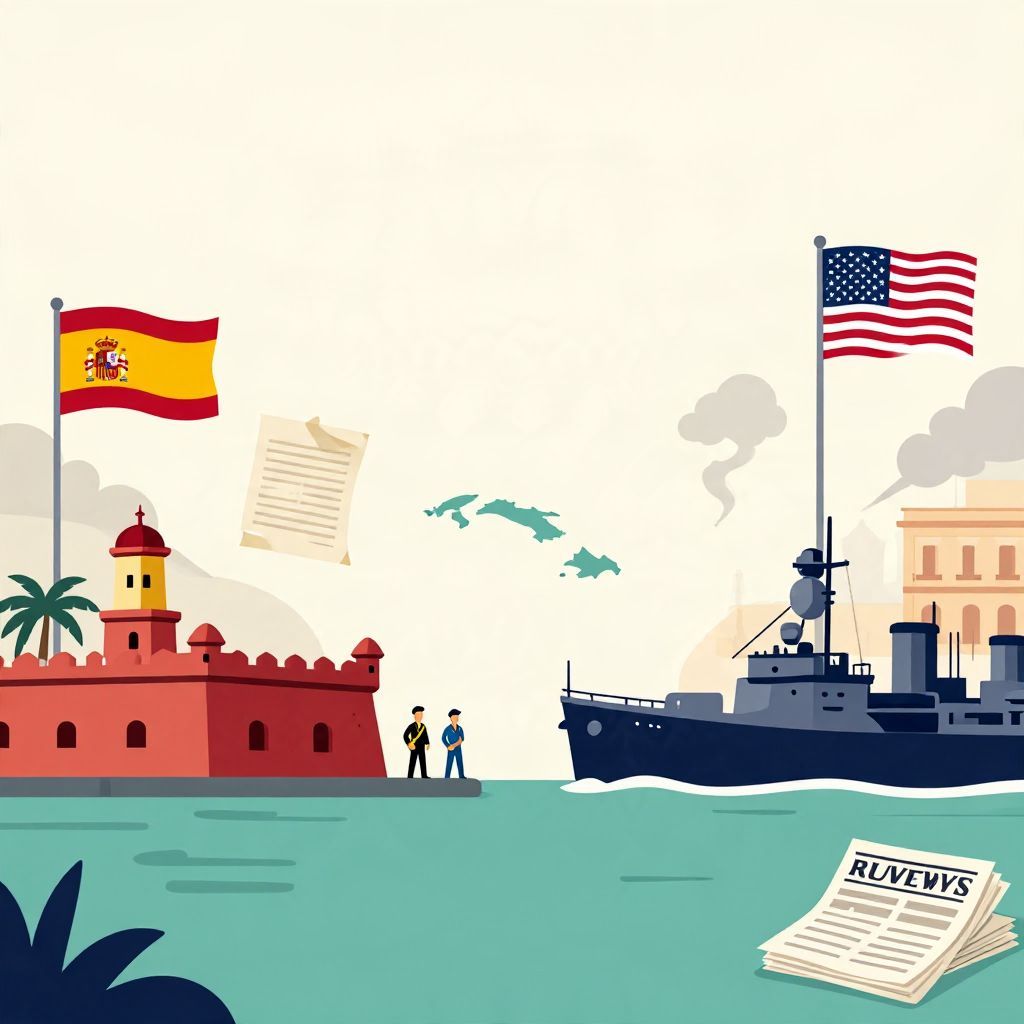
The Spanish-American War was caused by a mix of long-term U.S. expansionism, Cuban resistance to Spanish rule, economic interests, sensational journalism, and the immediate shock of the USS Maine explosion in Havana Harbor in 1898. It was not the result of one single event, but of years of tension between Spain, Cuba, and the United States.
By the time war began in April 1898, the conflict had become a turning point in both Cuban independence and American foreign policy. The war lasted only a few months, but its causes reveal how empire, nationalism, and public opinion could push nations into war.
What Caused The Spanish American War?
The Spanish-American War was caused by Cuban efforts to win independence from Spain, U.S. economic and strategic interests in the Caribbean, harsh Spanish colonial policies, and growing American public pressure after the USS Maine disaster. These forces combined in 1898, making war increasingly likely even before the first shots were fired.
The Long Cuban Struggle Against Spanish Rule
The most important background cause was Cuba’s long fight against Spanish colonial rule. Cuba had been under Spanish control for centuries, but many Cubans wanted independence by the late 1800s. Spain’s rule was increasingly seen as outdated, repressive, and economically exploitative.
The Ten Years’ War and renewed rebellion
From 1868 to 1878, Cubans fought the Ten Years’ War, a major but unsuccessful attempt to break away from Spain. Although the rebellion ended without independence, it left behind a strong nationalist movement. In 1895, another uprising began, led by figures such as José Martí, who became an important symbol of Cuban independence.
Spain responded with military force and harsh counterinsurgency tactics. The Spanish government tried to isolate rebels from civilian support, and this led to widespread suffering among ordinary Cubans. The violence made the conflict more visible in the United States and helped turn American sympathy toward the Cuban cause.
Spanish repression and civilian suffering
One of the most controversial Spanish policies was the use of reconcentration, a system that forced rural civilians into controlled areas so they could not aid rebels. This policy caused hunger, disease, and high death rates. American newspapers and politicians used these reports to portray Spain as cruel and incapable of governing Cuba humanely.
While the exact scale of suffering is sometimes debated in detail, there is no doubt that conditions in Cuba were severe and that Spanish policy helped inflame anti-Spanish feeling in the United States.
U.S. Expansionism and Strategic Interests
American involvement in the crisis was not purely humanitarian. The United States had growing economic and strategic interests in the Caribbean and the Pacific by the 1890s. Many Americans believed the country should play a larger role in world affairs, and Cuba’s location made it especially important.
Trade, investment, and geography
U.S. businesses had significant investments in Cuban sugar and other industries. Stability in Cuba mattered to American merchants and investors, and war threatened those interests. At the same time, Cuba sat near key shipping lanes and close to the entrance to the Gulf of Mexico, giving it major strategic value.
Some American leaders also feared that European powers might intervene in the Caribbean if Spain collapsed, or that instability in Cuba could threaten U.S. security. These concerns fit a broader late-19th-century trend toward overseas expansion and naval power.
Imperial thinking in the 1890s
The Spanish-American War came during an era when many industrial powers were expanding overseas. In the United States, some politicians, journalists, and military thinkers argued that the nation needed colonies, naval bases, and a stronger global presence. This imperial outlook did not cause the war by itself, but it made intervention in Cuba more acceptable to many Americans.
Yellow Journalism and Public Opinion
Public opinion played a major role in the road to war. In the 1890s, newspapers competed fiercely for readers, and some publishers used dramatic headlines, emotional stories, and exaggerated reporting to sell papers. This style became known as yellow journalism.
How the press shaped the crisis
Newspapers owned by William Randolph Hearst and Joseph Pulitzer were especially influential in covering Cuba. They highlighted Spanish brutality, Cuban suffering, and the possibility of American intervention. Not every report was false, but coverage was often sensationalized and sometimes overstated the evidence.
It is too simple to say that newspapers “caused” the war on their own. Still, they helped create a public climate in which many Americans came to see war as both justified and necessary. The press amplified anger, sympathy, and fear at a crucial moment.
The USS Maine Explosion
The immediate trigger for war was the explosion of the USS Maine in Havana Harbor on February 15, 1898. The battleship had been sent to Cuba during the crisis to protect American interests and show force. When it exploded and sank, more than 260 American sailors died.
What happened and what was believed
At the time, many Americans quickly blamed Spain, even though the exact cause was not immediately known. A U.S. naval inquiry later suggested the ship had been destroyed by an external mine, but the evidence was not conclusive by modern standards. Other explanations have been proposed by historians and naval experts, including an internal accident, though the event remains debated in technical detail.
What matters historically is that the explosion became a political turning point. The slogan “Remember the Maine, to Hell with Spain!” captured public anger and made compromise much harder. The disaster did not create the underlying conflict, but it transformed a tense situation into a war crisis.
Diplomacy Failed Before War Began
War was not inevitable in early 1898, but diplomacy was under severe strain. Spain tried to hold onto Cuba while also promising reforms. The United States demanded an end to the fighting and greater stability on the island. Neither side could fully satisfy the other.
Why compromise broke down
Spain feared that giving up Cuba would weaken its empire and encourage further colonial losses. American leaders, meanwhile, were under pressure from the public, Congress, and the press to act decisively. President William McKinley initially preferred a peaceful solution, but events moved faster than diplomacy could contain.
By April 1898, Congress authorized intervention, and the United States declared war on Spain. The war officially began on April 25, 1898, though fighting had already become likely once the Maine crisis and Cuban rebellion collided.
Was the War Really About Cuban Independence?
Cuban independence was a real and central cause, but it was not the only one. Many Americans genuinely sympathized with Cuban rebels and saw Spain as a colonial oppressor. At the same time, the United States also had its own ambitions. The war was shaped by a combination of humanitarian concern, strategic calculation, and imperial opportunity.
Historians’ main interpretations
- Humanitarian interpretation: The U.S. intervened to stop Spanish brutality and support Cuban freedom.
- Strategic interpretation: The U.S. wanted influence in the Caribbean and a stronger global position.
- Economic interpretation: American trade and investment interests helped push policy toward intervention.
- Media interpretation: Sensational journalism intensified public pressure for war.
Most historians today see the war as the product of all these forces together rather than a single cause. Cuba’s independence struggle was the immediate setting, but American power politics and public emotion turned the crisis into war.
Why the Spanish-American War Mattered
The war lasted only a few months, but its consequences were enormous. Spain lost Cuba, Puerto Rico, Guam, and the Philippines, marking the end of its old colonial empire. The United States emerged as a major overseas power, with new territory and a stronger military presence beyond North America.
Lasting consequences
For Cuba, the war did not lead to complete freedom in the way many rebels had hoped. The United States occupied the island and later exerted strong influence over Cuban affairs. For the United States, the war marked a shift toward a more interventionist foreign policy that would shape the 20th century.
In short, the Spanish-American War was caused by Cuban rebellion against Spanish rule, U.S. expansionist interests, sensational media coverage, and the explosive political impact of the USS Maine. If you want to explore the broader background, related topics like how industrialization led to imperialism and what mercantilism was help explain the larger world of empire that shaped the conflict.