
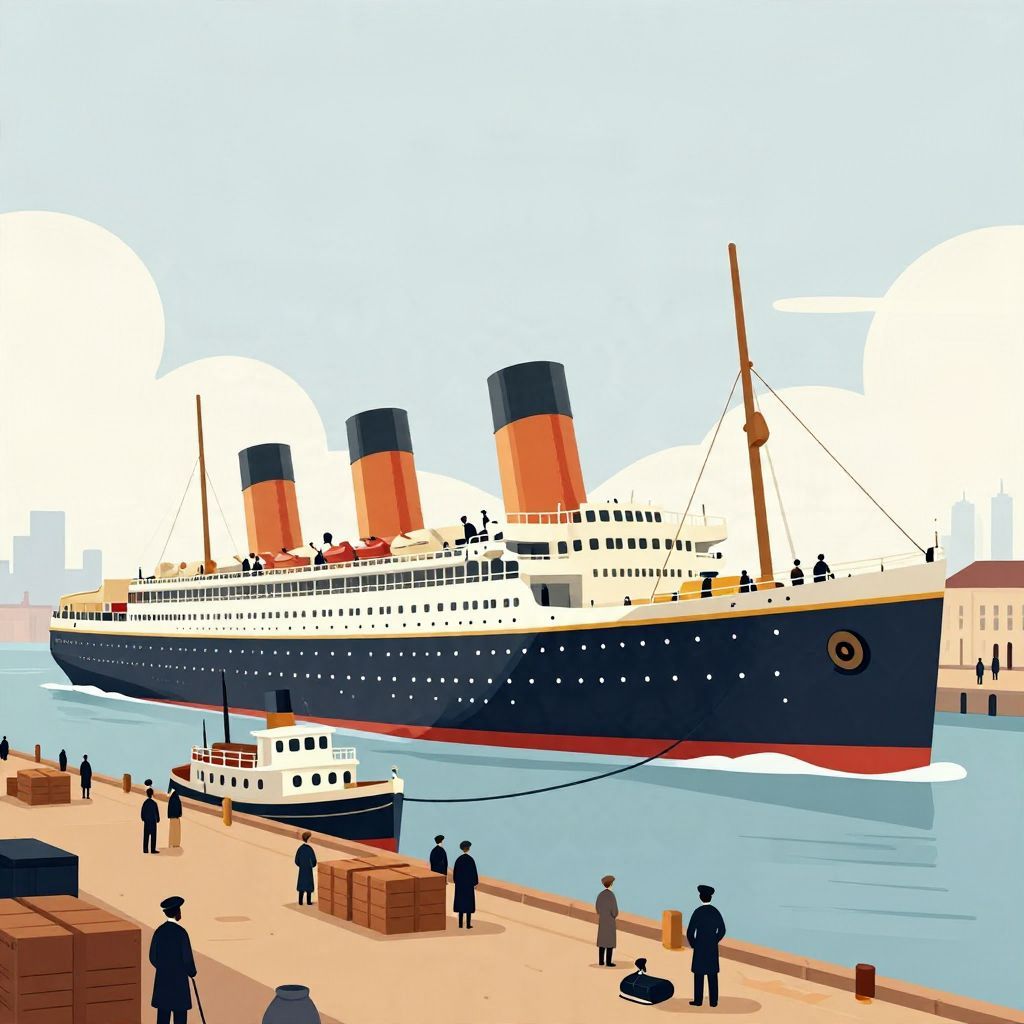
When people ask, “Where did the Titanic leave from?” they usually mean the ship’s first departure point on its fatal maiden voyage. The answer is straightforward: the RMS Titanic sailed from Southampton, England, on 10 April 1912. From there, it made scheduled stops in France and Ireland before heading into the North Atlantic.
That simple answer opens onto a larger story about early 20th-century ocean travel, the White Star Line, and the route that carried one of history’s most famous ships toward disaster.
Where Did the Titanic Leave From?
The Titanic left from Southampton, on England’s south coast, on 10 April 1912. It began its maiden voyage there before calling at Cherbourg, France, and Queenstown—now Cobh—in Ireland. Southampton was the ship’s official departure port, though many passengers boarded later at the other stops.
Why Southampton Was the Titanic’s Starting Point
Southampton was one of Britain’s busiest passenger ports in the early 1900s and a major base for transatlantic liners. The White Star Line used it as a principal home port because it offered strong rail connections, experienced dock facilities, and easy access to emigrants and travelers from London and southern England.
A major port for ocean liners
By the time the Titanic was launched, Southampton had become closely associated with the great passenger ships crossing the Atlantic. The port handled large liners regularly, and the Titanic was part of a broader commercial system that linked railways, shipping companies, and international travel. For many passengers, the journey to New York began not in a glamorous harbor but in an ordinary station or street in Britain, followed by a transfer to the ship.
Why the route mattered
The Titanic did not sail directly from Southampton to New York. Instead, it followed a common practice for major liners: it picked up passengers at several ports before crossing the ocean. This made the voyage more profitable and allowed the company to serve a wider market. It also meant that the ship’s passenger list reflected different social classes, nationalities, and travel purposes, from wealthy first-class travelers to emigrants in steerage.
The Titanic’s Departure on 10 April 1912
The Titanic departed Southampton on the morning of 10 April 1912. The ship was enormous for its time, and its movement out of port drew public attention. After leaving Southampton, it passed through the Solent and into the English Channel. The start of the voyage was routine in one sense, but the size of the liner and the excitement surrounding her made it a significant event.
What happened at the port
The departure was not without incident. As the Titanic pulled away, the displacement of water from its huge hull caused nearby ships to surge and shift. One smaller vessel, the SS New York, broke free from its moorings and drifted dangerously close before being brought under control. The episode was handled without major damage, but it highlighted the scale of the new liner and the challenges of operating such a large ship in a busy harbor.
The first leg of the voyage
After Southampton, the Titanic made two additional stops:
- Cherbourg, France — 10 April 1912, later that day
- Queenstown (Cobh), Ireland — 11 April 1912
These stops were part of the planned route. Cherbourg allowed continental passengers to board, while Queenstown served as a key embarkation point for Irish emigrants and other travelers. Only after leaving Queenstown did the Titanic begin its long Atlantic crossing in earnest.
What “Left From” Means in the Titanic’s Case
The question “Where did the Titanic leave from?” can be answered in more than one way depending on what a reader means. In strict historical terms, the ship’s maiden voyage began in Southampton. But if someone is asking where passengers boarded, the answer may include Cherbourg or Queenstown, depending on the traveler. That distinction matters because the Titanic’s voyage was a multi-port journey, not a single departure from one harbor.
Official departure versus passenger embarkation
For historians and shipping records, Southampton is the correct answer to the question of departure. For individual passengers, however, the “starting point” could be the place they joined the ship. A first-class traveler from France might think of Cherbourg as the beginning of the trip, while an Irish emigrant might remember Queenstown. The ship itself, though, had already started its voyage from Southampton the day before.
Historical Background: The Titanic and the White Star Line
The Titanic was built for the White Star Line, one of the leading British shipping companies of the era. It was designed to compete in the luxury transatlantic market, where comfort, size, and prestige often mattered as much as speed. The company emphasized elegance and scale, helping create the image of the Titanic as a marvel of modern engineering.
A ship of the Edwardian age
The Titanic belonged to the Edwardian world of the early 20th century, when steam travel, industrial wealth, and global migration were reshaping society. Ocean liners were not just transportation; they were symbols of national pride, commercial power, and technological progress. The Titanic’s departure from Southampton reflected that world: a modern ship leaving a modern port, carrying passengers across a rapidly connected Atlantic.
Why the maiden voyage attracted attention
Maiden voyages were important events because they introduced a new ship to the public and to the shipping market. The Titanic had been widely discussed before it ever sailed. Its departure was therefore not merely a routine timetable item but a moment of public fascination. Newspapers, travelers, and port workers all understood that this was a ship meant to impress.
The Route After Southampton
Once the Titanic left Southampton, its route followed the short hop across the Channel and then the longer Atlantic crossing. The ship’s itinerary was typical for large liners serving both British and continental passengers. This route also helped explain why so many different communities were connected to the disaster that followed.
Chronology of the opening voyage
- 10 April 1912: Departure from Southampton
- 10 April 1912: Stop at Cherbourg, France
- 11 April 1912: Stop at Queenstown, Ireland
- 11 April 1912 onward: Atlantic crossing toward New York
This sequence is well established in the historical record. The ship’s final destination was New York City, but its first movement on the voyage was from Southampton.
Why the Departure Point Still Matters
Knowing where the Titanic left from helps explain the ship’s wider historical significance. Southampton was not just a departure port; it was part of the infrastructure of migration, commerce, and imperial-era travel. The city’s role in the Titanic story also helps show how the disaster was international from the beginning, involving Britain, France, Ireland, the United States, and passengers from many backgrounds.
A local and global story
For Southampton, the Titanic’s departure became part of local memory and maritime identity. For the wider world, it became the opening chapter of a tragedy that would unfold in the North Atlantic. The ship’s route connected local geography to global history, which is one reason the question of where it left from continues to interest readers more than a century later.
What Happened After the Titanic Left Southampton?
The ship’s departure was only the beginning of a voyage that would end in catastrophe on the night of 14–15 April 1912. After leaving Queenstown, the Titanic headed west across the Atlantic. Four days later, it struck an iceberg and sank. The disaster exposed weaknesses in maritime safety, lifeboat provision, and emergency communication, leading to major changes in shipping regulations.
The aftermath of the voyage
The sinking transformed the Titanic from a celebrated new liner into a lasting symbol of human vulnerability and overconfidence. Investigations in Britain and the United States examined the causes of the disaster and the failures that made the loss so severe. In that sense, the ship’s departure from Southampton is historically important not only as a geographic fact but as the first step in one of the most studied voyages in modern history.
In Summary
The Titanic left from Southampton, England, on 10 April 1912. It then stopped at Cherbourg and Queenstown before beginning its Atlantic crossing. That departure marked the start of a voyage shaped by the ambitions of the White Star Line, the growth of transatlantic travel, and the maritime world of the early 20th century. For readers interested in the wider story, related questions such as how long it took the Titanic to sink and how far down the Titanic is help complete the historical picture.