
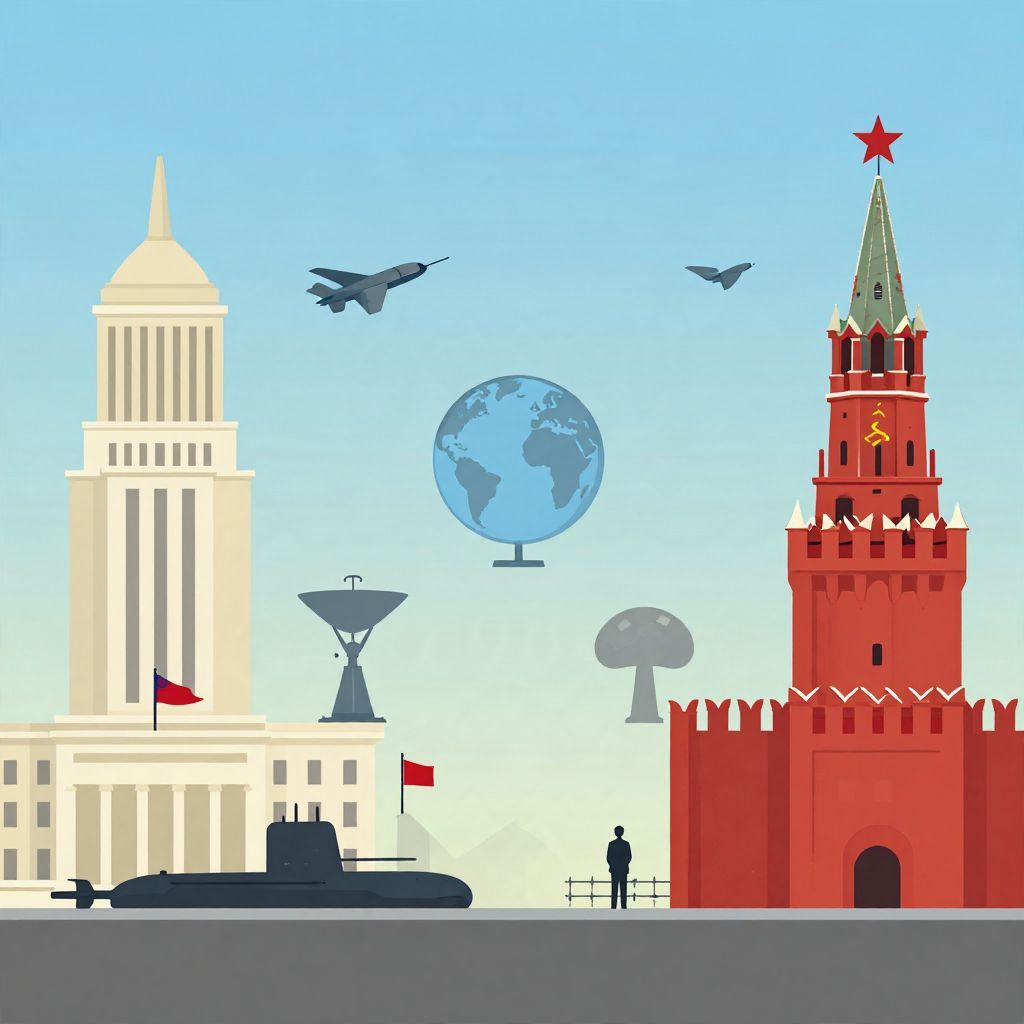
During the Cold War, what was the main concern of the United States? In the simplest terms, it was the fear that Soviet communism would expand and threaten American security, influence, and the post-World War II international order. That concern shaped U.S. foreign policy from the late 1940s through 1991.
But the issue was not only military. American leaders also worried about political instability in Europe and Asia, the spread of communist revolutions, nuclear war, and the possibility that allies would fall under Soviet influence. Those fears drove containment, alliances, arms buildup, and interventions around the world.
During the Cold War, what was the main concern of the United States?
The United States’ main concern during the Cold War was containing Soviet expansion and preventing the spread of communism. American policymakers believed that if the Soviet Union gained more territory, allies, or influence, it could weaken democratic governments, disrupt global trade, and eventually threaten the United States itself.
Why Soviet expansion alarmed the United States
After World War II, the United States and the Soviet Union emerged as rival superpowers with very different political systems. Washington saw Moscow’s control over Eastern Europe, support for communist parties abroad, and pressure on crisis zones like Berlin as signs of a larger challenge. The fear was not just that the Soviet Union would become stronger, but that it would reshape the world in ways hostile to American interests.
Ideology mattered as much as territory
The Cold War was a struggle between competing systems. The United States promoted liberal democracy and capitalism, while the Soviet Union promoted one-party communist rule under state control. American leaders often interpreted communist movements abroad as part of a coordinated Soviet strategy, even when local conditions also played a major role. This ideological rivalry made almost every international crisis seem larger than a single country or border dispute.
Security fears after World War II
The wartime alliance with the Soviet Union collapsed quickly after 1945. The memory of Nazi aggression, the devastation of Europe, and the development of atomic weapons made U.S. leaders especially sensitive to any sign of instability. If another major war broke out, or if Soviet forces advanced farther into Europe, the consequences could be catastrophic. That is why American strategy focused so heavily on keeping a balance of power favorable to the West.
The Cold War timeline: how the concern developed
The American response did not appear all at once. It developed through a series of crises and policy decisions from the late 1940s onward. Each event reinforced the belief that the United States had to actively resist Soviet influence rather than retreat into isolation.
- 1945–1946: Wartime cooperation breaks down, and tensions rise over Eastern Europe and the future of Germany.
- 1947: The Truman Doctrine announces U.S. support for countries resisting communist pressure, especially Greece and Turkey.
- 1948–1949: The Berlin Blockade deepens fears of Soviet coercion in Europe.
- 1949: The Soviet Union tests its first atomic bomb, and China’s communist revolution intensifies American alarm.
- 1950s: The Korean War, NATO expansion, and domestic anti-communism make containment a central U.S. policy.
- 1960s–1970s: Conflicts in Vietnam, Cuba, and elsewhere keep the spread of communism at the center of U.S. strategy.
- 1980s–1991: Renewed pressure on the Soviet system, arms competition, and internal weakness help bring the Cold War to an end.
1945–1949: from alliance to rivalry
In the immediate postwar years, the Soviet Union established communist governments across much of Eastern Europe. To American officials, this looked like expansion by force or intimidation. The Berlin crisis of 1948–1949 was especially important because it showed that the Soviet Union was willing to use pressure tactics to shape Europe’s future. The U.S. response, including the Berlin Airlift, demonstrated that containment would not be passive.
1950s: containment becomes policy
By the early 1950s, containment had become the guiding principle of U.S. foreign policy. The Korean War made the threat feel urgent: American leaders believed that if North Korea’s invasion succeeded without resistance, other communist advances might follow. The creation of NATO in 1949 and the strengthening of alliances in Europe and Asia reflected the belief that collective security was necessary to stop Soviet influence.
1960s–1970s: the concern spreads globally
As decolonization transformed Asia, Africa, and Latin America, the United States increasingly feared that revolutionary movements might align with Moscow or Beijing. Not every nationalist movement was communist, and not every communist government was controlled by the Soviet Union, but U.S. officials often treated these distinctions cautiously. This is one reason the Cold War became global rather than remaining centered only on Europe.
What the United States feared most: a few key dangers
The main concern was Soviet communism, but that broad fear included several specific dangers. American leaders were not worried about just one outcome; they feared a chain reaction in which one loss would lead to another.
- Loss of Europe: If Western Europe weakened or fell under Soviet influence, the balance of power would shift dramatically.
- Spread of communism: U.S. policymakers believed communist victories in one country could encourage similar movements elsewhere.
- Nuclear war: After 1949, the Soviet atomic bomb made direct conflict much more dangerous.
- Collapse of alliances: If allies doubted U.S. commitment, they might accommodate the Soviet Union or pursue their own weapons.
- Domestic subversion: Many Americans feared communist infiltration at home, which fueled loyalty programs and anti-communist investigations.
The “domino theory” and its influence
One influential idea was the domino theory, the belief that if one country fell to communism, neighboring countries might follow. This idea shaped U.S. decisions in Southeast Asia, especially Vietnam. Historians debate how accurately the theory described events, but it clearly influenced policy. It helped justify intervention by presenting local conflicts as part of a larger global struggle.
How nuclear weapons changed the American concern
The Cold War was not only about ideology and influence; it was also about survival in the nuclear age. Once both superpowers had atomic weapons, the fear of a direct war became much more intense. A conflict between the United States and the Soviet Union could destroy cities, economies, and millions of lives. That reality made deterrence, arms control, and military readiness central to U.S. strategy.
Deterrence and the balance of terror
American leaders hoped that showing strength would prevent Soviet aggression. This led to large defense budgets, strategic bomber forces, intercontinental missiles, submarine-launched weapons, and constant planning for worst-case scenarios. The logic was grim but simple: if both sides knew a nuclear war would be devastating, neither would risk starting one. This became known as deterrence.
Arms race and public anxiety
The arms race intensified public concern at home. Civil defense drills, bomb shelters, and media coverage of nuclear testing reminded Americans that the Cold War could become a catastrophe at any time. The Soviet launch of Sputnik in 1957 added another layer of fear by suggesting that the Soviet Union had advanced missile technology. This led to greater U.S. investment in science, education, and space exploration, as well as defense.
Was the concern only about communism?
No. Communism was the central issue, but the United States also cared about credibility, trade, access to resources, and the stability of the international system. American leaders wanted to preserve a world in which U.S. allies remained secure, markets stayed open, and hostile powers did not dominate key regions. In that sense, the Cold War was about power as well as ideology.
Economic and strategic interests
After 1945, the United States had a strong interest in rebuilding Europe and Japan as stable partners. Economic recovery abroad was seen as a safeguard against political extremism. If governments collapsed under poverty or instability, communist parties might gain support. So programs such as the Marshall Plan were not only humanitarian; they were also strategic tools meant to reduce the appeal of communism.
Prestige and leadership
U.S. leaders also worried about global leadership. If the Soviet Union appeared stronger, more disciplined, or more committed than the United States, other nations might side with it. American policy therefore aimed to show that democracy could defend itself effectively. This concern explains why the Cold War was fought through diplomacy, propaganda, intelligence, military alliances, and proxy wars, not just through direct combat.
Historical impact of the U.S. Cold War concern
The fear of Soviet expansion shaped nearly every major American foreign policy decision for more than four decades. It influenced the creation of NATO, interventions in Korea and Vietnam, covert operations in various regions, and a vast military buildup. At home, it also affected politics and culture, encouraging loyalty tests, anti-communist rhetoric, and public anxiety about subversion.
Long-term consequences
Some policies helped contain Soviet power and support allies. Others caused serious costs, including prolonged wars, political repression in partner states, and deep social divisions within the United States. Historians continue to debate whether every intervention was necessary or wise. What is clear is that the main concern—stopping communist expansion—became the organizing principle of U.S. strategy in the Cold War era.
So what is the best short answer?
The United States’ main concern during the Cold War was preventing the spread of Soviet communism and protecting its own security, allies, and global influence. That fear drove containment, nuclear deterrence, military alliances, and intervention in conflicts around the world. It was a struggle shaped by ideology, power politics, and the danger of nuclear war.
For related background, see what happened in 1945 and why the U.S. did not join the League of Nations, both of which help explain the broader American approach to world affairs.