
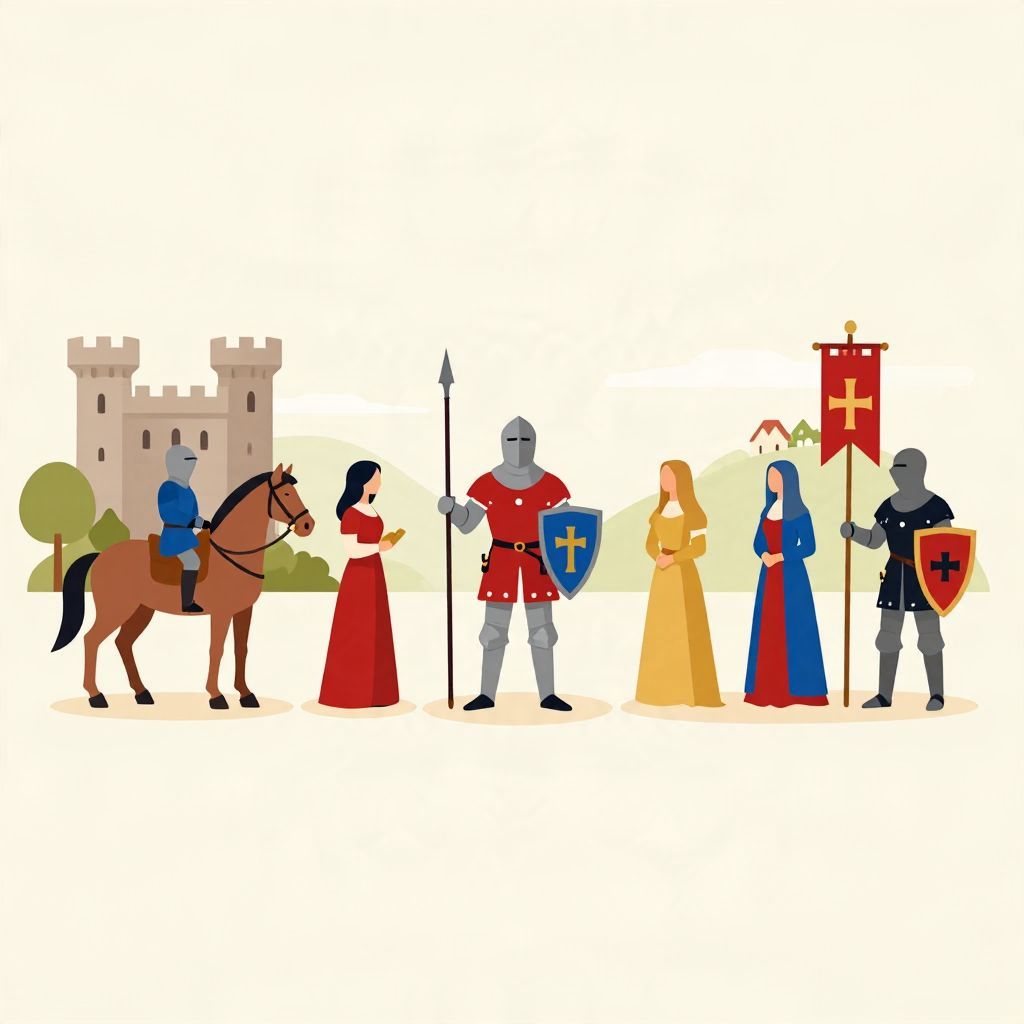
What does chivalry mean? Today, the word often suggests politeness, courtesy, or “gentlemanly” behavior. Historically, however, chivalry was much more than good manners: it was the code, culture, and idealized identity of medieval knights in Christian Europe.
Its meaning changed over time. Chivalry grew out of warfare, aristocratic status, and religious values in the Middle Ages, then became a literary and moral ideal that outlasted the age of armored cavalry itself.
What does chivalry mean in history?
Historically, chivalry referred to the social and moral code associated with knights in medieval Europe. It combined military skill, loyalty to a lord, bravery in battle, defense of the Church, and expected conduct toward women, the weak, and social equals. The word comes from the French chevalerie, linked to cheval (“horse”).
Where did chivalry come from?
Chivalry emerged in the high Middle Ages, roughly the 11th to 13th centuries, when mounted warriors became a powerful military and social class in western Europe. Knights were not simply fighters; they were part of a feudal world built on landholding, loyalty, and service. Chivalry developed as a way to define their status and regulate their behavior.
The military roots of the knight
In early medieval Europe, cavalry became increasingly important in warfare. Horses, armor, and training were expensive, so mounted warriors usually came from the nobility or from families moving into noble status. The knight was therefore both a soldier and a social symbol. Chivalry helped explain why this elite should be honored, disciplined, and morally distinct.
Christian influence on knightly ideals
The Church played a major role in shaping chivalric values. Clergy tried to limit violence through movements such as the Peace of God and Truce of God, and they encouraged knights to see warfare as legitimate only when directed toward Christian purposes. By the time of the Crusades, knightly conduct was increasingly tied to religious duty, piety, and protection of the faith.
What did chivalry mean to medieval people?
To medieval elites, chivalry meant more than battlefield courage. It implied loyalty to one’s lord, generosity, self-control, honor, and a willingness to act according to rank. It also carried an idealized expectation that knights should protect the vulnerable and behave with courtesy in courtly society, though real life often fell short of the ideal.
Core values associated with chivalry
- Bravery in combat and willingness to face danger
- Loyalty to lord, kin, and sworn obligations
- Honor and reputation among peers
- Courtesy in noble and courtly settings
- Generosity and largesse toward dependents and guests
- Religious devotion, especially in Christian contexts
Chivalry was an ideal, not a universal reality
Medieval warfare was often brutal. Knights could be ruthless in battle, and noble society was shaped by rivalry, vengeance, and political ambition. Chivalry did not eliminate violence; rather, it tried to give violence an honorable framework. Historians generally treat it as both a genuine ethical code and a cultural performance that helped aristocrats justify their power.
A brief timeline of chivalry
The meaning of chivalry changed over several centuries. A simple timeline helps show how a military practice became a broader social ideal and then a literary memory of the medieval past.
- 10th–11th centuries: Mounted warriors become more prominent in western Europe.
- 11th–13th centuries: Chivalry develops as a knightly code tied to feudal service and Christian ideals.
- 12th–13th centuries: Courtly literature, romances, and troubadour culture help romanticize knightly behavior.
- 14th–15th centuries: Chivalry becomes more ceremonial as warfare changes and noble tournaments, heraldry, and court ritual expand.
- 16th century onward: Gunpowder warfare reduces the battlefield role of armored knights, but chivalry survives as a cultural and moral ideal.
How literature transformed chivalry
Chivalry was not shaped by war alone. Medieval romances, epic poems, and courtly tales gave it a powerful imaginative life. Stories of King Arthur, Roland, and other heroic figures presented knights as noble, loyal, and restrained. These works did not describe ordinary warfare accurately; instead, they helped create a model of knightly behavior that audiences admired.
Courtly love and refined conduct
By the 12th century, chivalry became linked with courtly love, a literary tradition that emphasized admiration, service, and refinement in relations between men and women of noble rank. This did not mean medieval society became egalitarian or romantic in a modern sense. Rather, it added another layer to knightly identity: a knight was expected to be not only fierce but also disciplined, gracious, and socially polished.
Tourneys, heraldry, and public display
Tournaments and heraldic symbols also strengthened chivalric culture. These events allowed nobles to display skill, lineage, and prestige in highly visible ways. Armor, coats of arms, and ritualized contests turned chivalry into a public performance. In this sense, chivalry was as much about reputation and social order as it was about combat.
Did chivalry mean the same thing everywhere?
No. Chivalry was a western European concept, but it was not uniform across regions or centuries. French, English, Iberian, and German noble cultures all developed their own versions of knightly conduct. Local politics, warfare, and religious life shaped how the ideal was understood. Even within one kingdom, chivalry could mean different things to warriors, clergy, poets, and rulers.
Chivalry and the Crusades
The Crusades gave chivalry a new and sometimes contradictory meaning. Knights were encouraged to see themselves as defenders of Christianity, yet crusading also involved conquest, massacre, and territorial ambition. The language of holy war could sanctify violence while still pretending to moral restraint. This tension is one reason historians are careful not to treat chivalry as simply noble or purely humane.
Women and chivalric culture
Chivalry often claimed to protect women, but that protection was selective and shaped by class. Noble women could be idealized in literature and politics, yet most women in medieval society had little access to the privileges associated with chivalric culture. The “ladies” of courtly romance were usually aristocratic figures, not a universal category of women.
What happened to chivalry over time?
As military technology changed, the practical importance of knights declined. Gunpowder weapons, professional infantry, and centralized states reduced the battlefield dominance of armored cavalry. Chivalry did not disappear, but it shifted from a military code into a ceremonial and moral language used by nobles, writers, and later generations looking back on the Middle Ages.
From battlefield code to social ideal
By the late medieval and early modern periods, chivalry increasingly referred to noble conduct, etiquette, and honor rather than actual knightly warfare. Kings and princes continued to use knightly ceremonies, orders of chivalry, and court ritual to reinforce status. The word became less about how to fight and more about how an elite should behave.
The modern meaning of chivalry
In modern English, chivalry usually means courteous or gallant behavior, especially toward women. That meaning is historically derived, but it is narrower than the medieval concept. Modern usage often strips away the military, religious, and feudal dimensions that originally defined the term. In everyday speech, “chivalrous” may suggest kindness; in history, it points to a much larger system of aristocratic values.
Why does chivalry matter historically?
Chivalry matters because it reveals how medieval Europe tried to control violence, define nobility, and link power to moral language. It was never just a romantic fantasy. It shaped real institutions, from knighthood ceremonies to court culture, and it influenced ideas of honor that lasted long after the medieval world changed.
It also shows how societies create ideals that both reflect and disguise reality. Chivalry praised restraint, loyalty, and protection, but it existed alongside war, inequality, and social exclusion. Studying it helps explain how medieval elites understood themselves and how later generations turned that elite culture into legend.
So, what does chivalry mean? Historically, it was the knightly code of medieval Europe: a blend of military duty, Christian morality, aristocratic honor, and courtly behavior. Over time, that code became a symbol of courtesy and gallantry, but its original meaning was rooted in the power and politics of the Middle Ages. For more on medieval rank and court life, see what a lady-in-waiting was and what a duke was in royalty.