
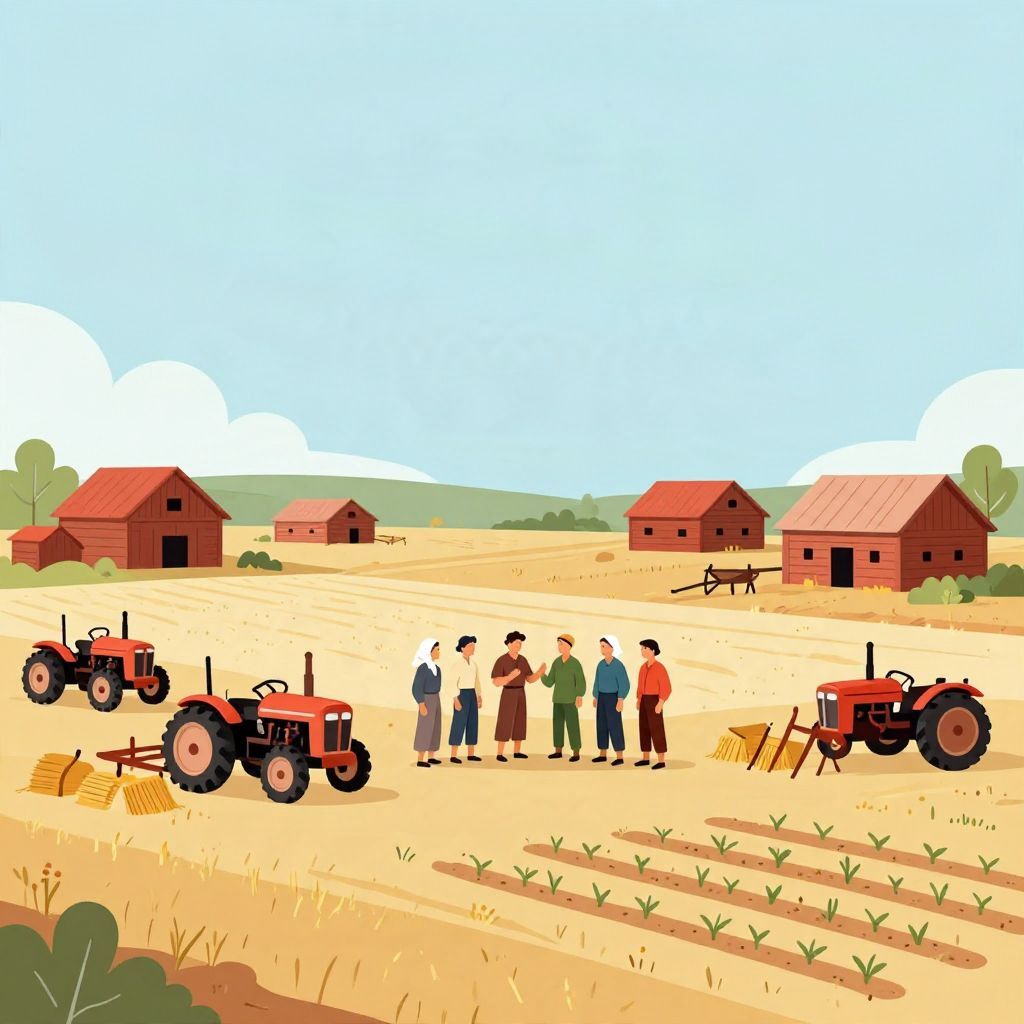
What is collectivization? In history, collectivization is the process of reorganizing land, livestock, tools, and agricultural labor from private ownership or small family farming into collective or state-controlled production. It is most often associated with 20th-century communist governments, especially the Soviet Union, but similar policies appeared elsewhere in different forms.
The idea was promoted as a way to increase efficiency, modernize agriculture, and fund industrial development. In practice, collectivization often brought coercion, resistance, lower short-term productivity, and severe human suffering. Its history is therefore not just about farming, but about power, ideology, and the transformation of rural society.
What Is Collectivization?
Collectivization is a policy that replaces individual or family farming with collective farms, state farms, or other shared systems of production. In the 20th century, it usually meant the government taking control of land and forcing peasants to join larger agricultural units. The goal was to centralize food production and tighten state control over the countryside.
Where Did Collectivization Come From?
Modern collectivization emerged from socialist and communist ideas that criticized private property and argued that large-scale agriculture could be more efficient than millions of small farms. After the Russian Revolution of 1917, Bolshevik leaders debated how to transform the peasant-dominated countryside. The policy became most famous under Joseph Stalin in the late 1920s and 1930s.
Ideological roots
Marxist theory viewed private ownership of land as part of an unequal economic system. Revolutionary governments believed that collective farming could break the power of wealthy peasants, reduce class divisions, and make grain easier for the state to collect. This was not simply an agricultural reform; it was also a political project aimed at reshaping society.
Why governments supported it
States often backed collectivization for practical reasons as well as ideological ones. Large centralized farms were expected to make it easier to extract grain, feed cities, and support industrialization. In the Soviet case, the government wanted to finance rapid industrial growth and believed the countryside should serve that larger national goal.
How Did Soviet Collectivization Work?
In the Soviet Union, collectivization began in earnest around 1929. Peasants were pressured or forced to join collective farms known as kolkhozy, while state farms called sovkhozy were directly run by the government. Land, animals, and equipment were pooled, and local party officials supervised production and deliveries to the state.
Forced implementation
Although collectivization was presented as voluntary in official language, it was often imposed through coercion. Authorities used propaganda, taxation, grain requisitions, arrests, and deportations to compel compliance. Wealthier peasants labeled kulaks were targeted as supposed enemies of the socialist order, though the term was often applied broadly and inconsistently.
Resistance in the countryside
Many peasants resisted by hiding grain, slaughtering livestock rather than surrendering it, or refusing to cooperate. The Soviet state responded harshly. Villages were pressured by armed force, and thousands of families were deported. The destruction of livestock was especially severe and had long-term effects on agricultural output.
What Were the Consequences of Collectivization?
Collectivization had dramatic and often tragic consequences. In the Soviet Union, it contributed to widespread disruption, falling agricultural productivity in the short term, and catastrophic famine in some regions, especially in 1932–33. Historians debate the exact balance between policy failure, coercion, and local conditions, but there is broad agreement that state actions intensified the crisis.
The human cost
Millions of people suffered from hunger, displacement, and repression. The famine in Soviet Ukraine, often discussed under the term Holodomor, remains one of the most contested and politically charged episodes in modern history. Scholars differ on legal and interpretive questions, but the role of state policy in worsening starvation is well established.
Economic results
Supporters claimed collectivization would modernize farming and secure grain supplies. In the long run, it did create a more controllable agricultural system, but it rarely delivered the efficiency promised by planners. Incentives for individual farmers weakened, local knowledge was often ignored, and production remained vulnerable to bureaucratic targets and poor planning.
Collectivization Beyond the Soviet Union
Although the Soviet model was the most influential, collectivization appeared in other communist states after World War II. Governments in Eastern Europe, China, North Korea, and elsewhere adopted similar policies, usually with local variations. The basic pattern was the same: private farming was reduced or eliminated in favor of collective or state-managed agriculture.
China
In the People’s Republic of China, collectivization accelerated in the 1950s and became extreme during the Great Leap Forward. Rural people were organized into large communes, and state demands for grain were immense. The result was one of the worst famines in modern history, showing how forced collectivization could combine with unrealistic planning to produce disaster.
Eastern Europe
After 1945, Soviet-backed governments in Eastern Europe pushed collectivization as part of wider communist transformation. In countries such as Romania, Bulgaria, and East Germany, the process was often resisted and unevenly enforced. Some states completed it more fully than others, but everywhere it altered village life, property relations, and political authority.
Why Was Collectivization So Controversial?
Collectivization was controversial because it touched the most basic parts of rural life: land, food, family labor, and local autonomy. For many peasants, land was not just an economic asset but a source of identity and security. Taking it away in the name of ideology made the policy deeply unpopular and often violently resisted.
Competing historical interpretations
Historians generally agree that collectivization was coercive, but they differ on emphasis. Some stress economic modernization and state-building goals; others focus on repression, class warfare, and famine. The policy can be understood as both a revolutionary attempt to remake agriculture and a tool for extending political control over the countryside.
How Did Collectivization Change Rural Society?
Collectivization transformed villages by weakening traditional household farming and replacing it with bureaucratic management. It changed who controlled land, how crops were distributed, and how peasants related to the state. In many places, it also altered gender roles, migration patterns, and the social standing of rural elites.
Loss of autonomy
Before collectivization, peasant families often made decisions about planting, harvesting, and livestock care. Under collective systems, those choices were increasingly subject to state plans and quotas. Even where small private plots survived, the broader structure of rural life was no longer centered on independent family ownership.
Migration and urbanization
Collectivization sometimes pushed people off the land or made rural life less attractive, contributing to migration into cities and industrial centers. In the Soviet Union and China, this helped supply labor for factories and construction. The policy therefore linked agriculture to broader campaigns of state-led modernization.
Was Collectivization the Same Everywhere?
No. The word covers a family of policies rather than one identical system. Some collectivization campaigns were total and violent; others were partial or gradual. Some states allowed limited private plots alongside collective farms, while others tried to eliminate private farming almost entirely. The local political context mattered a great deal.
- Soviet Union: rapid, coercive, and tied to Stalinist industrialization.
- China: collective farming expanded into communes and was linked to the Great Leap Forward.
- Eastern Europe: imposed after World War II under communist governments, with varying intensity.
- Other contexts: the term can also be used more loosely for cooperative farming or state-led land reform, though those are not always the same as coercive collectivization.
What Is the Historical Legacy of Collectivization?
Collectivization remains one of the most important and painful examples of state intervention in the modern countryside. It shows how revolutionary governments tried to remake society through economic control, and how such efforts could produce unintended consequences on a massive scale. Its legacy includes famine, repression, political centralization, and long-lasting distrust of state farming schemes.
At the same time, collectivization is a reminder that history is shaped not only by ideas, but by the way power is used to enforce them. If you want to place it in a broader political context, you may also find it useful to read about political ideology and political engagement. In historical terms, collectivization was never just about agriculture; it was about who controlled land, labor, and the future of society.