
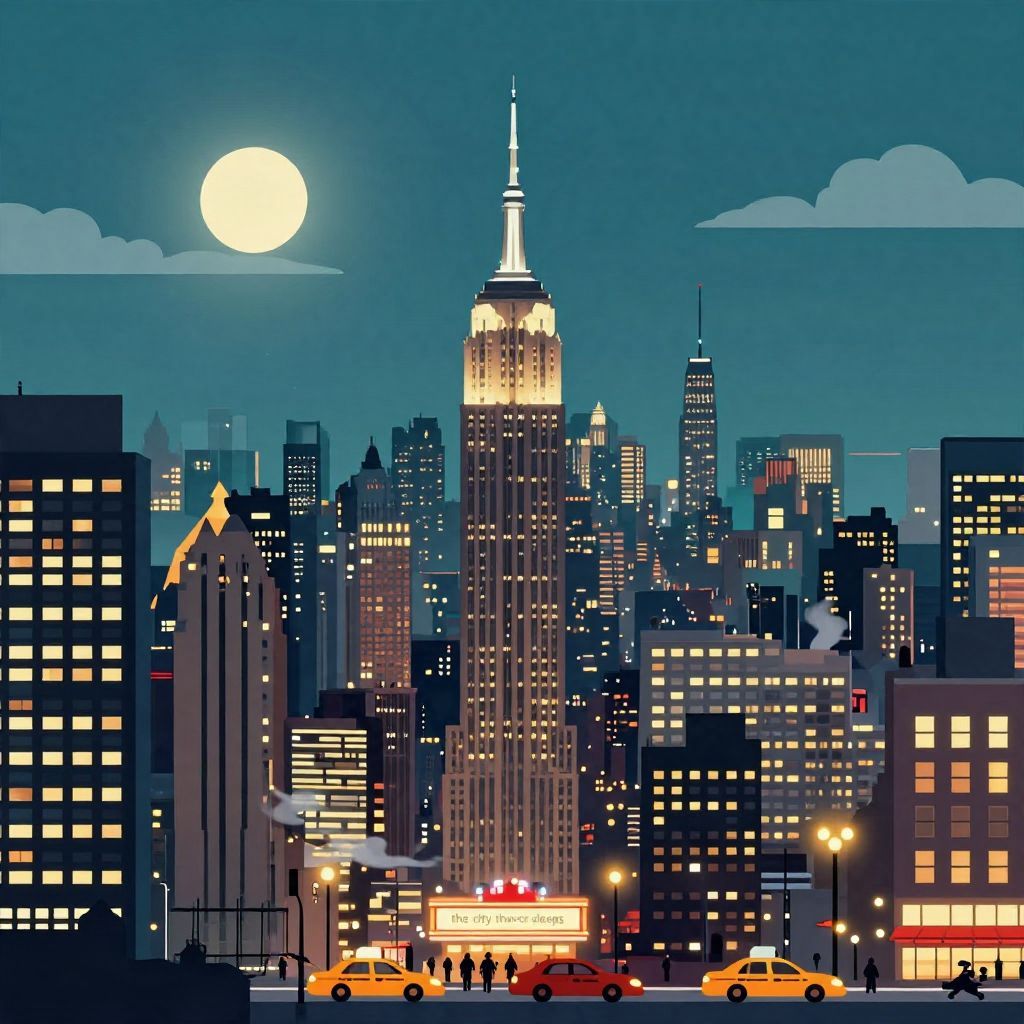
What is the “City That Never Sleeps”? Most people mean New York City, especially Manhattan, where the phrase became a lasting nickname for round-the-clock energy, lights, transit, and nightlife. The expression is not an ancient title or an official slogan; it grew out of modern urban life and was popularized in the 20th century.
Its history reflects more than sleeplessness. The nickname captures how New York developed into a global metropolis shaped by immigration, commerce, theaters, newspapers, factories, and a transportation system that kept the city active long after dark.
What Is the City That Never Sleeps?
The “City That Never Sleeps” is New York City, a nickname that describes its nonstop pace, especially in Manhattan. The phrase became widely associated with New York in the early 20th century, when the city’s bright lights, late-night entertainment, and 24-hour activity made it stand out as a modern urban center.
Why New York Got the Nickname
A city built on constant movement
New York’s nickname did not appear by accident. By the late 1800s and early 1900s, the city had become one of the busiest ports and commercial hubs in the world. Ships, rail lines, factories, stock trading, newspapers, restaurants, and theaters all helped create a place where work and leisure often continued late into the night.
Electric light changed the city after dark
One of the biggest reasons the nickname stuck was the spread of electric lighting. As streets, storefronts, theaters, and advertising signs lit up at night, New York became visually different from older cities that still dimmed out after sunset. Bright commercial districts such as Times Square helped make nighttime activity part of the city’s identity.
Immigration and urban density
New York’s population growth also mattered. Millions of immigrants arrived in the city during the 19th and early 20th centuries, filling crowded neighborhoods and expanding the labor force. Dense housing, street traffic, and a constant flow of workers meant the city rarely felt quiet. In that sense, “never sleeps” was both a compliment and a description of urban pressure.
The Historical Origin of the Phrase
The exact origin of the phrase is not completely settled, but historians generally trace its modern popularity to the early 20th century. It was used in print and advertising to emphasize New York’s energy, and it became especially associated with the city through popular culture, journalism, and tourism. The expression likely developed gradually rather than being coined in a single moment.
Popularization through culture
By the 1920s and 1930s, New York was already famous for Broadway, jazz clubs, newspapers, and a fast-moving business culture. Writers and advertisers used the city’s late-night life as shorthand for modernity. Over time, “the city that never sleeps” became one of several nicknames that helped define New York in the public imagination.
Not an official title
It is important to note that the phrase is a nickname, not a formal designation. New York City has many unofficial labels, including the Big Apple, but “the City That Never Sleeps” is especially evocative because it describes a habit of life rather than a single event or institution.
How New York Became a 24-Hour Symbol
Broadway and nightlife
Entertainment played a major role in shaping the nickname. Broadway theaters, music halls, restaurants, and clubs created an evening economy that made the city famous far beyond the United States. Visitors could find shows, dining, and social life late into the night, reinforcing the idea that New York remained active when other places had gone quiet.
Commerce and finance
New York was also a city of business. As the financial center of the United States grew in importance, the rhythms of trade and communication stretched across time zones. Even when offices closed, the city’s markets, newspapers, and transport networks kept a sense of urgency alive. The nickname reflected this economic intensity as much as its nightlife.
Transportation and the urban clock
The subway, ferries, elevated trains, taxis, and later buses made movement possible at all hours. A city that can carry workers, performers, and customers late into the night naturally feels different from one that shuts down early. New York’s transit system helped turn “late” into a normal part of daily life.
What the Nickname Means Historically
“The City That Never Sleeps” tells us how people saw New York in the modern era: energetic, crowded, ambitious, and sometimes overwhelming. It is both praise and critique. To admirers, it suggests opportunity and excitement. To critics, it can imply noise, exhaustion, and a pace of life that leaves little room for rest.
A symbol of modern urban life
Historically, the nickname became a symbol of the modern metropolis itself. Cities in the industrial age were increasingly associated with artificial light, mass transit, anonymous crowds, and continuous labor. New York came to represent these changes more strongly than most places, which is why the phrase endured.
More than Manhattan alone
Although the nickname is most often linked to Manhattan, it refers to the broader city. The five boroughs—Manhattan, Brooklyn, Queens, the Bronx, and Staten Island—each contributed to New York’s growth. Still, Manhattan’s density, skyline, and concentration of nightlife made it the part of the city most closely tied to the phrase.
Other Cities and Similar Nicknames
New York is the best-known “city that never sleeps,” but other cities around the world have also been described in similar ways. These comparisons usually reflect late-night culture, tourism, or round-the-clock business rather than a unique historical title. The phrase is therefore part of a wider tradition of urban nicknames used to market and describe city life.
- New York City — the most famous and widely recognized use of the phrase.
- Tokyo — often described in similar terms because of its bright districts and late-night activity.
- Las Vegas — associated with nonstop entertainment, though for different historical reasons.
Why the Nickname Endured
The phrase lasted because it was memorable and accurate enough to survive changing times. New York has gone through economic booms, crises, blackouts, transit changes, and shifts in nightlife, yet it still projects the image of a city that remains active at all hours. The nickname became part of the city’s brand, tourism, and self-image.
From description to identity
Over time, what began as a description became part of New York’s identity. Residents, businesses, and visitors repeated the phrase until it became almost inseparable from the city itself. That is often how strong historical nicknames work: they start as observations and end as cultural shorthand.
Historical Takeaway
The “City That Never Sleeps” is New York City, a nickname that emerged from the city’s modern growth, electric nightlife, dense population, and nonstop commerce. It is not an ancient title, but a product of industrial and urban history. If you want to explore how New York’s identity formed, you may also enjoy reading about why New York is called the Big Apple and why it is called Hell’s Kitchen.