
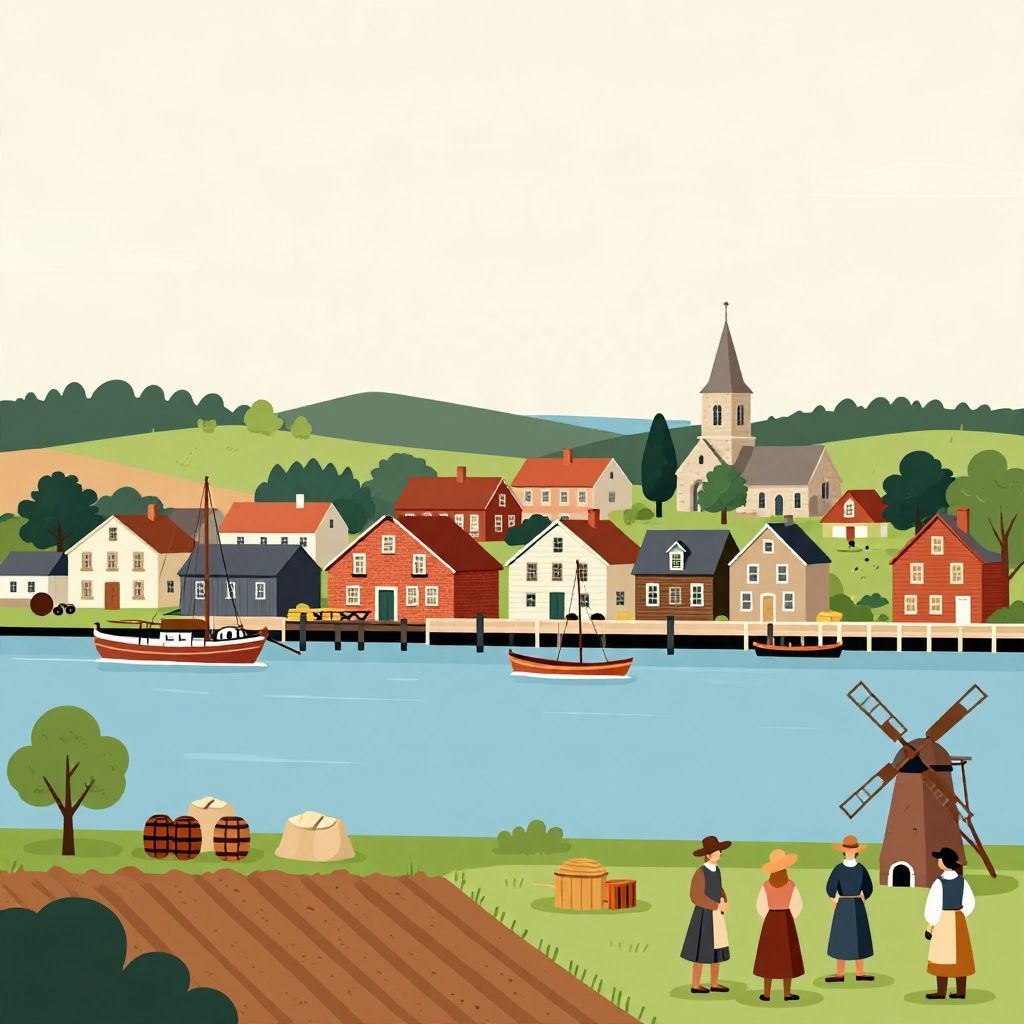
What were the Middle Colonies? In British North American history, the Middle Colonies were a group of colonies located between New England and the Southern Colonies, known for fertile farmland, diverse populations, and religious variety. They became some of the most economically productive and culturally mixed colonies in mainland North America.
They included New York, New Jersey, Pennsylvania, and Delaware, and they played a crucial role in trade, agriculture, and the growth of colonial society. Their location and diversity helped shape the future United States in ways that were both practical and political.
What Were the Middle Colonies?
The Middle Colonies were the British colonies of New York, New Jersey, Pennsylvania, and Delaware. They sat between the colder, more commercially focused New England colonies and the plantation-based Southern Colonies. Because of their climate, geography, and settlement patterns, they developed a mixed economy of farming, trade, and small-scale industry.
Where Were the Middle Colonies Located?
The Middle Colonies stretched along the mid-Atlantic coast of North America, roughly from the Hudson River valley south to the Delaware River. This central position made them a natural crossroads for transportation, commerce, and migration. Their ports connected Atlantic trade with inland river systems, while their fertile soil supported wheat and other grain crops.
Why geography mattered
Unlike New England, where rocky soil limited large-scale farming, or the Chesapeake and Lower South, where plantation agriculture dominated, the Middle Colonies had a more balanced environment. Rivers, rich farmland, and relatively moderate winters encouraged settlement by a wide range of people. That geography helped produce a more diverse economy and population.
Which Colonies Were Considered the Middle Colonies?
The standard list of Middle Colonies includes New York, New Jersey, Pennsylvania, and Delaware. Historians generally agree on this grouping, though colonial boundaries and political control changed over time. Delaware was long tied administratively to Pennsylvania, and New Jersey was originally split into East and West Jersey before being unified.
A quick colonial timeline
- 1600s: Dutch and Swedish settlements appear in the region before English control expands.
- 1664: England captures New Netherland and renames it New York.
- 1660s–1700s: New Jersey develops as an English proprietary colony.
- 1681: William Penn receives the charter for Pennsylvania.
- 1704: Delaware gains a separate assembly, though it remains linked to Pennsylvania for a time.
How Did the Middle Colonies Begin?
The Middle Colonies did not emerge all at once. Their history began with Dutch, Swedish, and Finnish settlement in the early 1600s, followed by English conquest and colonization later in the century. These overlapping imperial claims created a region shaped by multiple European traditions, Native American diplomacy, and constant movement of people.
Dutch and Swedish roots
The Dutch established New Netherland in the Hudson River valley, including New Amsterdam on Manhattan Island. Sweden created a smaller colony, New Sweden, along the Delaware River in the 1630s and 1640s. Although both colonies were eventually absorbed by England, they left lasting marks on landholding, trade, and local culture.
English takeover and expansion
In 1664, England seized New Netherland from the Dutch, turning New Amsterdam into New York. This conquest gave England control over a strategic harbor and an important inland waterway system. English rule then spread through New Jersey, Pennsylvania, and Delaware, though each colony retained distinct political arrangements.
Why Were They Called “Middle” Colonies?
The name “Middle Colonies” refers to their geographic position in the chain of British colonies along the Atlantic coast. They were literally in the middle, between the northern colonies of New England and the southern plantation colonies. The term is a later historical grouping, useful for teaching and analysis rather than a formal colonial title used uniformly at the time.
More than just a location
The label also reflects broader patterns. The Middle Colonies shared features that set them apart from neighboring regions: mixed farming, ethnic diversity, religious pluralism, and commercial development. In that sense, “middle” describes both geography and a kind of social and economic balance.
What Made the Middle Colonies Distinct?
The Middle Colonies were distinctive because they combined several colonial models. They had thriving port cities, productive farms, and a population made up of English, Dutch, German, Scots-Irish, Irish, African, and other communities. Compared with other regions, they were less socially uniform and often more tolerant in religious practice.
Religious diversity
Pennsylvania, founded by Quaker leader William Penn, became especially known for religious tolerance. Quakers, Lutherans, Reformed Protestants, Mennonites, Catholics, Jews, and others lived there in significant numbers. This did not mean complete equality or freedom from conflict, but it did create a more pluralistic society than many other English colonies.
Ethnic and linguistic variety
Immigration shaped the region deeply. Germans settled in large numbers in Pennsylvania, Dutch communities remained influential in New York, and Scots-Irish migrants moved into frontier areas. This diversity influenced language, farming methods, church life, and local customs, making the Middle Colonies some of the most varied in colonial North America.
What Was the Economy of the Middle Colonies?
The Middle Colonies developed a mixed economy based on agriculture, trade, shipping, and craft production. They were often called the “bread colonies” because they produced large amounts of wheat, barley, and other grains. Their grain exports fed both local communities and Atlantic markets, especially in the Caribbean and Europe.
Agriculture and the “breadbasket” role
Fertile soil and relatively long growing seasons made grain farming profitable. Small and medium-sized farms were common, unlike the large slave plantations of the South. Families usually worked their own land, though enslaved labor, indentured servitude, and tenant farming also existed in parts of the region.
Trade and cities
New York and Philadelphia became major colonial ports. Merchants used them to move flour, timber, furs, iron, and imported goods. These cities also became centers of printing, shipbuilding, finance, and political debate. Their growth gave the Middle Colonies an urban importance that rivaled or exceeded that of other colonial regions.
What Was Life Like in the Middle Colonies?
Daily life varied widely depending on class, religion, ethnicity, and location. Urban residents might work as merchants, artisans, laborers, or dockworkers, while rural families farmed, milled grain, or traded locally. Life was often less hierarchical than in plantation societies, but inequality remained a major feature of colonial society.
Families and communities
Households were central to work and social life. In farming areas, families often relied on labor from children, servants, and sometimes enslaved people. Churches, meetinghouses, and local courts helped organize communities. Because populations were so mixed, many settlements included multiple languages and religious traditions.
Slavery in the Middle Colonies
Although the Middle Colonies were not plantation societies on the scale of the Chesapeake or South Carolina, slavery was still present. Enslaved Africans worked in households, docks, workshops, and on farms, especially in urban and commercial centers. The region’s relative diversity should not be mistaken for equality; colonial prosperity was still tied in part to coerced labor.
How Did Government Work in the Middle Colonies?
Political arrangements in the Middle Colonies varied. New York began as a proprietary colony under English control after Dutch rule. New Jersey was also proprietary, while Pennsylvania was founded as a proprietary colony under William Penn. Delaware shared institutions with Pennsylvania for much of its early history before developing a separate political identity.
Colonial assemblies and local power
Like other British colonies, the Middle Colonies had elected assemblies that represented property holders, though voting rights were limited. These assemblies often clashed with governors over taxes, defense, and land policy. The tension between proprietary authority and local self-government became an important part of colonial political culture.
How Did Native Peoples Shape the Middle Colonies?
Native American nations were essential actors in the region’s history. The Lenape, Iroquois, Susquehannock, and other Indigenous peoples shaped trade, diplomacy, warfare, and settlement patterns. European colonists depended on Native alliances and often displaced Indigenous communities through pressure, land deals, and conflict.
Trade and diplomacy
Early colonial survival often depended on Native knowledge of land and trade routes. Fur trade networks linked Europeans to Indigenous middlemen and regional powers. At the same time, colonial expansion steadily reduced Native landholdings, producing long-term conflict and migration. The Middle Colonies were not simply “settled”; they were contested spaces.
Why Were the Middle Colonies Important in American History?
The Middle Colonies mattered because they became a bridge between regions, peoples, and ideas. Economically, they helped feed the Atlantic world. Politically, they nurtured habits of local self-government and debate. Culturally, they showed that colonial society could be more diverse and religiously mixed than many Europeans expected.
Contribution to the future United States
The region’s diversity foreshadowed the broader American experience. Its cities helped develop print culture and political organizing. Its farms supported population growth. Its mix of ethnic and religious groups offered an early example of plural society, even though that society remained unequal and deeply shaped by empire, land seizure, and slavery.
How Were the Middle Colonies Different from New England and the South?
The Middle Colonies stood between two contrasting colonial worlds. New England was more centered on towns, congregational religion, and small-scale commerce. The Southern Colonies relied more heavily on plantation agriculture and enslaved labor. The Middle Colonies combined elements of both, but in a more varied and flexible pattern.
Key differences at a glance
- New England: denser towns, strong religious uniformity, rocky farmland.
- Middle Colonies: mixed economy, diverse population, fertile grain lands.
- Southern Colonies: plantation agriculture, larger enslaved population, export crops such as tobacco and rice.
Legacy of the Middle Colonies
The Middle Colonies left a lasting legacy in American history. They showed how geography and migration could produce a society that was commercially dynamic and culturally diverse. Their cities became major centers of revolutionary politics, and their pluralism helped shape later ideas about religious freedom and social variety in the United States.
In short, the Middle Colonies were the British mainland colonies of New York, New Jersey, Pennsylvania, and Delaware, located between New England and the South. They were known for fertile land, busy ports, and diverse populations, and they became one of the most important regions in colonial America. For more context, see what the Southern Colonies were and what the Northwest Ordinance was.