
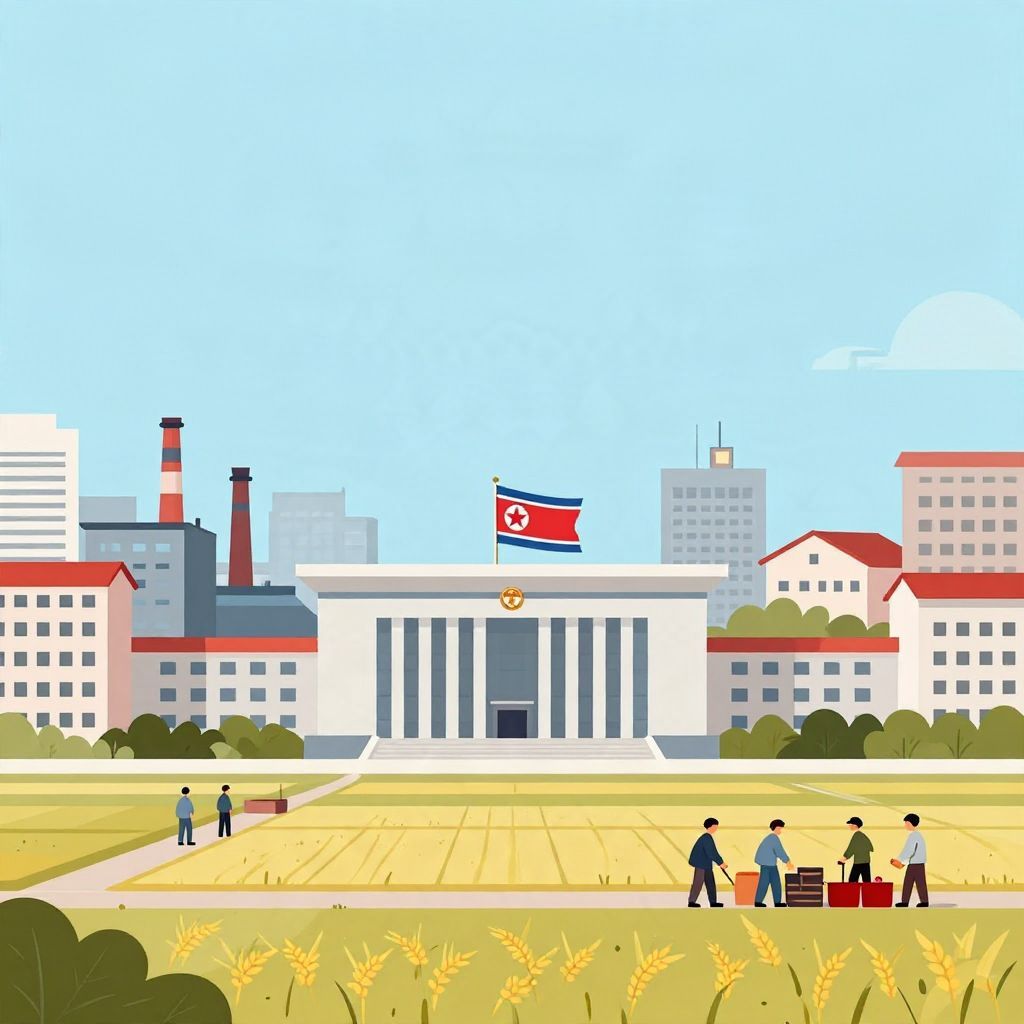
Which nation has a communist command economy? In the modern world, the clearest answer is North Korea. Its economy is organized through state ownership, central planning, and political control rather than market competition, making it the best-known surviving example of a communist-style command economy.
That said, the answer depends on how strictly one defines “communist.” North Korea officially presents itself as socialist and later as a self-reliant system, but in historical and comparative terms it is the country among the choices that most closely fits the command-economy model.
Which Nation Has a Communist Command Economy?
North Korea is the nation most associated with a communist command economy. Unlike Norway, South Korea, or the United States, it has long relied on centralized state planning, public ownership, and political directives to shape production, prices, labor, and distribution. Its system developed after World War II and became especially rigid under the Kim family regime.
Why North Korea Fits the Definition
Command economy versus market economy
A command economy is one in which the state makes major decisions about what is produced, how it is produced, and who receives goods and services. In a communist system, this is usually tied to state ownership of land, industry, and major resources. North Korea has historically followed this model far more closely than the other countries in the question.
Why the other countries do not fit
- Norway has a mixed economy with strong welfare policies, but it is not communist and does not run on central planning.
- South Korea is a capitalist market economy with private enterprise, exports, and global trade.
- The United States is a capitalist economy built on private ownership and market competition, despite regulation and public spending.
The Historical Origins of North Korea’s Command Economy
Japanese colonial rule and postwar division
The roots of North Korea’s economic system lie in the upheavals of the early 20th century. Korea was annexed by Japan in 1910 and subjected to colonial exploitation, industrial development aimed at imperial needs, and harsh political control. After Japan’s defeat in 1945, Korea was divided along the 38th parallel, with the Soviet Union occupying the north and the United States the south.
In the northern zone, Soviet-backed authorities helped build a new state under Kim Il Sung. The regime adopted Marxist-Leninist ideas, nationalized major industries, and suppressed private economic power. By 1948, the Democratic People’s Republic of Korea had been established, and the economy was being reorganized under state direction.
The Korean War and economic militarization
The Korean War, from 1950 to 1953, devastated the peninsula. In North Korea, the destruction reinforced the regime’s belief that security required total political and economic control. Reconstruction after the war strengthened central planning, heavy industry, and military priorities. The state came to dominate nearly every major aspect of economic life.
How the North Korean Command Economy Worked
Central planning and state ownership
North Korea’s government took control of factories, farms, transportation, and trade. Economic goals were set by the state rather than by private businesses. Planning agencies assigned output targets, labor allocations, and resource distribution. In theory, this was meant to eliminate class inequality and create rapid industrial growth.
Collectivization of agriculture
One of the most important changes was the collectivization of agriculture. Private farming was replaced by collective farms, where land and production were controlled by the state. This mirrored policies seen in other communist states, especially the Soviet Union and China. In practice, collectivization often reduced farmer autonomy and tied food production to government quotas.
Juche and self-reliance
Over time, North Korea promoted juche, usually translated as self-reliance. This ideology did not reject socialism; rather, it adapted communist planning to a highly nationalist and authoritarian form. Juche emphasized independence from foreign powers, but in reality North Korea still depended heavily on aid, trade, and political support from allies such as the Soviet Union and China during the Cold War.
Timeline of North Korea’s Communist Command Economy
Major stages in development
- 1945 — Japan surrenders; Korea is divided into Soviet and American occupation zones.
- 1948 — The Democratic People’s Republic of Korea is founded in the north.
- 1950–1953 — The Korean War destroys infrastructure and deepens state control.
- 1950s–1960s — Heavy industry, collectivized farming, and central planning expand.
- 1970s–1980s — The system becomes increasingly rigid and isolated.
- 1990s — The collapse of the Soviet bloc triggers severe economic crisis and famine.
- 2000s–present — Limited informal markets appear, but the state remains dominant.
The 1990s crisis
The end of the Cold War was a turning point. When the Soviet Union collapsed in 1991, North Korea lost a major source of trade, fuel, and support. The economy faltered badly, and the country suffered a catastrophic famine in the 1990s. This crisis exposed the limits of a rigid command economy, especially one weakened by isolation, poor infrastructure, and overcentralization.
Why North Korea Is the Best Answer, Historically Speaking
A surviving communist-style economy
Many states in the 20th century adopted communist or socialist command economies, including the Soviet Union, Maoist China, Cuba, and others. Most later introduced market reforms or mixed systems. North Korea remains the clearest surviving case among the options given because it still preserves a highly centralized, state-dominated economic structure.
Important historical nuance
Historians often note that North Korea is not a textbook communist society in the theoretical sense described by Karl Marx, where class divisions disappear and the state eventually “withers away.” Instead, it is better understood as a communist-inspired authoritarian command state. Its economy has been shaped as much by dynastic rule, military priorities, and national security concerns as by ideology alone.
How the Other Nations Compare
Norway
Norway is sometimes misunderstood because it has a large public sector, extensive welfare programs, and state involvement in key industries like energy. But it is not communist. It uses democratic institutions, private property, and market mechanisms. Its economy is best described as social democratic or mixed, not command-based.
South Korea
South Korea began as a poor postwar state and later developed into one of the world’s leading industrial economies. Although the government played a major role in industrial policy during periods of authoritarian rule, South Korea never became a communist command economy. Its growth depended on private firms, exports, and integration into global capitalism.
The United States
The United States is the classic example of a capitalist economy. It has government regulation, public programs, and periods of state intervention, especially during wars or crises, but production and investment are overwhelmingly driven by private ownership and markets. It is the opposite of a communist command economy in historical terms.
Historical Significance of North Korea’s Economic System
Cold War ideology in practice
North Korea is historically significant because it shows how communist planning worked when combined with extreme authoritarianism and isolation. The state’s economic model was not just an abstract theory; it shaped everyday life, from food rations and housing to employment and mobility. Economic policy became inseparable from political loyalty.
Lessons from central planning
The North Korean case is often studied alongside other command economies because it highlights both the ambitions and the weaknesses of centralized planning. Such systems can mobilize resources quickly, especially for heavy industry or wartime needs, but they often struggle with efficiency, innovation, consumer supply, and responsiveness to local conditions.
Persistence despite hardship
Even after severe economic breakdowns, North Korea did not abandon its command structure entirely. Instead, it adapted by tolerating limited informal markets while preserving state control over the core economy. This mixture of rigidity and improvisation makes North Korea historically unusual and important for understanding the long afterlife of communist economic systems.
Conclusion
The nation that has a communist command economy is North Korea. Its system emerged from Japanese colonial rule, Soviet-backed state formation, the Korean War, and decades of centralized planning under the Kim regime. Among the choices given, it is the clearest historical example of a communist-style command economy, even though its real system has also been shaped by nationalism and authoritarian rule. For related context, see why communism is often criticized and what collectivization meant in communist states.